Why Repeated Star Shreddings Dim ✛ ✦
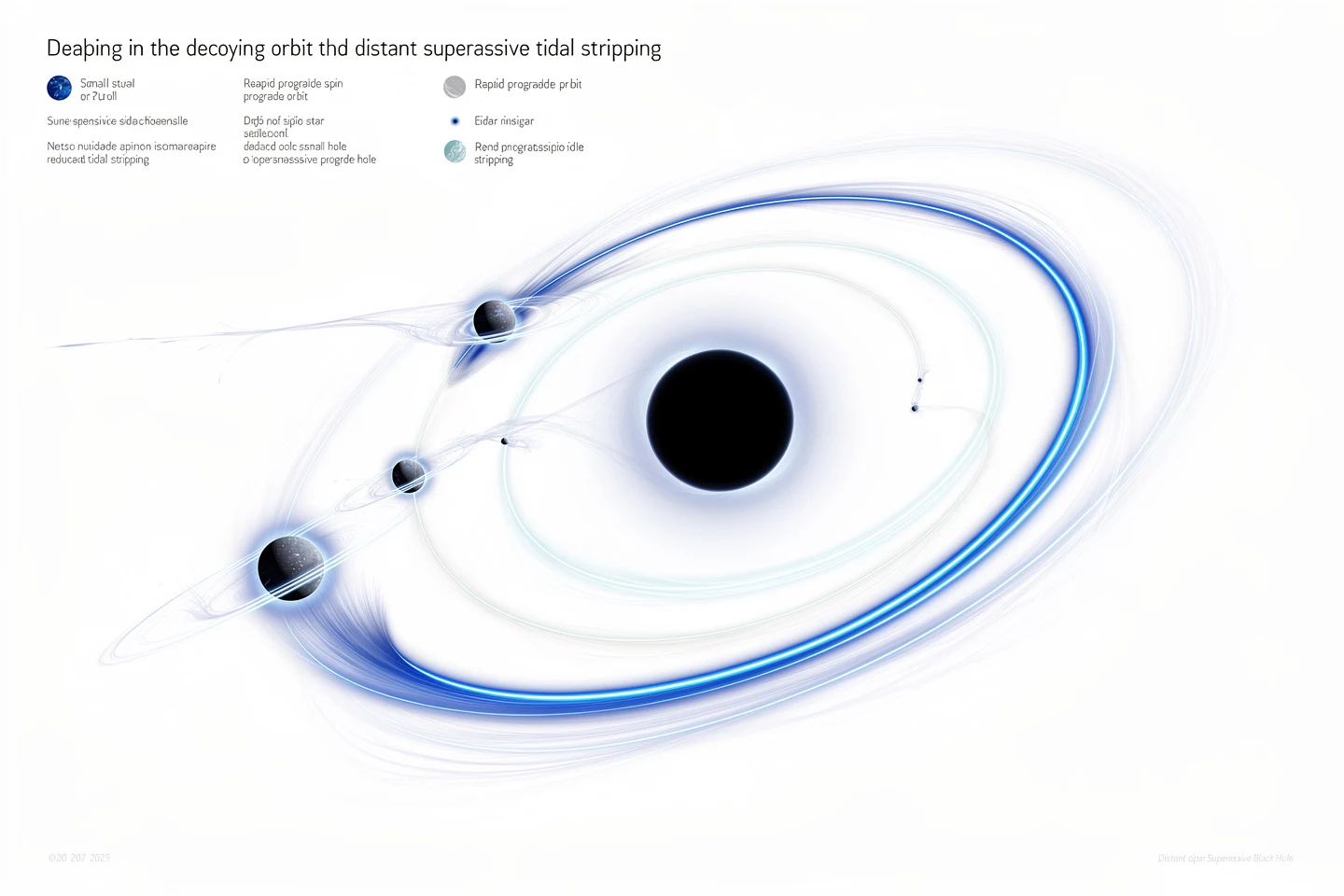
Some black holes at the centers of galaxies don't destroy a star outright: they nibble at it with each close passage. With these repeated flares, each successive one is dimmer. The answer lies in the star's spin. Think of a child's pinwheel: if it spins with the wind, the breeze just keeps it going without speeding it up. If the star spins in the same direction that the tidal force pulls it, the "tidal wind" weakens. As a result, less gas (hydrogen and helium) is torn away, and the flare fades. But if the spin went the opposite way, each flare would get brighter, as predicted long ago by Chandrasekhar. Although these flares dim, they're easy to mistake for supernovae.
The object eRASSt-J045650 backed up the model: five flares faded one after another. This points to a likely scenario: the star was once part of a binary system that broke apart during an encounter with the black hole. This picture was sketched out in the mid-20th century by John Wheeler, building on the work of Schwarzschild. In the future, the James Webb Space Telescope will measure the brightness and color makeup of these flares to test the theory.
When a binary system breaks apart through the Hills mechanism, one star gets captured into a tight orbit while the other is flung away at hundreds of kilometers per second — giving birth to hypervelocity stars that leave the galaxy forever.