Fading Black Hole Flares: The Key Is the Star's Rapid Spin ✛ ✦
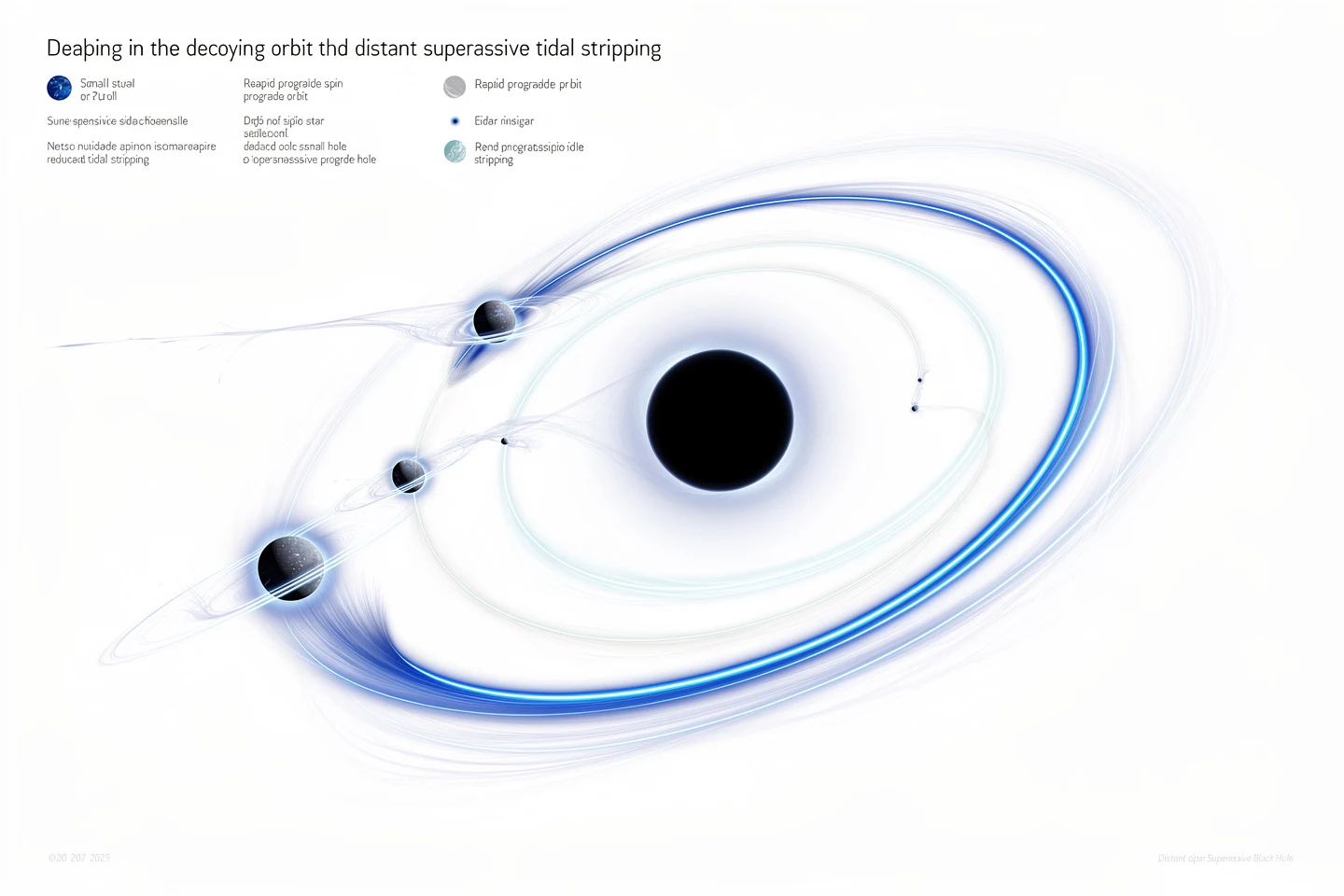
In the centers of galaxies, where supermassive black holes lie dormant surrounded by stellar swarms, lights of monstrous power sometimes flare up — tidal disruption events. But some of these events behave oddly: they repeat again and again, and each new ignition is dimmer than the last. Object eRASSt-J045650 gave five successive flares, and AT2022dbl several with clear fading. Models had been refined for decades, starting with the pioneering works of Karl Schwarzschild and John Wheeler. They predicted: if a star clings to life and doesn't perish immediately, mass losses should either grow or stay constant. But the universe stubbornly showed the opposite.
The solution came from a rarely considered angle: the star's own rotation. Imagine a figure skater in a pirouette. If she is already spinning rapidly, an extra push hardly speeds her up — the energy dissipates uselessly. This principle is the key to the mystery. When a binary star system dangerously approaches a supermassive black hole, one star can be captured onto an elongated orbit while the other is catapulted away (the Hills mechanism). If the captured star initially spins rapidly and in the same direction as its orbital motion, a scenario highly likely for tight binaries, then at the point of closest approach, tidal forces are powerless to add more spin. The critical condition is simple: when the orbital angular frequency at pericenter $Ω_p$ is close to the star's own frequency Ω_*, multiplied by a geometric factor ($Ω_p$ ≈ Ω_* × ($M_{BH}$/M_*)^{1/2} (R_*/$r_p$)^{3/2}), the tidal torque "slips". The star stops effectively stripping mass from itself. Thus a sequence of fading flares is born — instead of spinning up more and more, the star loses less and less hydrogen and helium with each orbit, and its brightness dims.
Numerical modeling using the smoothed-particle method (code PHANTOM) with initial models calculated following stellar evolution recipes tracing back to Subrahmanyan Chandrasekhar, reproduced this picture. For a 1 M⊙ star at an early stage (ZAMS) with a spin parameter λ=0.7 of the breakup frequency, the peak accretion rate, measured photometrically, dropped by about a factor of 1.5 over four passes. For a more massive, evolved star of 3 M⊙ (TAMS, λ=0.8, β=1.0) the decline was even more pronounced. Without initial spin, the spin rapidly increased, and brightness rose, as in old calculations. So it is the special stars (massive, aged and thus denser, and most importantly, rapidly spinning) that become the culprits of dimming performances. The tidal radius $r_t$ = R_* (M_•/M_*)^{1/3} plays the role of that "piano in the bushes"—the invisible boundary where the drama begins: the more massive the black hole, the farther it extends its tidal arms and the more devastating the consequences.
These results weave a unified picture of stellar dynamics in galaxy nuclei, the growth of central black holes, and the origin of hypervelocity objects. Each fading flare is an echo of an ancient binary disruption that may have left an outcast star with a monstrous velocity somewhere on the galaxy's outskirts. In the coming years, spectroscopy on JWST and mass surveys like LSST will reveal dozens of new repeating TDEs. Some may masquerade as supernovae, and only detailed light curve and spectral analysis will distinguish one from the other. The already known object AT2018fyk showed a brightness drop by an order of magnitude — perhaps relativistic effects awakened there by a hundred-million-solar-mass black hole. Each such event is a chance to peer into the heart of a gravitational abyss and read in the traces of torn stars the history of their intricate dance with eternity.
In a single close pass, the star loses only a fraction of a percent of its mass, but that’s enough to outshine an entire galaxy for months — a pinch of stellar stuff eclipses the light of hundreds of billions of suns.