phenomenon

black hole activity cycles

Cycles of activity and dormancy in black holes, including awakening and feedback effects.
5 related articles · 6 formulas

Description

Black holes are not perpetually active; they cycle through phases of intense accretion and relative dormancy. When matter falls into a black hole, it heats up and emits radiation, making the black hole 'active' — often as an active galactic nucleus or a microquasar. Over time, the supply of nearby matter diminishes, and the black hole becomes quiet, only to be reawakened when fresh material, such as a passing star or gas cloud, comes within its gravitational reach. These activity cycles are crucial for understanding how black holes grow and how they influence their host galaxies.

History

The idea of episodic black hole activity emerged in the 1970s with the discovery of X-ray binaries and the realization that active galactic nuclei must be powered by recurring accretion events. The term 'activity cycle' became standard in the 1980s as observations of radio galaxies revealed multiple epochs of jet activity.

How it works

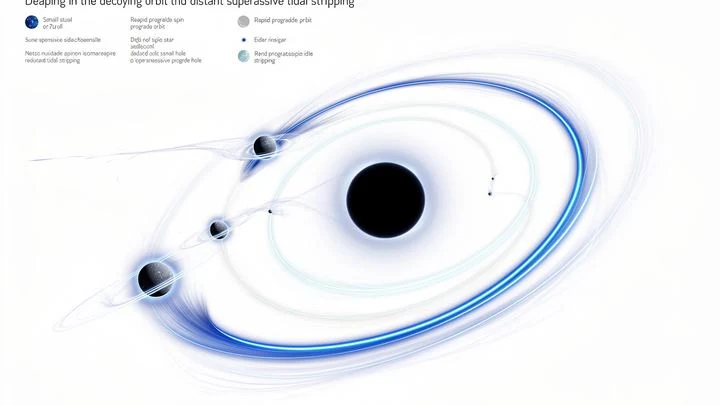
The cycle is driven by the availability of matter. In the active phase, gas spirals into an accretion disk, where friction and magnetic fields heat it to millions of degrees, producing X-rays and jets. As the disk is consumed or blown away by radiation pressure, accretion slows and the black hole enters a quiescent state. A new influx of matter — from a stellar tidal disruption, a galaxy merger, or instabilities in the interstellar medium — can restart the cycle. Feedback from jets and outflows can also regulate the process by pushing gas away, creating a self-limiting loop.

In practice

Studying activity cycles helps astronomers interpret variability in quasars and X-ray binaries, and informs models of galaxy evolution where black hole feedback regulates star formation.

Fun fact

Our own galaxy's supermassive black hole, Sagittarius A*, is currently in a dormant phase, but it shows occasional flares when it consumes small clumps of gas — and it may have been far more active in the past, as evidenced by the Fermi bubbles extending above the galactic plane.

Concept graph →

Formulas

$$\Delta(r) = r^2 - 2Mr + a^2 + Q^2$$
Horizon function for charged rotating black holes with charge Q.
What is in the formula
rvariableradial coordinate — radial coordinate metre
Mvariableblack hole mass — mass kilogram
avariablespecific angular momentum (spin parameter) — angular momentum per unit mass metre
Qvariableelectric charge — electric charge coulomb
δ_{{ed}}(r)=r^2-2mr+a^2+q · 2607.13992
$$r_{\pm} = \frac{GM}{c^2} \left(1 \pm \sqrt{1 - \frac{k_e Q^2}{G M^2}}\right)$$
Locations of event horizons in charged black holes.
What is in the formula
r_±variableInner and outer event horizon radii — horizon radius metre
QvariableElectric charge of the black hole — electric charge coulomb
MvariableMass of the black hole — mass kilogram
GconstantNewtonian constant of gravitation — gravitational constant = 6.67430e-11 cubic metre per kilogram per second squared
cconstantSpeed of light in vacuum — speed of light = 299792458 metre per second
k_econstantElectrostatic force constant in Coulomb's law — coulomb constant = 8.9875517923e9 newton metre squared per coulomb squared
r_{\pm}=\frac{gm}{c^2}(1\pm\sqrt{1-\xi}) · 2605.10587v1
$$M_{\rm BH} \propto L^\alpha \, {\rm FWHM}^\beta$$
Black hole mass scales with luminosity and line width.
What is in the formula
M_BHvariableBlack hole mass — mass kilogram
LvariableContinuum luminosity (e.g., at 5100 Å) — luminosity watt
FWHMvariableFull width at half maximum of emission line — line width metre per second
αvariablePower-law index for luminosity — power law index
βvariablePower-law index for line width — power law index
m_{\rmbh}=a(\frac{l_{5100}}{10^{44}{\rmэрг/с}})^b(\frac{{\rmfwhm}_{\rmhα}}{v_{\rmnorm}})^c · 2606.06226v1
m_{{bh}}\proptol_{{h}α}^{0.55}*{fwhm}_{{h}α}^{2.06} · 2607.01330v1
$$A = 8\pi M \left(M + \sqrt{M^2 - a^2}\right)$$
The area of a Kerr black hole depends on mass and spin.
What is in the formula
AvariableArea of the event horizon — area square metre
MvariableMass of the black hole — mass kilogram
avariableSpecific angular momentum (angular momentum per unit mass) — specific angular momentum metre
πconstantRatio of a circle's circumference to its diameter — pi = 3.14159
a=8πm^2(1+\sqrt{1-a^2}) · 2606.06592v1
$$\Delta(r) = r^2 - 2Mr + a^2$$
Horizon function for Kerr black holes with mass M and spin a.
What is in the formula
\Delta(r)variableHorizon function of the Kerr metric — horizon function square metre
rvariableRadial coordinate (Boyer-Lindquist) — radial coordinate metre
MvariableBlack hole mass — mass kilogram
avariableSpecific angular momentum (spin parameter) — specific angular momentum metre
δ_{{dm}}(r)=r^2-2m[1+\frac{\varepsilon}{m}μ_{{dm}}(r)]r+a^2 · 2607.13992
$$r_{\text{ISCO}} = r_g \left[3 + Z_2 \mp \sqrt{(3-Z_1)(3+Z_1+2Z_2)}\right]$$
Radius of the innermost stable circular orbit around a Kerr black hole.
What is in the formula
r_{\text{ISCO}}variableradius of the innermost stable circular orbit — radius metre
r_gvariablegravitational radius (GM/c^2) — radius metre
Z_1variableauxiliary function of spin parameter a
Z_2variableauxiliary function of spin parameter a
\mpoperatorindicates two possible solutions depending on orbital direction — minus plus sign
\sqrt{}operatortakes the square root of the argument — square root
r_{{isco}}=r_g[3+z_2\mp\sqrt{(3-z_1)(3+z_1+2z_2)}],\quadz_1=1+(1-a^2)^{1/3}[(1+a)^{1/3}+(1-a)^{1/3}],\quadz_2=\sqrt{3a^2+z_1^2} · 2607.22418v1

Related articles · 5

General Relativity2026-06-271 minarXiv:2606.29101express
Black Holes Sing About Their Transformations
A black hole is not a dead object. After a disturbance, such as merging with another hole, it rings like a bell. This ring is not just a sound but a complex set of damped oscillations called quasinormal modes. Their frequency and damping rate depend on the hole itself: its mass, charge, and spin.
High Energy2026-06-101 minarXiv:2606.12049express
A Blob of a Star Grazes a Black Hole
A blob of cold helium swoops dangerously close to a black hole. But this isn't just a blob: it's a dead star the size of Earth, yet with a mass comparable to the Sun's.
Fading Black Hole Flares: The Key Is the Star's Rapid Spin
In the centers of galaxies, where supermassive black holes lie dormant surrounded by stellar swarms, lights of monstrous power sometimes flare up — tidal disruption events. But some of these events behave oddly: they repeat again and again, and each new ignition is dimmer than the last.
Galaxies2026-02-252 minarXiv:2602.21502express
A Galaxy Wakes Up Before Our Eyes
Deep in the constellation Ophiuchus lies the galaxy NGC 6447. Until recently, it was quiet and unremarkable, like a house with its windows dark. But over the past 14 years, something has ignited at its center, and now it's visible in infrared light.
The Cosmic Metronome Loses Its Beat: Ansky's Flares Slow to Half Tempo
At the core of the distant galaxy SDSS J1335+0728, 2.5 billion light-years from Earth, a supermassive black hole beats out a rhythm. Every few days it flares in X-rays like a cosmic metronome, but in 2025 that metronome suddenly shifted from allegro to andante.