Stellar rotation explains fading flares in repeated tidal disruptions ✛ ✦
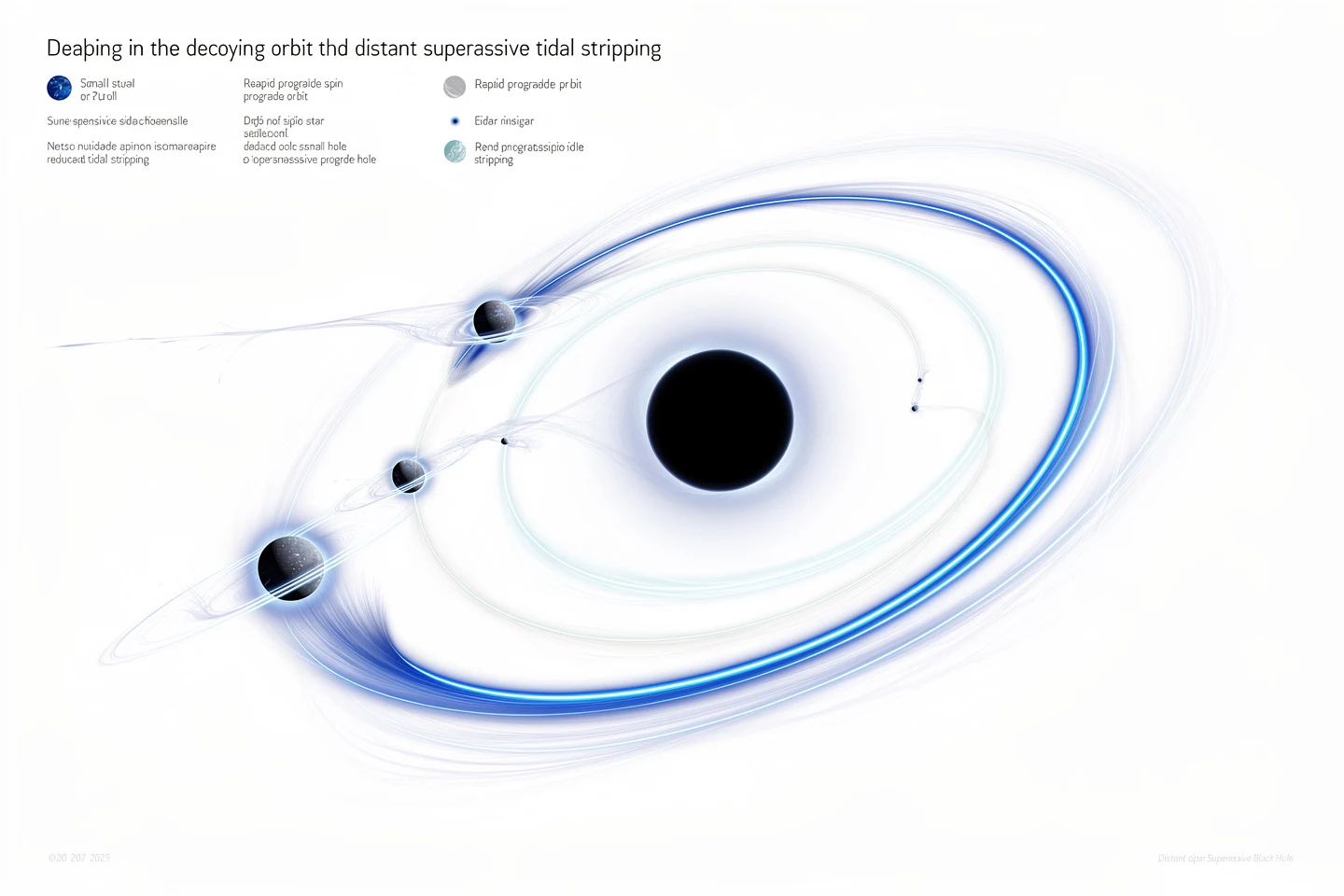
Context
Repeating tidal disruptions are a rare class of events where a star on a highly elongated orbit periodically loses some mass when passing close to a supermassive black hole. When Karl Schwarzschild found the first exact solution to Einstein's equations, no one imagined black holes could tear stars apart. Current hydrodynamic models predicted that for massive stars, the amount of stripped material and peak luminosity either increase or stay constant, contradicting observations of several candidates exhibiting fading flares. This points to an overlooked physical factor. Back in the mid-20th century, John Wheeler coined the term 'black hole', and since then, studying tidal disruptions around these objects has become crucial for understanding the growth of galactic nuclei.
Methods
The authors used the smoothed-particle hydrodynamics method (code PHANTOM) to simulate partial disruptions of main-sequence stars, whose structure was computed with the MESA code. The modeled stars consisted mainly of hydrogen and helium, with initial rotation up to 80% of the critical breakup speed. For constructing initial stellar models, theory tracing back to the work of Chandrasekhar was employed. The simulations covered 1 and 3 M⊙ stars on parabolic orbits around a black hole of mass $10^6$ M⊙ with pericenter parameter β = 0.6–1.0. The accretion rate—a key quantity determining the flare brightness—and the evolution of core rotation over up to four consecutive passages were tracked.
Results
The results unequivocally show that when a star rotates prograde with angular frequency comparable to the orbital frequency at pericenter (Ω_p ≈ Ω_* × ($M_{BH}$/M_*)^{1/2} (R_*/$r_p$)^{3/2}), the tidal interaction hardly increases its spin. Instead, the mass loss from one encounter to the next decreases. For a 1 M⊙ star on the ZAMS (λ=0.7, β=0.6), the peak accretion rate dropped by a factor of ~1.5, and for a 3 M⊙ star on the TAMS (λ=0.8, β=1.0)—even more significantly. This decline persists over all four calculated passages, reproducing for the first time observations in the centers of galaxies of objects like eRASSt-J045650 (five flares) and AT2022dbl. In contrast, when there was no initial rotation, the spin quickly increased and peak luminosity grew, as in previous work. A third case—rotation faster than Ω_p—also leads to fading, but with the star spinning down. Thus, it is the combination of high initial spin and a sufficiently massive (≳1 M⊙) evolved star that leads to successively weakening flares.
Implications
These results provide strong indirect evidence for the Hills mechanism (disruption of a tight binary, with one star captured and the other ejected from the galaxy). Only such a scenario naturally gives the star rapid prograde rotation and the short orbital period observed in rpTDEs. Additionally, constraints are placed on the nature of the progenitor star: it must be massive, sufficiently evolved (so that its mean density increases during mass loss), and rapidly rotating. This is consistent with the overall dynamical picture in the centers of massive galaxies.
Future development
Future studies need to test retrograde rotations (expected to cause brightness increases, unless the spin exceeds Ω_p). Of particular interest is the case of AT2018fyk, where the luminosity drop reached an order of magnitude, which might indicate relativistic effects with a more massive black hole (M∼$10^7$.7 M⊙). With the launch of JWST and the start of LSST surveys, the discovery of many new rpTDEs is expected. Joint photometric and spectroscopic surveys (e.g., with JWST) will enable precise measurements of luminosity decline and periods to test our predictions.
Impact
This work will impact our understanding of the growth of supermassive black holes through accretion of stellar material, the statistics of hypervelocity stars, and the classification of nuclear transients, as some repeating TDEs may mimic supernovae or AGN activity.
Next steps
A systematic parameter scan (spin, stellar mass, β) and comparison with the full observed sample are needed to identify allowed regions. Including more realistic physics (radiation, magnetic fields, relativistic corrections) will improve prediction accuracy.
Key open problems
The study directly addresses the unsolved problem of short-period orbit formation in tidal disruption events and the connection between binary dynamics in the nuclei of galaxies and accretion activity. It also deepens understanding of the feedback between stellar populations and the growth of central black holes.
The knowledge machine's view
This section is addressed to the author of the paper and their colleagues. Neighbouring works were found by meaning-based search across our archive, not by word overlap. We do not review: we show the field around the work.
What the work does
The authors modeled repeated partial tidal disruption events of main-sequence stars with initial rotation using the PHANTOM code and MESA models. They showed that for sufficiently fast prograde stellar rotation, the accretion rate and peak luminosity of the flares decrease from one passage to the next, which for the first time reproduces the observed decay in eRASSt-J045650 candidates. They concluded that such a scenario naturally arises when a star is captured from a tight binary via the Hills mechanism.
Where its strength is
This work is the first to quantitatively link the initial stellar rotation to the evolution of repeating tidal flares, offering a concrete observational test for the Hills mechanism. The use of self-consistent stellar models and three-dimensional hydrodynamics lends robustness to the results.
Where it could go next
- It might be interesting to see how a gas disk at the Galactic center, capable of disrupting binary stars, affects the distribution of initial rotations among captured stars and hence the expected pattern of repeating flares.based on: Gravitational Rudder: How a Gas Disk Rips Binary Stars Apart in the Galactic Center arXiv:2607.26205v1
- Closely related is the study of how a small object orbiting a black hole with a disk changes its orbit; perhaps a similar feedback mechanism with the accretion disk from previous flares could further influence the rate of subsequent disruptions.based on: A Black Hole with a Disk: How a Small Object Changes Its Orbit arXiv:2606.18341
- To test predictions of decaying flares, it would be useful to compare them with the observed properties of X-ray sources in galactic centers that may be associated with tidal disruption events.based on: X-ray Beacons in Galactic Centers arXiv:2606.27661
Worth trying
- Test whether accounting for a gas disk leads to preferential capture of stars with a specific direction and magnitude of rotation.
- Compare model light curves with observations of eRASSt-J045650 and AT2022dbl, varying the mass and evolutionary stage of the star.
- Estimate how often repeating flares should exhibit decay depending on the binary parameters before its disruption.
Nearby works in our archive
- X-ray Beacons in Galactic Centerssimilarity 0.66
- Rhythms of Black Holes: 34 Pulsations in Gamma-Ray Burstssimilarity 0.66
- Gravitational Rudder: How a Gas Disk Rips Binary Stars Apart in the Galactic Centersimilarity 0.65
- Dark Stars: Cradle of Giant Black Holessimilarity 0.64
- Dark Matter Waves Stir Stars in Dwarf Galaxiessimilarity 0.64
- The Arrow Piercing the Disk: Recipe for an X-ray Flaresimilarity 0.64
- A Black Hole with a Disk: How a Small Object Changes Its Orbitsimilarity 0.64
The closest work in the archive sits at 0.66 by meaning — the usual level for our corpus.
Original abstract
as written by the authors arXiv:2606.02692v1
The repeated tidal stripping of a star by a supermassive black hole, known as a repeating partial tidal disruption event (rpTDE), can give rise to a transient that rebrightens months to years after the first outburst. Among the rpTDE candidates so far observed, some exhibit dimmer peak luminosities during each successive outburst, which is a trend that has not been reproduced from theoretical models when the star survives more than one encounter with the black hole. Here we suggest that this trend can be recovered if the partially disrupted star is initially (i.e., prior to its first mass-stripping event) rapidly rotating, which is expected if the star was placed on its orbit through the Hills breakup of a tidally locked and tight binary. We test this hypothesis with hydrodynamical simulations of high-mass ($$\geqslant 1 M_{\odot}$$) main sequence stars repeatedly partially disrupted by a $$10^6 M_{\odot}$$ black hole, and demonstrate that successively dimmer outbursts are indeed recovered for high (tens of percent breakup) and prograde (i.e., aligned with the orbital angular momentum) stellar spins. Our results provide strong indirect evidence for the operation of the Hills mechanism in seeding the stars in rpTDEs.
When a binary system disrupts via the Hills mechanism, one star is captured into a tight orbit while the other is flung away at hundreds of kilometers per second — thus hypervelocity stars are born, leaving the galaxy forever.
Key numbers
- black hole mass (model): 106 M⊙
- stellar spin λ: 0.7–0.8 of breakup frequency
- drop in peak luminosity: by a factor of 1.5–10
- tidal encounter parameter β: 0.6–1.0
- number of flares in eRASSt-J045650: 5