Red dots in space do not disappear, they transform ✛ ✎ ✦
Using the James Webb telescope, astronomers discovered 'little red dots' in the distant Universe. Their light reddened due to the expansion of space — an effect discovered by Edwin Hubble. Inside each dot hides a massive black hole. To study these objects, scientists applied spectroscopy (light decomposition), photometry (brightness measurement), and gravitational lensing (light amplification by other galaxies).
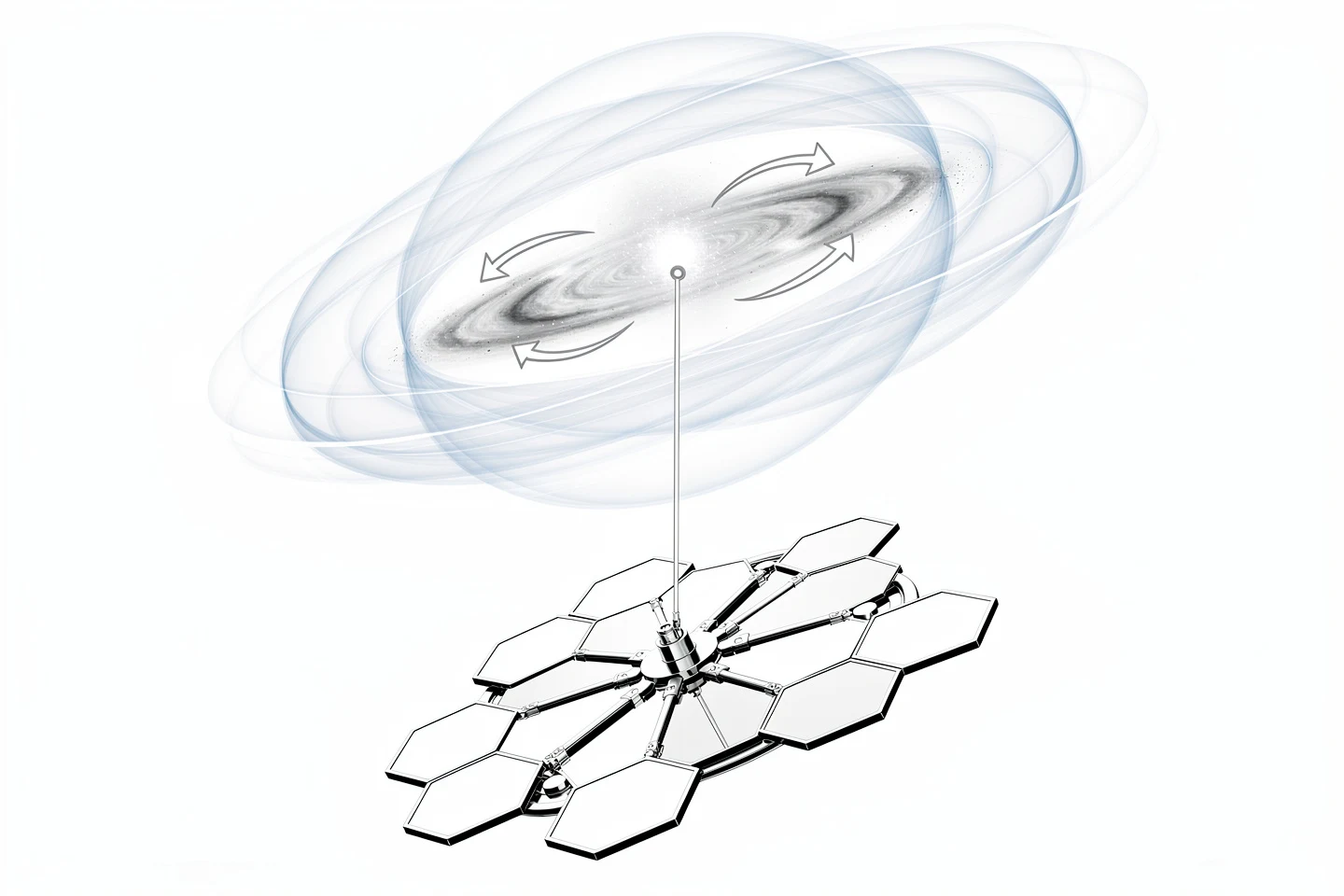
These dots disappear as the Universe ages. It turns out, they behave like startups: first huddled in a 'garage' with a minimum of dark matter, which serves as their invisible structural framework. The idea of such matter was proposed by Fritz Zwicky, and observations by Vera Rubin confirmed its reality. Gradually accumulating dark matter, the dot moves to a densely populated neighborhood, where there are many other galaxies. There it expands, loses its red hue and becomes an ordinary stellar system. This is not disappearance, but transformation: a little red dot is a future galaxy that hasn't yet acquired a spacious invisible 'office'.
A surprising detail: despite its tiny appearance, the black hole inside such a dot can weigh as much as a billion Suns.
The term 'little red dots' appeared in 2022 after the first Webb images. They are so distant that even at maximum magnification, they remain tiny ruby dots.
These objects resemble the monoliths from '2001: A Space Odyssey': compact, holding the secrets of the young Universe.