Ruby Pupae: How Dark Matter Transforms the Face of Galaxies ✛ ✎ ✦
Among the precious scatterings of the early Universe captured by James Webb, there are objects that resemble ruby beads scattered on black velvet. These are the 'little red dots' (LRDs) — compact sources with steep red spectra, inside which lurk supermassive black holes up to a hundred million solar masses. They are like galactic pupae, wrapped in dense cocoons of gas and dust. But the most puzzling thing is not their brightness, but their rapid disappearance: by z<3, LRDs are almost nowhere to be found. What metamorphosis turns them into ordinary galaxies? The answer came from a study of their cosmic environment.
Astronomers studied 98 LRDs with redshifts from 3 to 7 — the very effect that Edwin Hubble discovered nearly a century ago. Spectra were obtained with the spectrograph NIRSpec/PRISM in six deep fields, including CEERS and JADES. Using archival photometry and DESI data on nearby analogs, they reconstructed the large-scale picture: how much more densely galaxies cluster around LRDs in cylinders with a radius of 5 h⁻¹ Mpc, and from this overdensity they estimated the mass of dark matter halos via cross-correlation. The key was the linear bias parameter, first applied by Fritz Zwicky to clusters. Its modern calibration relies on a robust halo model and on galaxy rotation — the very phenomenon that Vera Rubin unequivocally explained by invisible mass.
Key result: at z>4, LRDs prefer sparse regions — their environment is on average an order of magnitude poorer than that of typical galaxies. The overdensity ratio $δ_{LRD}$/$δ_{Gala}$xy drops from ~0.1 to ~1 by z~3.5, while the mass of dark matter halos grows rapidly: from less than $10^{10}$.1 M⊙ at z~7.5 to about $10^{11}$.3 M⊙ at z~3.5. And most astonishingly, this entire transformation takes a mere half a billion years — a cosmic blink between two sips of coffee. It's like a pupa in a cocoon: at first, the cocoon is snug, but as it accumulates dark matter, the pupa transforms, and eventually the galaxy spreads its wings. The black hole inside hardly changes, so the $M_{BH}$–$M_{halo}$ ratio evolves, approaching the local scaling.
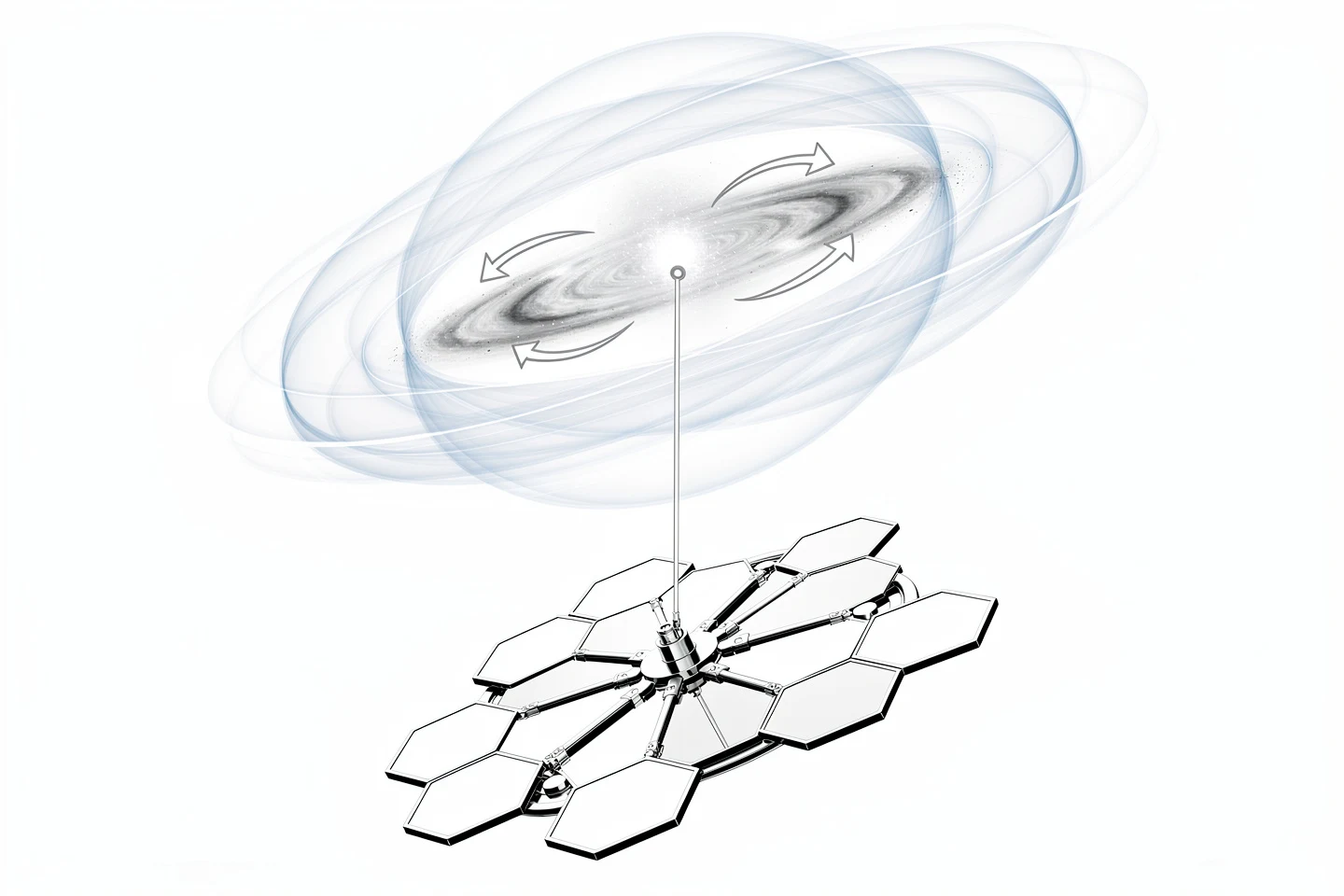
As the halo mass grows, the inflow of angular momentum increases: the galaxy 'spreads its wings,' its size reaches a kiloparsec, and the distinctive V-shaped continuum is diluted by stellar light. Thus, the red dots lose their opaque 'rubiness' and become indistinguishable from their neighbors. This work proves for the first time that LRDs are not an exotic class, but a transitional phase in the joint evolution of supermassive black holes and their dark matter halos. This picture naturally accommodates both the low-spin halo model of Pacucci and Loeb, and the hypothesis of dark matter collapse as a mechanism for birthing black hole seeds. Further observations by JWST and the future Roman telescope will allow us to catch the moment of LRD disappearance at z~2–3 and test exactly how halo spin regulates compactness. The story of these ruby dots reminds us: even on megaparsec scales, evolution obeys an ancient law — to everything there is a season, and every pupa eventually becomes a butterfly.
The term 'little red dots' entered astronomical slang in 2022 after the first JWST images: these objects remain unresolved even at maximum magnification, appearing as ruby dots against the black sky.
These distant 'red dots' evoke the mysterious monoliths from Arthur C. Clarke's 'Space Odyssey' — compact sources that, like alien artifacts, hold the secrets of the early Universe's evolution.