Why do 'little red dots' vanish at z<3: evolution of environment and halo mass ✛ ✎ ✦
Context
The James Webb Space Telescope has discovered a population of 'little red dots' (LRDs) — compact sources with steep red spectra and anomalously massive supermassive black holes (up to 10⁸ M⊙). Their sharp disappearance at z<3 challenges models of co-evolution of galaxies and black holes. Understanding the evolution of their environment and dark halo mass can reveal how the first structures formed and why compact objects cease to stand out.
Methods
We studied 98 LRDs with spectroscopic redshifts 3
Results
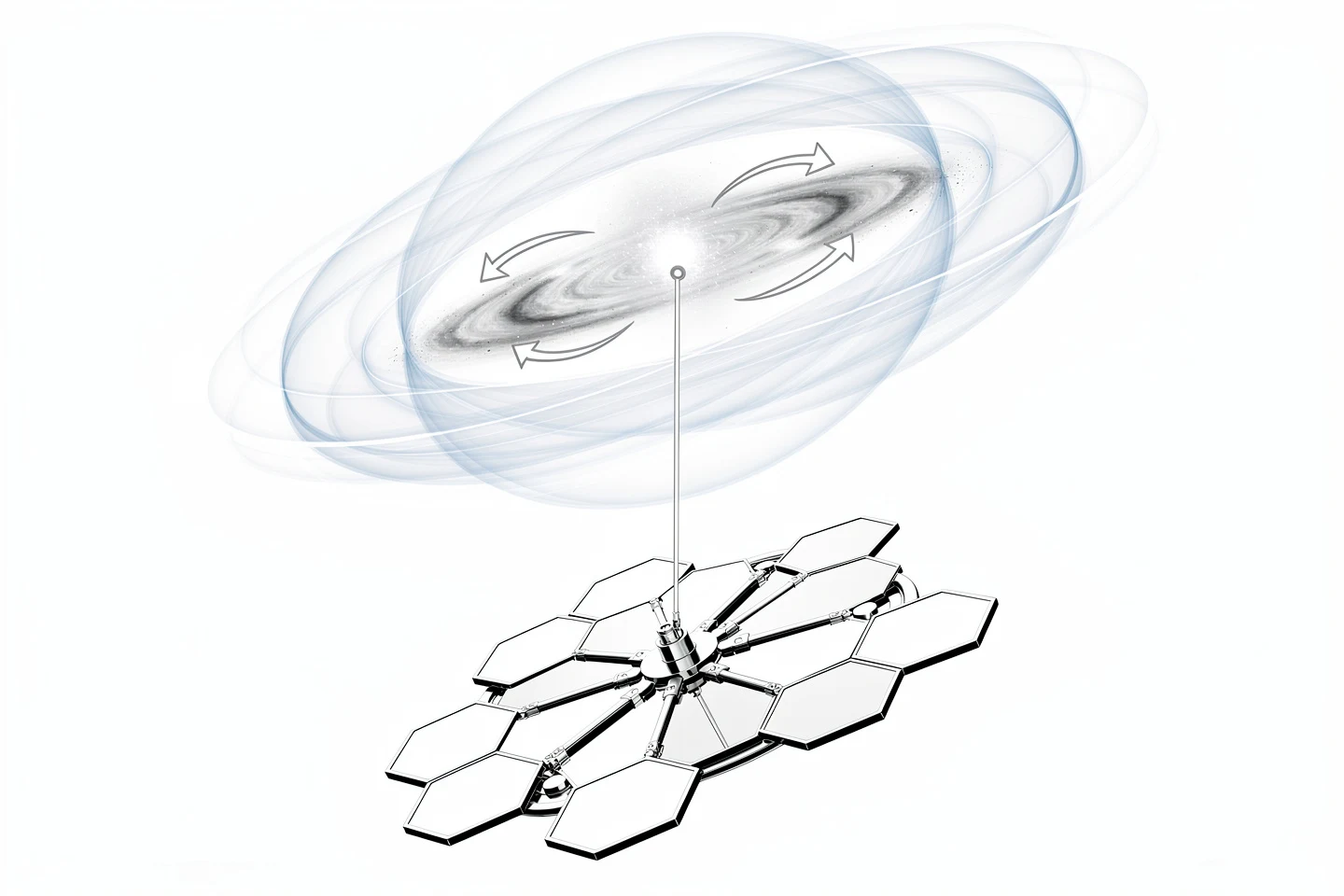
Key finding: at z>4, LRDs reside in underdense regions (significance >5σ) relative to ordinary galaxies; the overdensity ratio δLRD/δGalaxy drops from ~0.1 to ~1 by z~3.5. The dark halo mass of LRDs grows rapidly: from less than $10^{10}$.1 M⊙ at z~7.5 to ~$10^{11}$.3 M⊙ at z~3.5. The black hole mass barely changes, so the $M_{BH}$–$M_{halo}$ ratio evolves, approaching the local scaling. At z~3.5, LRDs are indistinguishable from normal galaxies by halo mass and environment. Simulations show that as the halo grows, the inflow of angular momentum increases, the galaxy expands, compactness vanishes, and the V-shaped spectrum gives way to a typical galaxy spectrum.
Implications
The work demonstrates for the first time that the disappearance of LRDs is driven by the evolution of dark halos. In low-mass halos (z>4), low angular momentum sustains compactness and dense gas, producing the characteristic V-shaped continuum. As halo mass grows, spin increases, sizes reach ~1 kpc, and the spectrum gets 'diluted' by stellar radiation. Thus, LRDs are a transitional phase in the evolution of supermassive black holes and their hosts, not a separate class. This agrees with the low-spin halo model by Pacucci and Loeb and highlights the role of environment in early evolution.
Future development
Further observations with JWST and future telescopes (e.g., Roman) will allow a more detailed study of the link between halo spin and compactness, and test models of black hole seed formation via dark matter collapse. High-resolution spectroscopy will refine black hole masses, and statistics at z~2–3 will pinpoint the moment of LRD disappearance.
Impact
The findings refine theories of co-evolution of galaxies and supermassive black holes, as well as models of the formation of the first structures within ΛCDM cosmology.
Next steps
It is necessary to expand the LRD sample at z~2–3 and perform direct modeling of the spin evolution of dark halos including gas inflow.
Key open problems
The study links the disappearance of LRDs to the fundamental problem of supermassive black hole growth in the early Universe and their connection to dark halos. The discovered role of environment supports scenarios of rapid black hole seed formation in underdense regions.
The knowledge machine's view
This section is addressed to the author of the paper and their colleagues. Neighbouring works were found by meaning-based search across our archive, not by word overlap. We do not review: we show the field around the work.
What the work does
We studied 98 little red dots (LRDs) with spectroscopic redshifts 3
Where its strength is
This work is the first to link the disappearance of LRDs to dark halo evolution, demonstrating that the transition from compact objects to normal galaxies occurs when a certain halo mass and environmental density are reached.
Where it could go next
- It might be interesting to compare the derived halo mass and environment evolution of LRDs with models where compactness is maintained by pressure in dense gas, as in the work.based on: Cosmic Pressure Cooker: Unraveling the Mystery of Little Red Dots arXiv:2607.17448v1
- A related analysis links LRDs to dark matter and conditions for black hole growth; it might be worth checking how your halo mass estimates align with their theoretical scenarios.based on: Cradle for a Black Hole: Dark Matter and the Mystery of Red Dots arXiv:2606.02539v1
Worth trying
- Test whether the found anti-correlation between environmental density and black hole mass persists when using other halo mass estimates from weak lensing.
- Compare the predicted growth of halo angular momentum with observed LRD sizes at z~4–5.
- Search for LRD analogs in the local Universe with halo masses below 10^11 M⊙ to test the universality of the scaling.
Why this may matter
Understanding how environment and halo mass govern the visibility of compact objects with active black holes could clarify the early stages of co-evolution of galaxies and supermassive black holes, and explain why such objects are rare today.
Nearby works in our archive
- Red Lanterns of the Cosmos: What Compact Objects from the Early Universe Concealsimilarity 0.72
- The Telescope's Red Dots Are Just the Tip of the Icebergsimilarity 0.71
- Red Dots Are Not Twins of Dusty Quasarssimilarity 0.70
- Tiny Black Holes Build Giantssimilarity 0.70
- Cradle for a Black Hole: Dark Matter and the Mystery of Red Dotssimilarity 0.69
- Red Dots: The Universe's Neutrino Cannonssimilarity 0.68
- Cosmic Pressure Cooker: Unraveling the Mystery of Little Red Dotssimilarity 0.68
The archive is crowded around this work: 9 reviews nearby, closest at 0.72. This ground is well walked — and there is plenty to compare against.
The term 'little red dots' emerged in astronomical slang in 2022 after the first JWST images: these objects remain unresolved even at maximum magnification, appearing as ruby dots against the black sky.
These distant 'red dots' are reminiscent of the mysterious monoliths from Arthur C. Clarke's 'Space Odyssey' — compact, reddish, holding secrets of the early Universe's evolution.
Key numbers
- halo mass at z~7.5: less than 1010.1 M⊙
- halo mass at z~3.5: ~1011.3 M⊙
- typical black hole mass: 106–108 M⊙
- space density of LRDs at z>4: 10^−5–10^−4 per cubic megaparsec
- size: less than a few hundred parsecs