Stellar Lighthouse: A White Dwarf Pulsing with Radio Waves ✛ ✦
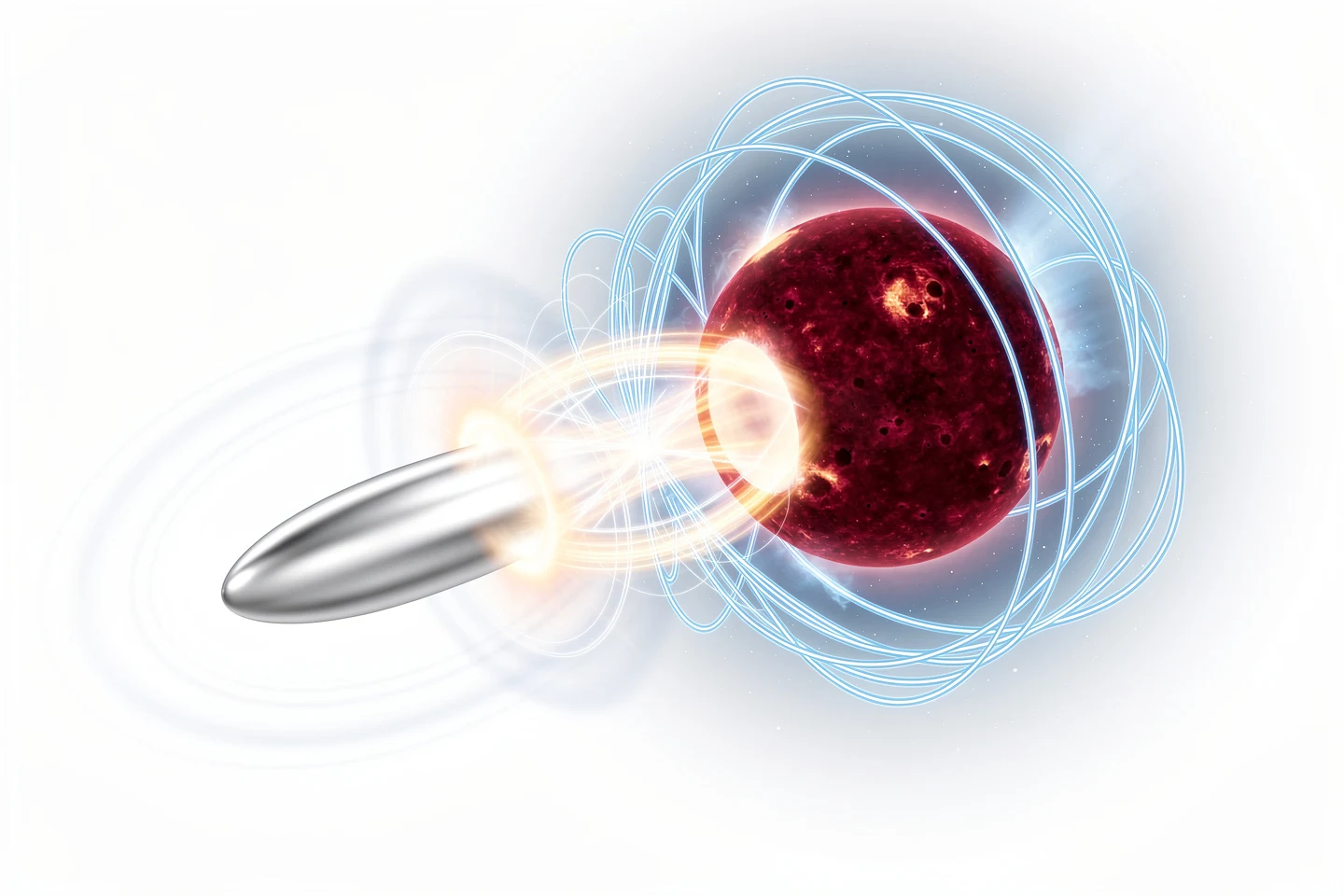
In space, an astonishing pair has been found: a tiny but monstrously dense white dwarf and its puffy, lightweight neighbor — a red dwarf. They race around their common center every 1.37 hours. The white dwarf's gravity rips gas from its companion — mostly hydrogen and helium — and that gas, spiraling inward, slams into the magnetic poles, heating up to millions of degrees. Each time the pole faces our way, a radio flash erupts — just like a lighthouse beam piercing the darkness.
This mechanism resembles pulsars — rapidly spinning neutron stars, discovered by Jocelyn Bell Burnell in 1967 — but here the period is much longer. And the key discovery: the white dwarf's mass is teetering on the Chandrasekhar limit. Add just a pinch more matter, and the star will collapse, igniting a supernova that outshines an entire galaxy. Right now, this lighthouse is operating on the brink of its own destruction.
The radio signal showed patterns resembling ripples from two stones thrown into a pond — something previously seen only with Jupiter and its moon Io.