Accreting white dwarf: periodic radio pulses in a binary system ✛ ✦
Context
Since 2022, astronomers have been puzzling over long-period radio transients — sources of powerful polarized radio bursts repeating with periods from minutes to hours. Unlike ordinary radio pulsars, discovered by Jocelyn Bell Burnell in 1967, these objects are too slow for neutron stars, unless they are magnetars with extremely strong fields. An alternative hypothesis suggests they are white dwarfs in binary systems, but until now there was no direct evidence of accretion, characteristic of cataclysmic variables. Understanding the nature of these transients is important for the physics of compact objects and the generation of coherent emission.
Methods
For a comprehensive study of ASKAP J1745−5051, the team led by Kovi Rose used a wide arsenal of instruments. Radio observations were carried out with the Australian telescopes ASKAP and ATCA, and the South African MeerKAT, which provided detailed dynamic spectra. Optical spectroscopy on the SOAR and Magellan telescopes revealed emission lines of hydrogen (Balmer series) and helium, characteristic of magnetic cataclysmic variables. X-ray data were obtained by the Swift and Einstein Probe space observatories, and photometry by the Gaia satellite. Period analysis was performed using radio pulse timing and Doppler measurements.
Results
The orbital period of the system, measured from the Doppler shift of spectral lines, was 1.368 ± 0.053 hours — one of the shortest among such objects. This period coincides with the radio pulse period (1.34497 hours), confirming orbital modulation of the emission. The X-ray light curve also shows periodicity with a phase shift relative to the radio bursts: in some observations, the X-ray peak coincides with radio pulses, in others it is in antiphase. This behavior indicates accretion of matter from a low-mass red dwarf (spectral class M6) onto a magnetic white dwarf. The radio pulses were found to be elliptically polarized, with a narrowband structure and frequency drift, and their brightness temperature exceeds $10^{12}$ K, which unequivocally requires a coherent emission mechanism. The optical spectrum is dominated by narrow emission lines of hydrogen and helium, including the HeII 4686 Å line — an indicator of magnetic accretion. The Hα/Hβ intensity ratio ≤ 1 indicates a high electron density (ne ≳ $10^{13}$ cm^{-3}), typical of accreting polars. The white dwarf mass is estimated at 0.83 M☉ — close to the Chandrasekhar limit, established by Subrahmanyan Chandrasekhar.
Implications
This discovery directly links long-period radio transients with cataclysmic variables for the first time, confirming that accretion plays a key role in generating the observed emission. Unlike isolated white dwarfs or neutron stars, ASKAP J1745−5051 demonstrates how the interaction of the magnetospheres of two stars can produce powerful coherent radio emission — possibly through a relativistic electron-cyclotron maser. This forces a revision of models for other transients, such as GLEAM-X J0704 and ILT J1101, and opens a new path for studying accretion physics in extreme magnetic fields.
Future development
Future long-term optical and radio observations, especially with simultaneous X-ray coverage, will help refine the geometry of magnetic fields and the emission modulation mechanism. Detailed modeling of magnetospheric interaction in asynchronous systems like this one could explain unique pulse features — such as frequency drift and modulation bands. With the commissioning of new instruments like SKA and advances in spectropolarimetry, we can expect the discovery of a whole population of such objects, turning them from curiosities into a full-fledged class of astrophysical sources.
Impact
The results will impact the physics of accreting white dwarfs, the theory of stellar magnetospheres, and the understanding of coherent emission mechanisms in astrophysical plasma. They may also help interpret other transient classes, including fast radio bursts.
Next steps
Immediate next steps include obtaining deep spectropolarimetric data to estimate the white dwarf's magnetic field and conducting coordinated multi-wavelength campaigns with high time resolution. A search for similar systems in archival radio survey data is also needed.
Key open problems
The discovery touches on several fundamental problems: the nature of long-period radio transients, the mechanism of coherent radio emission in stellar systems (electron-cyclotron maser vs other processes), and the role of magnetic fields in accretion onto compact objects. In particular, it remains unclear how exactly the accreting plasma creates conditions for maser amplification and why the pulses are so narrowband and polarized. It also resonates with the mystery of the anomalously high radio luminosity of some cataclysmic variables.
The knowledge machine's view
This section is addressed to the author of the paper and their colleagues. Neighbouring works were found by meaning-based search across our archive, not by word overlap. We do not review: we show the field around the work.
What the work does
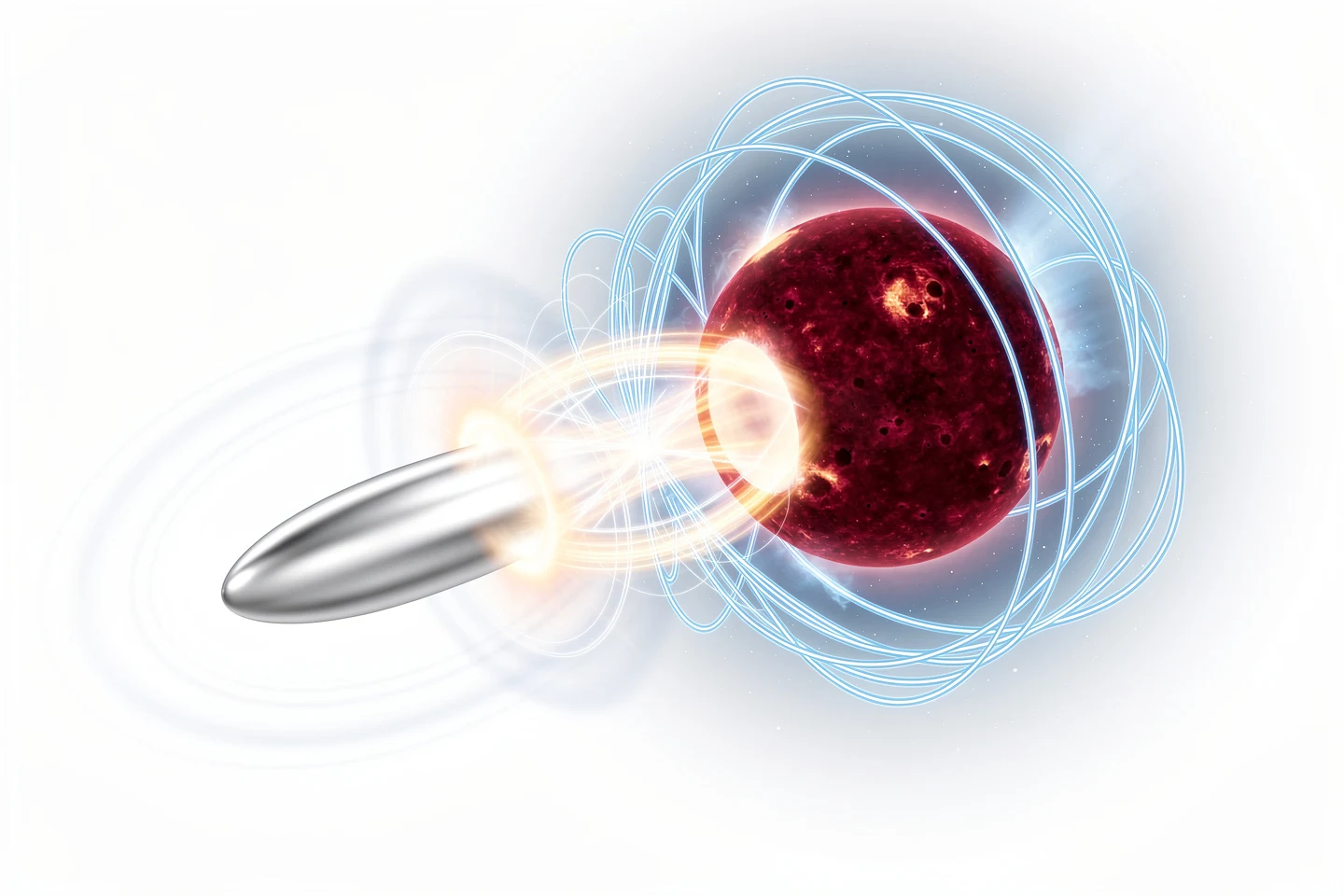
The study focuses on the source ASKAP J1745−5051, which exhibits periodic radio pulses with a period of about 1.34 hours. The authors used radio, optical, and X-ray observations to show that it is a binary system with an accreting white dwarf and a red dwarf, and that the radio pulses are modulated by the orbital motion.
Where its strength is
For the first time, a long-period radio transient has been directly linked to a cataclysmic variable, confirming the hypothesis that accreting white dwarfs are the sources of such objects. The multi-wavelength approach and the precise match between the orbital period and the radio pulse period provide a solid foundation for further research.
Where it could go next
- It might be interesting to compare the properties of ASKAP J1745−5051 with other long-period radio transients to identify common features and differences in emission mechanisms.based on: Radio Beacons with a Minute-Long Rhythm: Who Lights Them Up arXiv:2608.08243v1
- A related paper discusses radio pulsars observed by gravitational-wave detectors; perhaps similar methods could help refine the system parameters or search for analogous objects.based on: Radio Pulsars in the Crosshairs of a Space-Based Gravitational-Wave Detector arXiv:2608.04628v1
- It is worth considering the possibility of coherent radiation generation in the context of maser mechanisms, as in the work on energy leakage in cosmic masers.based on: A Leaky Bucket Doesn't Quench a Cosmic Maser arXiv:2608.00332v1
Worth trying
- Check whether ASKAP J1745−5051 shows X-ray pulsations with the same period as the radio pulses, and how they are related in phase.
- Search for signs of optical variability at the orbital period using high-speed photometry.
- Assess whether the emission mechanism could be related to the electron cyclotron maser, similar to what has been proposed for other transients.
Why this may matter
Understanding the nature of long-period radio transients is important for the physics of compact objects and the generation of coherent radiation, as well as for population studies of white dwarf binaries.
Nearby works in our archive
- Radio Beacons with a Minute-Long Rhythm: Who Lights Them Upsimilarity 0.68
- Radio Pulsars in the Crosshairs of a Space-Based Gravitational-Wave Detectorsimilarity 0.66
- Listening to the Heartbeats of Stars with a Space Observatorysimilarity 0.64
- A Leaky Bucket Doesn't Quench a Cosmic Masersimilarity 0.63
- X-ray Beacons in Galactic Centerssimilarity 0.62
- Gravitational Hunt for Whirling Black Holessimilarity 0.62
The closest work in the archive sits at 0.68 by meaning — the usual level for our corpus.
Original abstract
as written by the authors arXiv:2606.04232v1
Long period radio transients (LPTs) are coherent bursts of polarised radio emission that repeat periodically on timescales of minutes to hours. Little is known about the physical origins of these systems. Astronomers have proposed magnetars that rotate slowly and white dwarfs that rapidly orbit with a companion star as potential explanations. While several recent examples appear to support the latter hypothesis, the mechanism generating these bright radio pulses remains poorly understood. Here we report our discovery and classification of the LPT ASKAP J174508.9-505149 as an accreting white dwarf binary. This object has a ~1.3h spectroscopic orbital period and exhibits orbitally-modulated X-ray emission and radio bursts. These elliptically polarised radio bursts drift in emission frequency, potentially due to a longer beat period, and turn off for several hours at a time. Some long period radio transients have been associated with non-interacting white dwarf binaries. We have spectroscopically confirmed this system as an accreting cataclysmic variable, identified through characteristic optical emission lines and an ongoing X-ray outburst. Our results strengthen the link between at least some long period radio transients and white dwarf binaries.
The radio pulses of ASKAP J1745−5051 are so intense that their brightness temperature exceeds $10^{12}$ K — that's a hundred times hotter than the center of the Sun, requiring a coherent emission mechanism akin to earthly lasers, but on cosmic scales. Moreover, the radio signal shows 'modulation bands' — interference patterns previously observed only in decametric emission from Jupiter from its moon Io!
Key numbers
- orbital period: 1.37 hours
- radio period: 1.345 hours
- X-ray luminosity (0.2–10 keV): 1030–1033 erg/s
- radio luminosity (1.365 GHz): 1018–1021 erg/s/Hz
- brightness temperature: >1012 K