Cosmic Waltz: How a White Dwarf Became a Radio Beacon ✛ ✦
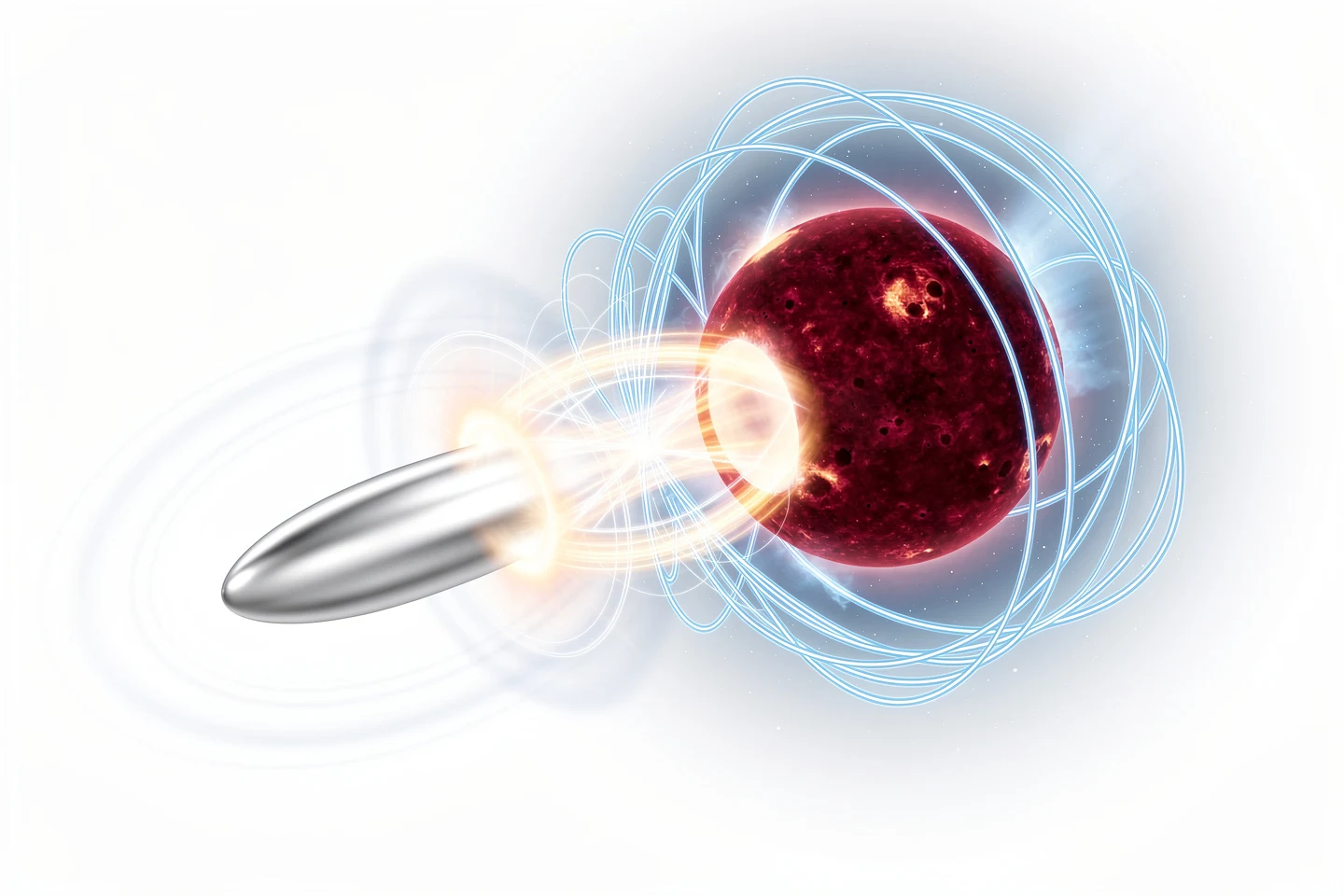
In 2022, astronomers began discovering strange cosmic beacons — long-period radio transients. Unlike fast pulsars, discovered by Jocelyn Bell Burnell in 1967, these objects flared with periods of tens of minutes and hours. There were suspicions that behind them were not neutron stars, but accreting white dwarfs, but direct evidence was lacking. And then the system ASKAP J1745−5051 in the constellation Pavo provided the long-awaited answer.
Two stars are locked in a tight waltz: a massive white dwarf with a mass of 0.83 solar masses, nearly reaching the limit predicted by Subrahmanyan Chandrasekhar — the fateful threshold beyond which gravity takes over and the star may explode as a Type Ia supernova — and a lightweight red dwarf of spectral class M6. The orbital period is just 1.37 hours — one of the shortest among such pairs. With each revolution, the white dwarf's magnetic field, like an invisible hand, tears a stream of plasma from its companion. This plasma, rich in hydrogen and helium, falls onto the magnetic poles, and at that moment a blinding radio pulse is born. The brightness temperature of the burst exceeds 10¹² K — a hundred times hotter than the Sun's core — which is inexplicable without coherent amplification, akin to a cosmic maser.
The key to solving this was a multi-instrument approach. Spectroscopy with the SOAR and Magellan telescopes revealed bright emission lines of hydrogen and helium, including the HeII 4686 Å line — an unmistakable indicator of magnetic accretion. Analysis of photometry from the Gaia satellite and X-ray data from the Swift and Einstein Probe observatories showed that the radio bursts are synchronized with high-energy emission, though sometimes with a puzzling phase shift. This suggests that the accretion stream sometimes hits the pole directly, sometimes curves around it — depending on the rotation phase. The period of the radio pulses matched the orbital period, definitively confirming the binary system scenario.
The discovery of ASKAP J1745−5051 not only settles the debate on the nature of long-period transients — it opens the door to new physics. It turns out that cataclysmic variables, known for decades, are capable of much more spectacular performances. The detailed dance of magnetic fields and accreting plasma, similar to the electron-cyclotron maser in the auroras of Earth and Jupiter, paves the way to a unified understanding of coherent emission in astrophysical environments. With the commissioning of SKA and the development of spectropolarimetry methods, we will be able to peer into the heart of the accretion funnel and possibly predict which of these white dwarfs is destined to explode as a Type Ia supernova. The waltz continues, and each new beat brings us closer to deciphering the rhythm of the Universe.
In the radio signal of ASKAP J1745−5051, 'modulation bands' were noticed — interference patterns previously observed only in decametric radiation from Jupiter from its moon Io.