Shattered Inkwell: Impact Downpour 800 Million Years Ago ✛ ✦
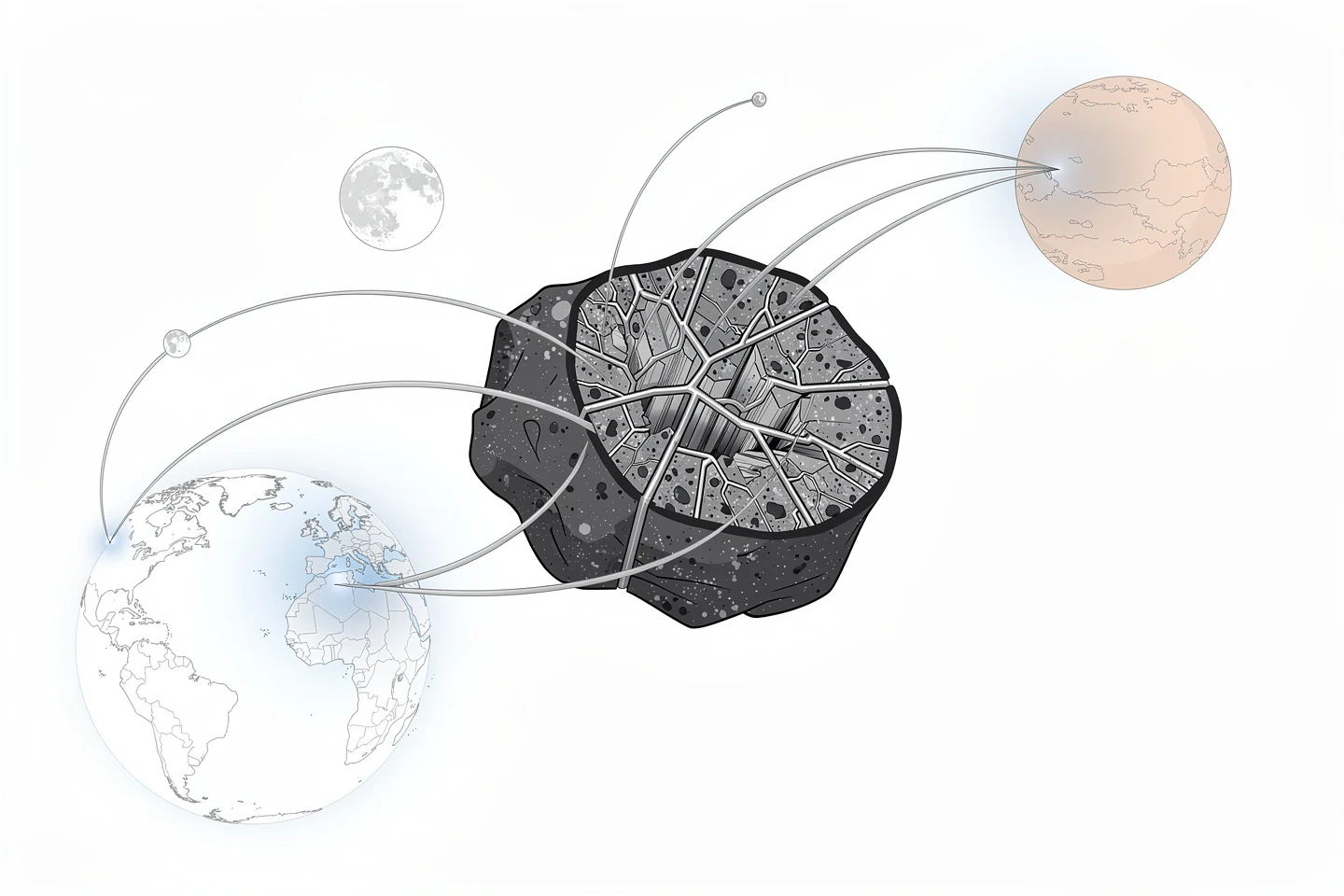
Eight hundred million years ago, in the main asteroid belt, a giant inkwell shattered. The parent body, over a hundred kilometers in diameter, made of primitive carbonaceous chondrites, suddenly broke apart near the J3:1 resonance with Jupiter. Dark as ink, the fragments sprayed in all directions — and a large share of them streamed into the inner Solar System. Thus began the impact downpour, leaving crater-blots on the faces of the planets.
To reconstruct this event, astronomers used an elegant method: Yarkovsky chronology. Heated unevenly by sunlight, asteroids re-radiate heat and receive a microscopic nudge. Over millions of years, this effect, like the quiet but relentless breathing of light, noticeably shifts orbits, with smaller bodies drifting faster than larger ones. By analyzing the V-shaped distribution of orbits, scientists calculated that the breakup occurred about 865 million years ago. Spectroscopic data — color indices like a* — helped filter out interlopers: comet nuclei and asteroids of other types. The foundation for such analysis was laid by Joseph von Fraunhofer, who discovered dark lines in the solar spectrum. That very color index a*, combining photometry data, is like an ink shade that betrays membership in the Eulalia family.
Three-quarters of the fragments ultimately ended up on a resonant conveyor belt that shot them toward Earth, Moon, and Mars. Several bodies the size of the Chicxulub impactor — up to eight kilometers across — crashed onto our planet. The lunar surface was scarred with craters like the 93-kilometer Copernicus. And on Mars, seismic shudders likely awakened volcanoes. Earth's biosphere didn't escape either: the Bitter Springs isotopic anomaly in ancient oceans — a sharp shift in the carbon cycle — may be a direct consequence of the release of carbon dioxide and cosmic dust from multiple impacts. The ink spilled across the pages of planetary history, writing a new chapter.
Decoding these records paves the way for predicting future catastrophes. By comparing the Eulalia downpour to the L-chondrite event 466 million years ago or other major breakups, we can identify patterns in how asteroid bombardments affect climate and life. The hunt for geochemical inks — iridium or osmium anomalies in ancient rocks — will allow us to reconstruct details of ancient impacts. And modeling the atmospheric aftermath will reveal whether such downpours could have plunged Earth into snowball states. Incidentally, even today about a ton of cosmic dust settles on Earth daily — a quiet whisper of ancient catastrophes, reminding us of our vulnerability. Perhaps these inks were not just blots, but punctuation marks in the history of life — points of no return, after which evolution wrote new lines. Ultimately, we are learning to read the chronicle written by impacts from space, so as not to be caught off guard by the next chapter.
The Copernicus crater — one of the most noticeable on the Moon — was possibly created by a fragment of the same parent body as asteroid Bennu, from which OSIRIS-REx delivered soil.
‘Don't Look Up’ compresses a catastrophe into months — we stretch it over millions of years to discern the inevitability of the cosmic threat.