The radiation-dominated era was the earliest epoch of the universe, lasting from shortly after the Big Bang until the universe was roughly 50,000 years old. During this period, the energy density of the universe was overwhelmingly carried by radiation — photons and other relativistic particles — rather than by matter (baryons or dark matter) or dark energy. Because radiation density scales as the fourth power of the scale factor (while matter scales as the third), radiation inevitably dominated when the universe was very small and hot. This era set the stage for nucleosynthesis, the formation of the cosmic microwave background, and the eventual matter-dominated epoch that allowed galaxies to form.
History
The concept emerged from the hot Big Bang model developed in the 1940s by George Gamow and collaborators, and was formalized in the 1960s–70s as the standard cosmological model took shape.
How it works
In the early universe, temperatures were so extreme that particles moved at relativistic speeds, and the energy of individual photons was enormous. The total energy budget was therefore dominated by radiation, which also drove the expansion rate: the universe expanded as t^(1/2) during this era, faster than the t^(2/3) of the later matter-dominated era. As the universe expanded, radiation cooled and its energy density dropped faster than that of matter, so eventually matter took over — a transition that occurred at a redshift of about 3400. The physics of this era is governed by the Friedmann equations, with the radiation term dominating the right-hand side.
In practice
Understanding the radiation-dominated era is essential for interpreting cosmic microwave background anisotropies and for predicting the relic abundances of light elements like helium and deuterium.
Fun fact
During the radiation-dominated era, the entire observable universe was smaller than the Solar System, yet contained more energy than all the matter in today's galaxies combined.
In the first half-billion years after the Big Bang, galaxies grew like crazy. Gas fell in rapidly and collapsed into stars without any resistance. This period is called 'unimpeded star formation.' It's like frying pancakes on a scorching skillet without a lid: splatters fly, but nothing holds them back.
In the big world, there's a simple rule: energy density can't be negative, and its flow can't outrun light. In a café, that would look like this: a waiter can't deliver orders faster than he can run. Physicists call this restriction the energy dominance condition.
But in the microworld, where quanta rule and spacetime can bend, energy starts acting up.
A bright lantern in thick fog seems dim, while a weak flame in clear air can be seen a kilometer away. A similar oddity baffled astrophysicists almost half a century ago.
Boiling water in a pot is a good place to start. Bubbles of steam rise, pop, and the surface settles down. Something similar might have happened in the first moments of the universe's life with a special field filling space: bubbles of a new phase inflated and collided, like islands of steam in liquid.
In 1981, Alan Guth proposed a scenario of cosmological inflation — a lightning-fast expansion of space that stretched quantum fluctuations to the scale of entire galaxies. Since then, cosmologists, like archaeologists, have been excavating this event from the structures of the Universe.
The standard cosmological model ΛCDM, where dark matter and dark energy act as the chief architects of the cosmos, has predicted astronomical data with Swiss-watch precision for decades. Its foundation was laid by three geniuses.
In the first moments after the Big Bang, the universe inflated at an unimaginable rate. This inflation left behind ripples — tiny overdensities in the hot radiation and plasma.
Elliptical galaxies are quiet stellar metropolises in retirement. By all rights, their light should be calm, reddish, like a sunset. But their spectra scream otherwise: in the far ultraviolet, these old-timers blaze like holiday lights. For three decades, astronomers have puzzled over this 'ultraviolet upturn' (UV upturn).
The origin of the hot Big Bang is one of the greatest mysteries. The familiar picture: after inflation, the inflaton field transfers energy to ordinary particles, reheating the Universe. Yet dark matter and dark energy hint that nature has hidden sectors.
Eight hundred million years ago, in the main asteroid belt, a giant inkwell shattered. The parent body, over a hundred kilometers in diameter, made of primitive carbonaceous chondrites, suddenly broke apart near the J3:1 resonance with Jupiter.
A street where houses have just been built. Some shine with clean windows, others are covered in construction dust. That's roughly what galaxies looked like when the universe was only a few hundred million years old. The new James Webb telescope peered into that era and saw dozens of bright star islands.
Just after the Big Bang, clumps weighing as much as a trillion Suns and with an electric charge of colossal strength, like trillions of electrified balloons, could have drifted through space.
Our Solar System isn't an island in the void: it's a sensitive web stretched in a dark cosmic corner. Planets circle their orbits like dewdrops on threads, and we are the spider sensing the faintest tremor. That tremor betrays the approach of the catastrophe astronomers call the Big Rip.
Axions are hypothetical elementary particles introduced in 1977 by Roberto Peccei and Helen Quinn to resolve the so-called strong CP problem in the Standard Model of particle physics.
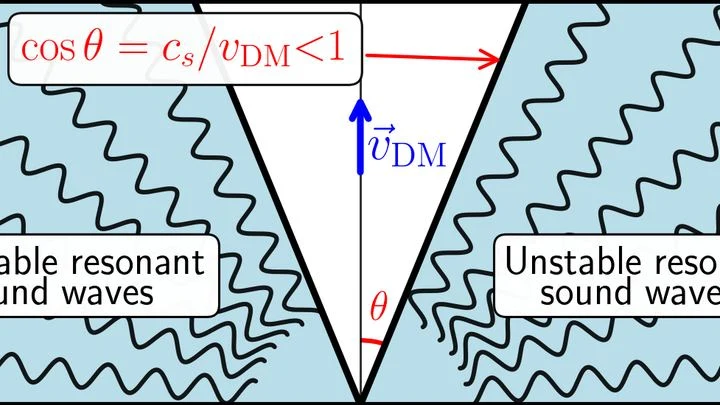
After the Big Bang, dark matter and ordinary matter (mostly hydrogen) went their separate ways in terms of speed. Their gravitational pull acts like a bow gliding across a string: when frequencies match, resonance occurs, and sound waves start to rapidly grow in ordinary matter.
There is something wildly generous about a garden where the first flowers don't just bloom but immediately scatter their seeds far beyond the fence. Something similar was happening in the young universe.
A tiny black hole the size of an atomic nucleus floats in the hot soup of the early universe. Normally, such a little one should quickly evaporate, releasing energy like a drop of water on a hot skillet. But if space is more complex than it seems and contains hidden dimensions, everything changes.
After the Big Bang, the Universe was filled with cold gas — mostly neutral hydrogen and helium. It enveloped the cosmos like a morning fog, impenetrable to light. The Dark Ages began.
When the first galaxies ignited, their radiation, like a searchlight beam, started knocking electrons out of atoms.
For 800,000 years, ice ages have occurred every 100,000 years. The rhythm matches the elongation of Earth's orbit. But the orbit changes the flow of solar heat so subtly — as if the conductor barely moved the baton, yet the orchestra thundered. It remained a mystery how this weak signal controls the ice sheets.
The density at the center of a neutron star is so extreme that a teaspoon of its material would weigh as much as a mountain. Physicists have long tried to figure out how massive such a star can get before it collapses into a black hole.
At the dawn of Earth, about four billion years ago, the planet was a harsh place: a dim sun, frequent asteroid impacts, and air without oxygen. Under such conditions, the first steps of life seem almost impossible.
Neutrinos are tiny particles that barely interact with matter. They pass straight through a star like bullets through fog. When a massive star is gearing up to explode, its core contracts, temperatures soar, and neutrinos start streaming out.
In the mid-20th century, astronomer Vera Rubin discovered that stars on the outskirts of galaxies were moving too fast — held by an invisible mass. Thus the mystery of dark matter was born. It doesn’t emit light but reveals itself through gravity. The big question: why is there exactly as much as we see?
The universe began with the Big Bang and subsequent inflation — a rapid expansion. Alan Guth suggested that in some regions this growth never stopped. They remained ‘underbaked’ pockets of eternal expansion forever.
In the first moments after the Big Bang, the cosmos was like a pot of boiling broth. In it, like lumps of flour, dense clumps of energy — oscillons — curdled and swelled. They grew, gained strength, and soon took over the expansion of the Universe.
Dark matter may not be particles but black holes from the Big Bang era. In the early Universe, which was like a swirling batter, they were like heavy lumps — barely moving, they gathered surrounding matter and spun it into the swift galaxy flows astronomers observe today.
The night sky is full of stars, but they are only a small part of everything that exists in the universe. Astronomers have long noticed a strange thing: galaxies rotate so fast that they should fly apart, yet they don't. Something invisible holds them together, like invisible threads linking beads on a spinning wheel.
This "something" was named dark matter.
By analyzing color indices — the ratio of brightness in different spectral bands in images from the James Webb Space Telescope, astronomers have identified galaxies whose light cuts off sharply in the ultraviolet.
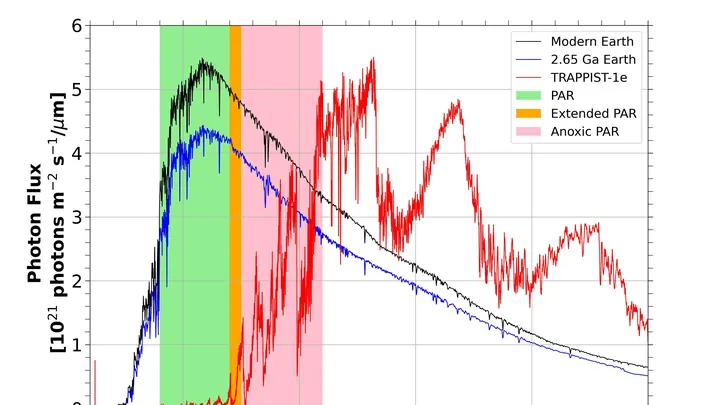
On the exoplanet TRAPPIST-1, oxygenic photosynthesis, the process by which light energy is converted into chemical energy with oxygen as a byproduct, is losing the race for survival. This M-dwarf star emits mostly in the infrared, not in the visible range like the Sun.
After the Big Bang, the universe was hot and dense. In clumps of dark matter, invisible stuff felt only through gravity, its particles, colliding, annihilated, giving birth to powerful radiation. This hidden heat, like an invisible furnace, warmed gas clouds from within.
The night of March 4, 2024. The MeerKAT radio telescope in South Africa catches a millisecond pulse: a fast radio burst coming from a depth of 17.4 gigaparsecs. This is light that traveled 10.5 billion years to reach Earth.
At night over the Siberian taiga, a faint blue light sometimes flickers. It's not the aurora borealis but a cosmic-ray shower: a single particle from deep space slams into the atmosphere and shatters into millions of secondary particles. They race toward the ground in a broad front, like a ripple from a stone dropped into water, and make the air glow.
The ATIC balloon rose over Antarctica and caught particles older than Earth itself. Among them are atomic nuclei from sulfur to chromium, and the higher their energy, the larger their fraction compared to iron. The standard 'leaky box' model predicted the opposite: heavy nuclei should dissolve like salt in water. But the data stubbornly rose.