Simple

How One Shattered Asteroid Showered Three Planets with Debris

Original: "An 800-Million-Year-Old Impact Shower on the Terrestrial Planets from the Breakup of the Eulalia Parent Body"
arXiv:2606.05036v1 · 2026-06-03 · CC BY 4.0 · ⏱ 1 min · Exoplanets
A collision in the asteroid belt sent a swarm of boulders hurtling toward Earth, the Moon, and Mars.
Abstract

Around 800 million years ago, a big asteroid shattered in space like a glass ball. For ages, its rubble rained down on the Moon, carving out giant craters, including the famous Copernicus. Did this celestial smash-up also leave a mark on Earth’s life?

Links in the knowledge graph 1

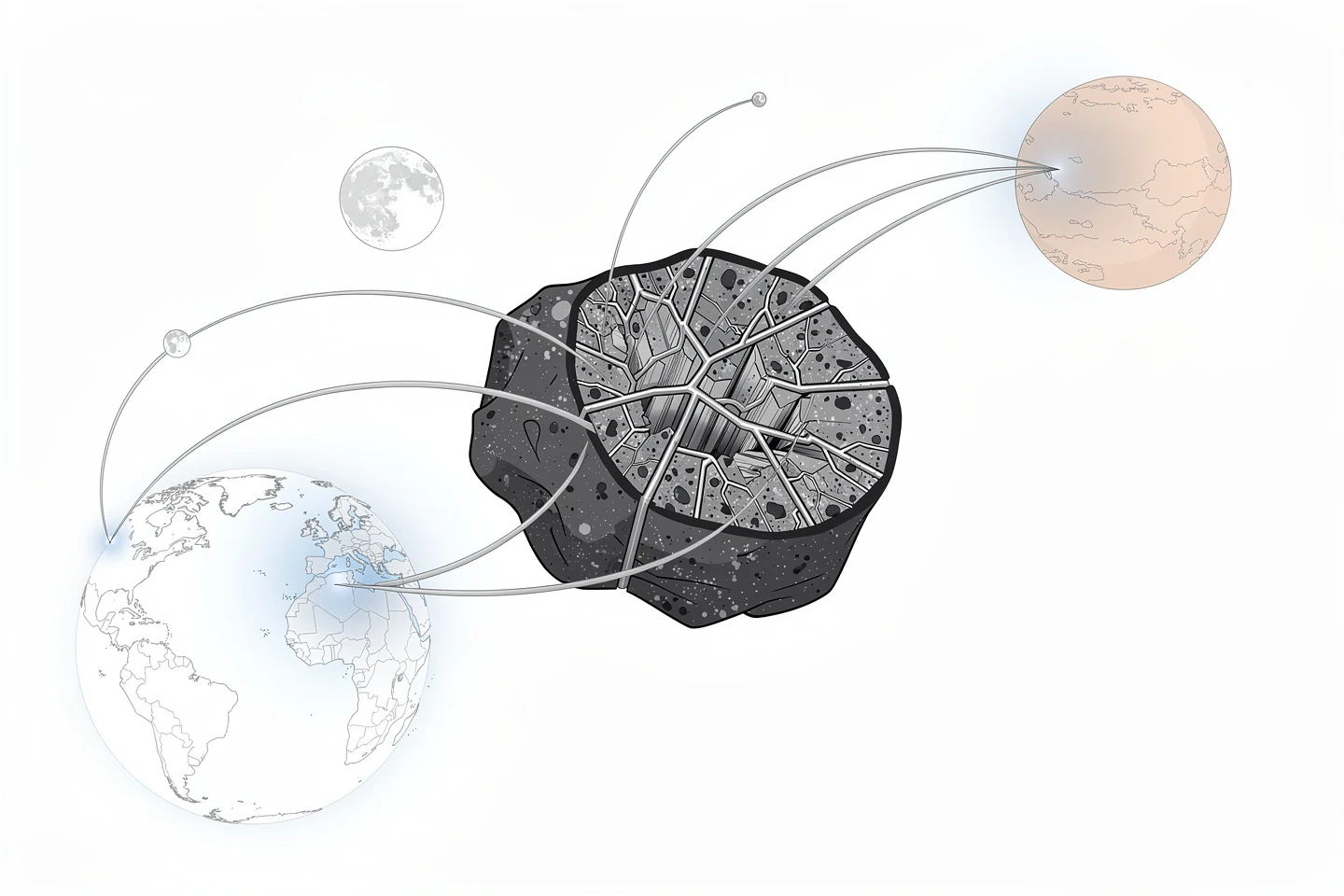
865 million years ago, a collision shattered a city-sized asteroid. Like a building demolition, boulders flew apart as dust blanketed the area. Under the sun's warmth, the fragments drifted slowly until Jupiter's gravity hurled them toward Earth, the Moon, and Mars.

One of these boulders blasted out the Moon's Copernicus crater. Material from asteroid Bennu, delivered by the OSIRIS-REx probe, likely comes from the same family.

The bombardment shook Earth: shockwaves released carbon dioxide, disrupting the ocean's carbon cycle and altering marine life. The Moon gained more craters, and volcanoes on Mars stirred to life. Scientists tell the fragments apart by their reflected light (spectroscopy, the Fraunhofer method) and brightness (photometry); they were once mistaken for comets. Traces of that ancient cosmic dust still settle today. And analysis of Bennu revealed amino acids—perhaps such impacts seeded Earth with organic material.

🎯 The Moon’s Copernicus crater was apparently carved by a fragment from the same parent body as asteroid Bennu, samples of which were brought to Earth.

🎬 It’s like the plot of ‘Don’t Look Up,’ but with a finale stretched over millions of years.

a^* = 0.89(g-r) + 0.45(r-i) - 0.57
This index combines magnitude differences in various filters, highlighting primitive C-type bodies among the multitude of asteroids.
Scientists
Christian DopplerD. B. McLaughlinDidier QuelozMichel MayorR. A. RossiterJames Clerk Maxwell
Tags
asteroid comet cosmic dust carbon dioxide carbon spectroscopy Sun photometry
Laws
Doppler effectMaxwell's equationsPlanck's lawPlanck–Einstein relationWien's displacement lawStefan–Boltzmann law
Original: arXiv:2606.05036v1 · CC BY 4.0 · bridge42worlds