Impact Rain 800 Million Years Ago: How the Breakup of Asteroid Eulalia Changed the Planets ✛ ✦
Context
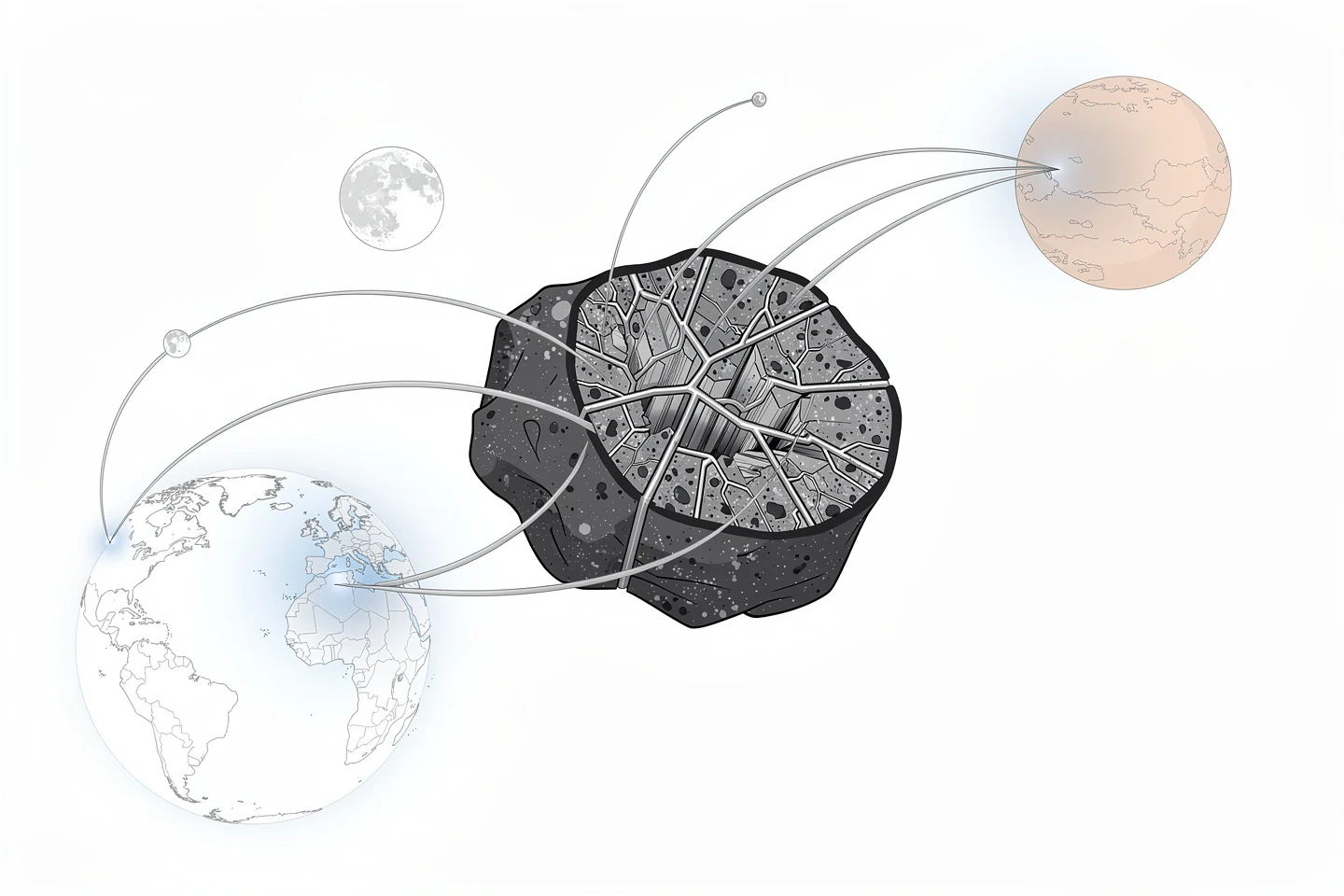
Large collisions in the solar system can radically alter the appearance of planets. A vivid example is the asteroid impact that created the Chicxulub crater 66 million years ago and ended the age of dinosaurs. However, tracing older catastrophes is challenging: Earth's craters are poorly preserved, and lunar evidence is often scattered. The hypothesis of an impact rain around 800 million years ago, first proposed from analysis of impact glasses from the Apollo missions, long lacked a convincing source. Now an international team of scientists has linked this event to the breakup of the parent body of the Eulalia asteroid family—primitive carbonaceous chondrites rich in volatiles. This rain coincided with the so-called Bitter Springs anomaly, a sharp shift in the isotopic composition of carbon in ancient oceans, hinting at a possible influence of the cosmic bombardment on the biosphere.
Methods
To reconstruct the history of the Eulalia family, researchers used a combination of celestial mechanics and observational spectroscopy. Using data from the WISE mission and the Sloan Digital Sky Survey (SDSS), they identified family members by color indices and albedo, filtering out background cometary and asteroidal interlopers. The Yarkovsky chronology method played a key role: thermal radiation re-emitted unevenly by asteroids causes them to drift in their orbits, with the speed depending on size—this effect, predicted long ago by Joseph von Fraunhofer in the context of light-matter interaction, creates a characteristic V-shaped structure in the distribution of orbits. By modeling this drift under solar heating and the YORP effect, along with collisional evolution, the authors estimated the breakup age and the number of fragments entering the 3:1 resonance with Jupiter—the main transport pathway to the inner solar system.
Results
Calculations showed that a parent body over 100 km in diameter broke up about 865 million years ago near the J3:1 resonance. Around three-quarters of the fragments eventually entered this resonance zone: some were ejected immediately, while others migrated gradually via thermal drift (the Yarkovsky effect). As a result, a true impact barrage rained down on the terrestrial planets. Estimates suggest that during the rain several Chicxulub-scale impactors (up to 8 km) struck Earth, fragments capable of creating craters like Copernicus (93 km) hit the Moon, and Mars experienced impactors that triggered a surge in volcanism. Comparison of the modeled flux with photometric data on lunar craters agreed within one standard deviation.
Implications
The discovery underscores that asteroid families are not just passive witnesses of history but active agents. On Earth, the sharp shift in carbon isotopes (the Bitter Springs anomaly) could have been caused by the release of carbon dioxide and dust from multiple impacts, disrupting the carbon cycle. On Mars, the peak in volcanism recorded by photometric dating of calderas was likely triggered by seismic awakening of magma chambers. This makes collisions in the main belt a significant factor in planetary evolution.
Future development
Future research should focus on finding direct geochemical traces of the Eulalia rain in ancient terrestrial rocks, such as iridium or osmium anomalies. Comparison with other large breakups, like the L-chondrite event 466 million years ago, will help build an overall picture of the influence of asteroid catastrophes on climate and life. Modeling the atmospheric effects of cosmic dust and large-body impacts will help quantify the initiation of 'Snowball Earth' glaciations. Additionally, detailed spectroscopic study of Eulalia family fragments will clarify their connection to the asteroid samples from Bennu and Ryugu.
Impact
They also allow calibration of asteroid bombardment models by using analogies with cometary streams, which is important for planetary science, paleoclimatology, and astrobiology.
Next steps
Next steps include drilling into ancient impact structures on Earth and the Moon to extract samples for radioisotope analysis, and launching missions to asteroids of the Eulalia family for direct age measurement.
Key open problems
The work touches on unresolved problems: the link between mass extinctions and impact events, the origin of lunar glasses, and long-term variations in meteorite flux. It also sheds light on the paradox of weak erosion of ancient craters on Earth and Venus.
The knowledge machine's view
This section is addressed to the author of the paper and their colleagues. Neighbouring works were found by meaning-based search across our archive, not by word overlap. We do not review: we show the field around the work.
What the work does
The study links the breakup of the parent body of the Eulalia asteroid family about 800 million years ago to an impact spike on the Moon, Earth, and Mars. Using WISE and SDSS data, the authors identified the family by albedo and color, and applied Yarkovsky drift and collisional evolution modeling to estimate the breakup age and the debris flux into the J3:1 resonance. The resulting flux matches the ages of large lunar craters and may explain the Bitter Springs anomaly on Earth.
Where its strength is
A quantitative link between the dynamical evolution of an asteroid family and specific bombardment signatures on different bodies is a rare example of an end-to-end analysis from source to consequences. Using the Yarkovsky effect for dating and flux estimation provides an independent tool for testing hypotheses.
Where it could go next
- One could compare the predicted debris flux with JWST data on dust disks and signs of recent catastrophes in other systems to assess how typical such events are and what they look like from the outside.based on: Dust Chronicles of Catastrophes: JWST Reveals Secrets of Planetary Smash-ups arXiv:2607.06684
- It is worth considering how a similar mechanism could have operated in the early solar system: work on the origin of Saturn's rings shows that collisional cascades and tidal disruption can produce long-lived debris populations.based on: Saturn's Rings: Trace of a Cosmic Collision arXiv:2602.09281
- It would be interesting to compare with models where passing stars or planets perturb comet and asteroid clouds, causing bombardment episodes: this could provide context for the frequency and intensity of impact showers.based on: Visitors from the Abyss: How Passing Planets Shaped Earth's Fate arXiv:2606.17105
Worth trying
- Check whether such impact showers leave a characteristic isotopic signature (e.g., in osmium or chromium) in terrestrial rocks of the same age.
- Model how a shower of carbonaceous chondrites could have affected the delivery of volatiles and organics to the early Earth.
- Search for a correlation between the ages of lunar craters and peaks in the orbital distribution of current Eulalia family asteroids.
Why this may matter
Such work connects local events in the asteroid belt to global changes on planets, which is important for understanding the evolution of habitability and comparative planetology.
Nearby works in our archive
- Visitors from the Abyss: How Passing Planets Shaped Earth's Fatesimilarity 0.63
- An X-ray flash that heralded a supernovasimilarity 0.59
- The Wind That Snuffs Out Starssimilarity 0.58
- Saturn's Rings: Trace of a Cosmic Collisionsimilarity 0.58
- A Nearby Supernova: Recipe for Rocky Planetssimilarity 0.58
- Cosmic Remelting of the First Rockssimilarity 0.57
- Dust Chronicles of Catastrophes: JWST Reveals Secrets of Planetary Smash-upssimilarity 0.57
The closest work in the archive sits at 0.63 by meaning — the usual level for our corpus.
Original abstract
as written by the authors arXiv:2606.05036v1
Multiple studies have proposed a substantial surge in large lunar impacts approximately $$800$$ million years ago (Ma). Some are based on analyses of the ages of large lunar craters, such as the $$93$$ km Copernicus crater. Others focus on the age distributions of impact glasses returned by lunar missions. A key challenge has been identifying and testing a plausible source for this putative impact spike. Here we use collisional and dynamical models to link this event to the formation of the Eulalia asteroid family, whose primitive carbonaceous chondrite-like parent body disrupted $$\sim 800$$ Ma near the 3:1 mean motion resonance with Jupiter (J3:1). Our simulations indicate that approximately three-quarters of the family's fragments eventually entered the J3:1 over a $$\sim 150$$-million year interval. While some fragments were injected into the resonance immediately after the disruption, others migrated more gradually via non-gravitational (Yarkovsky) thermal forces. Once in the J3:1, the fragments were dynamically transported into the planet-crossing region, leading to an elevated rate of bombardment on the Moon and terrestrial planets. Our results demonstrate that the Eulalia breakup can plausibly account for the observed lunar craters formed near $$800$$ Ma. Intriguingly, this event may also have had widespread repercussions across the inner Solar System. On Earth, its timing coincides with significant shifts in the biosphere, possibly linked to large impacts. On Mars, these impacts might have triggered a pulse of volcanic activity. Together, they showcase how certain catastrophic collisions in the main belt can have far-reaching consequences for the history of the terrestrial planets.
Interestingly, the Copernicus crater, one of the most prominent on the Moon, may have been created by a fragment from the same parent body as asteroid Bennu, from which the OSIRIS-REx mission recently returned samples.
The plot of the film 'Don't Look Up' ironically echoes our work: only here the threat stretched over millions of years, not a few months.
Key numbers
- Breakup age: ~865 million years
- Diameter of parent body: over 100 km
- Size of largest impactor for Earth: about 8 km
- Number of lunar craters aged ~800 million years: 7
- Fraction of family entering resonance: ~75%