A Cold Ensemble of 91 Ions express
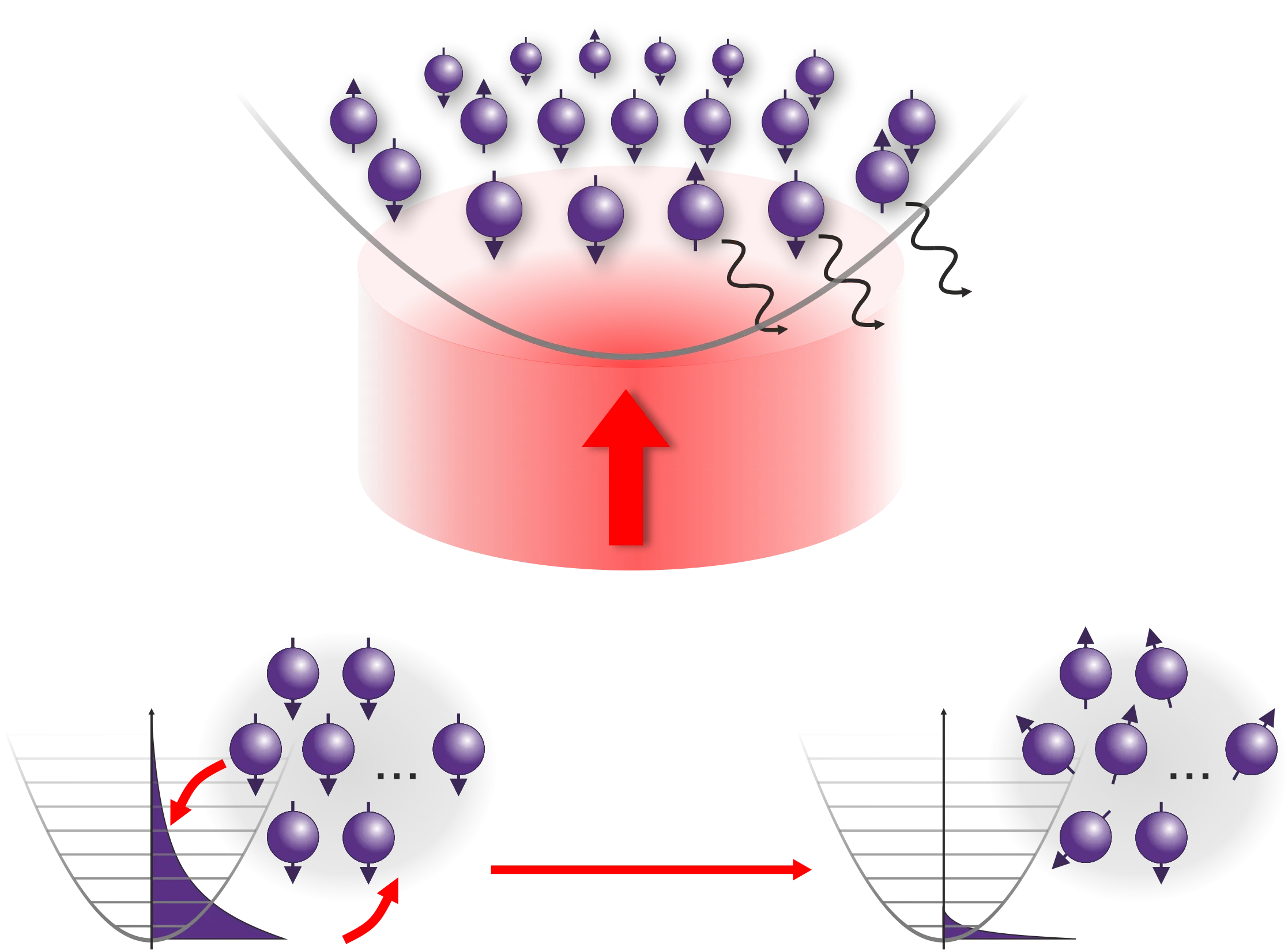
A tiny crystal of charged atoms, trapped in a trap, trembles with heat. Each ion oscillates like a ball on a spring, and these vibrations hinder using the crystal for precise quantum operations. Usually, excess energy is removed with a laser — the beam hits the ions and slows their motion, like a stream of air damping a pendulum.
But when the crystal contains dozens of ions, an unexpected effect emerges. At a certain moment, the laser not only slows the jitter but makes all ions exchange energy with their internal "little magnets"—the spins. This exchange happens so cooperatively that the vibrations of the entire crystal die down all at once. In an experiment with 91 ions, after a single such pulse, the residual heat turned out to be 8000 times smaller than for a single ion. The more ions, the cleaner the result — the dependence goes as one divided by the square of the number of particles.
By repeating the pulses, the physicists brought the crystal to a state where motion almost vanished. Moreover, the behavior of the large ensemble ceased to depend on how exactly the ions jiggled initially — the collective rhythm dominates everything. Such a "dance" can be used as an ultrasensitive sensor: by measuring the spins after the pulse, scientists reconstruct the vibrational pattern without disturbing the ion crystal itself.
The vibrational energy after cooling was so small that if it were converted into the height a grain of sand would rise, it would lift only a few atomic layers.