Invisible Conductors of Galactic Disks express
At the heart of nearly every large galaxy shines an active nucleus — a supermassive black hole surrounded by a flat, rotating disk of incandescent gas. The disk itself flickers, but astrophysicists suspect that within it lurks a whole swarm of small, stellar-mass black holes. They migrate through the gas like pebbles rolling into pits on an uneven surface, getting stuck in special places — migration traps.
The clustering of black holes in a trap acts as an invisible heater. Their gravity perturbs the gas, and magnetic fields in this jostling crowd snap and reconnect, releasing heat. The process is self-regulating: too many holes — some gas gets swept away, and the heating weakens. This gives rise to an additional, chaotic glow of the disk.
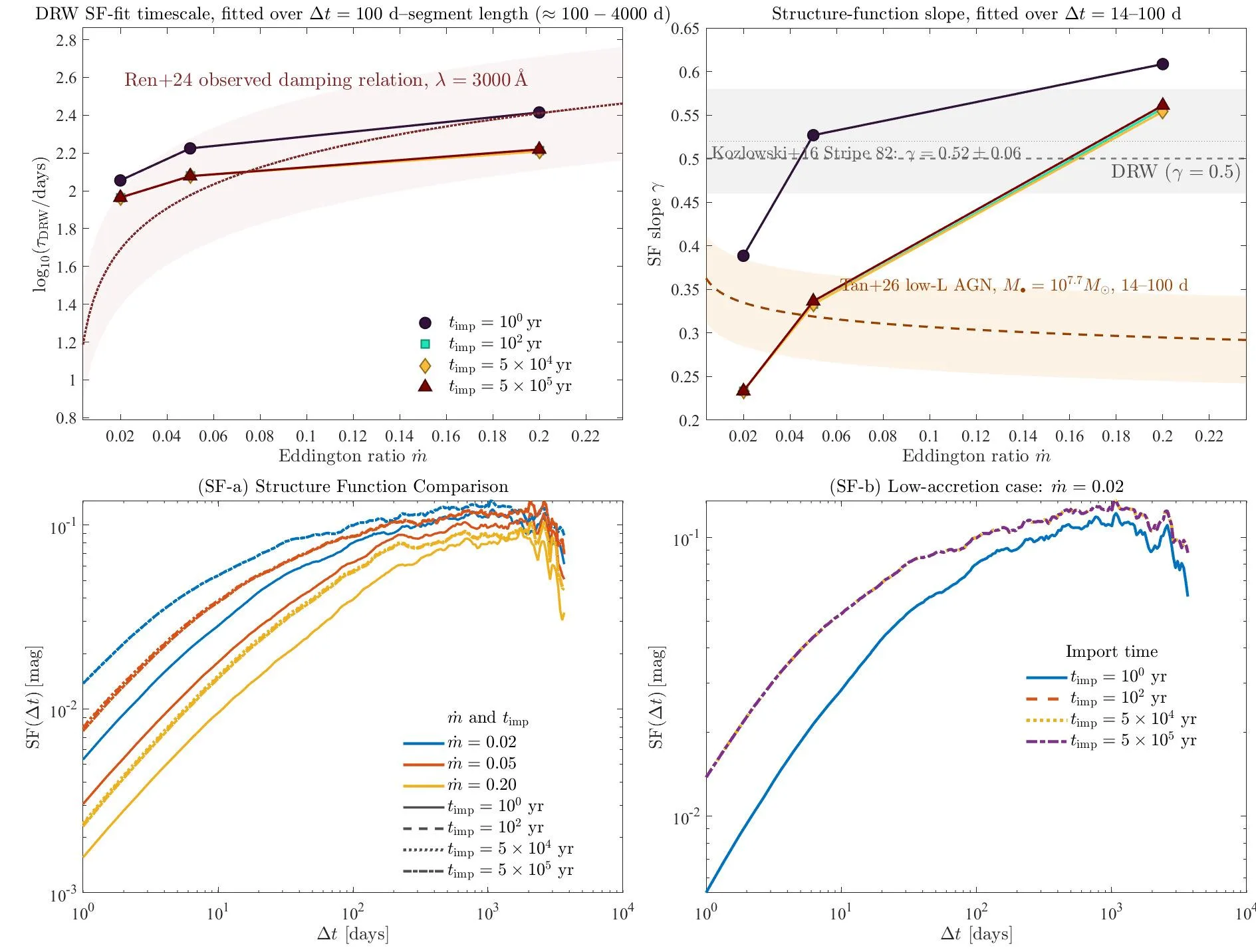
This extra light alters the character of the flickering. Usually, the disk flares and calms down more slowly the longer the radiation wavelength — red light lags behind blue. But hot spots from black holes add fast, short bursts and break this rule. The effect is especially noticeable when the disk is not too bright or hot on its own. Astronomers can catch such "jittery" variability in brightness and obtain indirect evidence that invisible objects are hiding in the disk.
The supermassive black hole at the center of the Milky Way weighs as much as 4 million Suns, and its companion disk could host tens of thousands of small black holes.
In Vernor Vinge's novel "A Fire Upon the Deep," ancient civilizations use the radiation of accretion disks as both a weapon and a means of communication.