Tong Liu

5 articles · 30 co-authors · latest: 2026-08-17
35 citations · h-index 3 · 20 papersData: Semantic Scholar

We have retold 5 papers by this author. most often about: gamma-ray burst, Gamma radiation, supernova. 30 co-authors across our retellings.

Links in the knowledge graph
High Energy2026-02-051 minarXiv:2602.05587express
How a Gamma-Ray Burst Dies
Light fades like a campfire when you stop adding wood. Gamma-ray bursts, the brightest explosions in the Universe, have their own rhythm of fading. Astronomers took 85 such bursts caught by the Swift satellite and looked at how fast their brightness drops. Inside a burst hides a black hole that greedily sucks in matter.
High Energy2026-06-192 minarXiv:2606.21105express
Red Dots in the Early Universe Are Black Holes Seen Edge-On
Imagine a spotlight: if you look at it from the side, it glows dim red, but if you stare straight into it, it blinds you with white-blue light. That, according to new data, is exactly what the mysterious 'little red dots' in the early universe look like. They are giant black holes, objects with gravity so strong that even light cannot escape, turned edge-on to us.
Galaxies2026-06-211 minarXiv:2606.22559express
Invisible Conductors of Galactic Disks
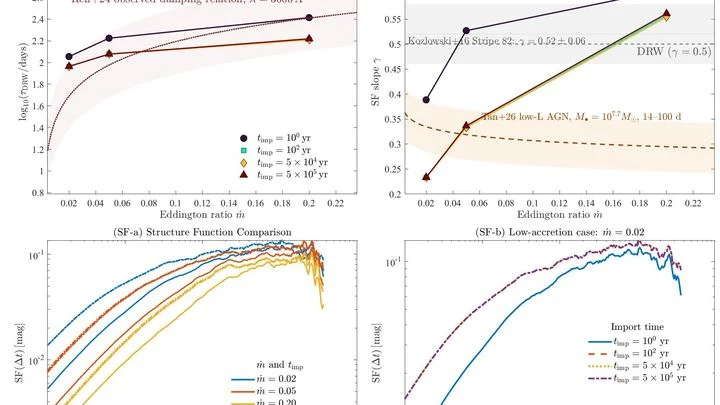
At the heart of nearly every large galaxy shines an active nucleus — a supermassive black hole surrounded by a flat, rotating disk of incandescent gas. The disk itself flickers, but astrophysicists suspect that within it lurks a whole swarm of small, stellar-mass black holes.
Disordered Systems2026-08-051 minarXiv:2608.04762express
Three Fates of Quantum Echo
The quantum world does not forgive forgetfulness. Throw a stone into a pond — the ripples spread and vanish, the information about the impact dissipates without a trace. In quantum mechanics, everything is different: the evolution of a system is reversible, and the past is never completely erased.
Machine Learning2026-08-172 minarXiv:2608.16134express
Brain-Computer Interface: Teaching Machines to Read Minds Day After Day
Every day, the brain sounds a little different. Yesterday, the thought of moving your left hand produced one pattern of electrical waves; today, it's slightly different. For a brain-computer interface (a device that turns mental commands into actions), this is a big problem: yesterday's settings don't work today.