Oxygen Decides Whether Ultrafast Radiation Saves Tissues express
A camera flash that fires in a thousandth of a second doesn't heat the subject — unlike a regular flash that lasts a full second. A similar trick has been found in radiotherapy: when a radiation dose is delivered in milliseconds instead of minutes, healthy tissues suffer less. This is called the FLASH effect.
Cancer cells still die as usual, but the skin or mucosa around the tumor remains almost untouched. For decades, researchers searched for the cause, and oxygen became the prime suspect. It's oxygen that determines how much radiation damages a living cell. With an ultrafast dose to tissue at moderate oxygen levels, the chemistry shifts: instead of aggressive hydroxyl radicals (molecule wreckers), more 'free' electrons form, which are less dangerous.
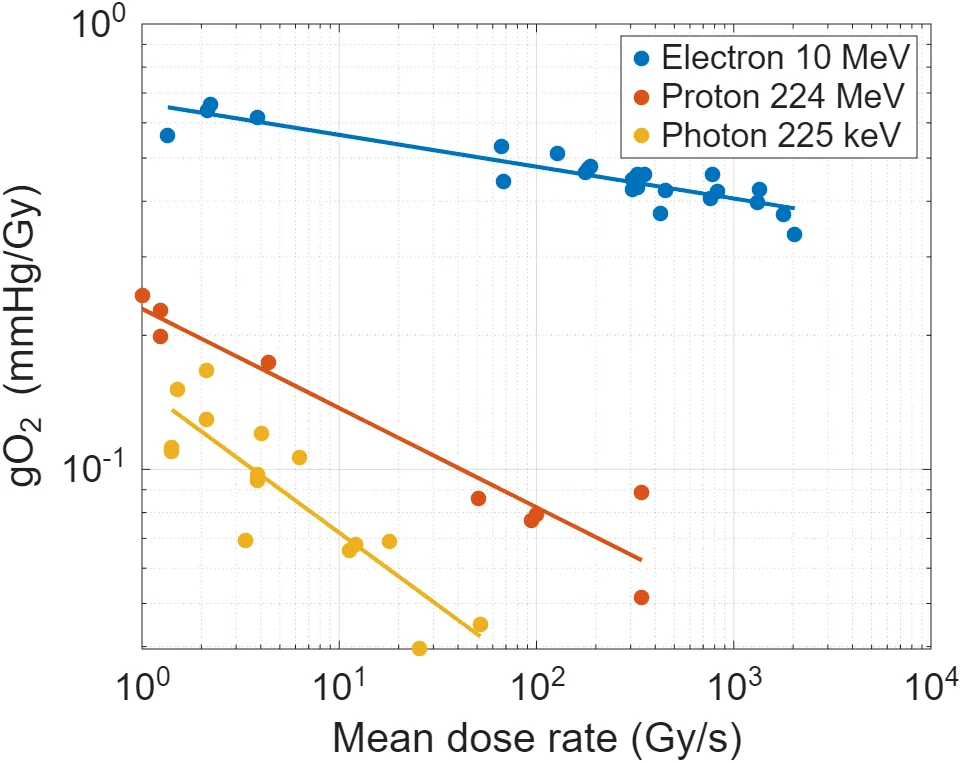
So oxygen fluctuations in and around a tumor could be the key to tailoring treatment. For the first time, researchers measured how fast tissue 'consumes' oxygen right during an ultrafast dose — what was a minute-long consumption becomes a millisecond-long one. Such speed changes the entire picture of radiation chemistry.
Now that it's clear the FLASH effect isn't magic but a precise tuning of oxygen conditions, we can design machines. They will 'see' tissue oxygen saturation and adjust the dose rate individually. That same camera flash, but life-saving.
With an ultrafast radiation dose, tissue consumes oxygen so quickly that a temporary 'oxygen shadow' forms locally, which protects healthy cells.
In Andy Weir's novel 'The Martian,' the protagonist survives thanks to precise oxygen control — here, the same principle governs the fate of cells under the beam.