A Bright Flash from the Universe's Youth express
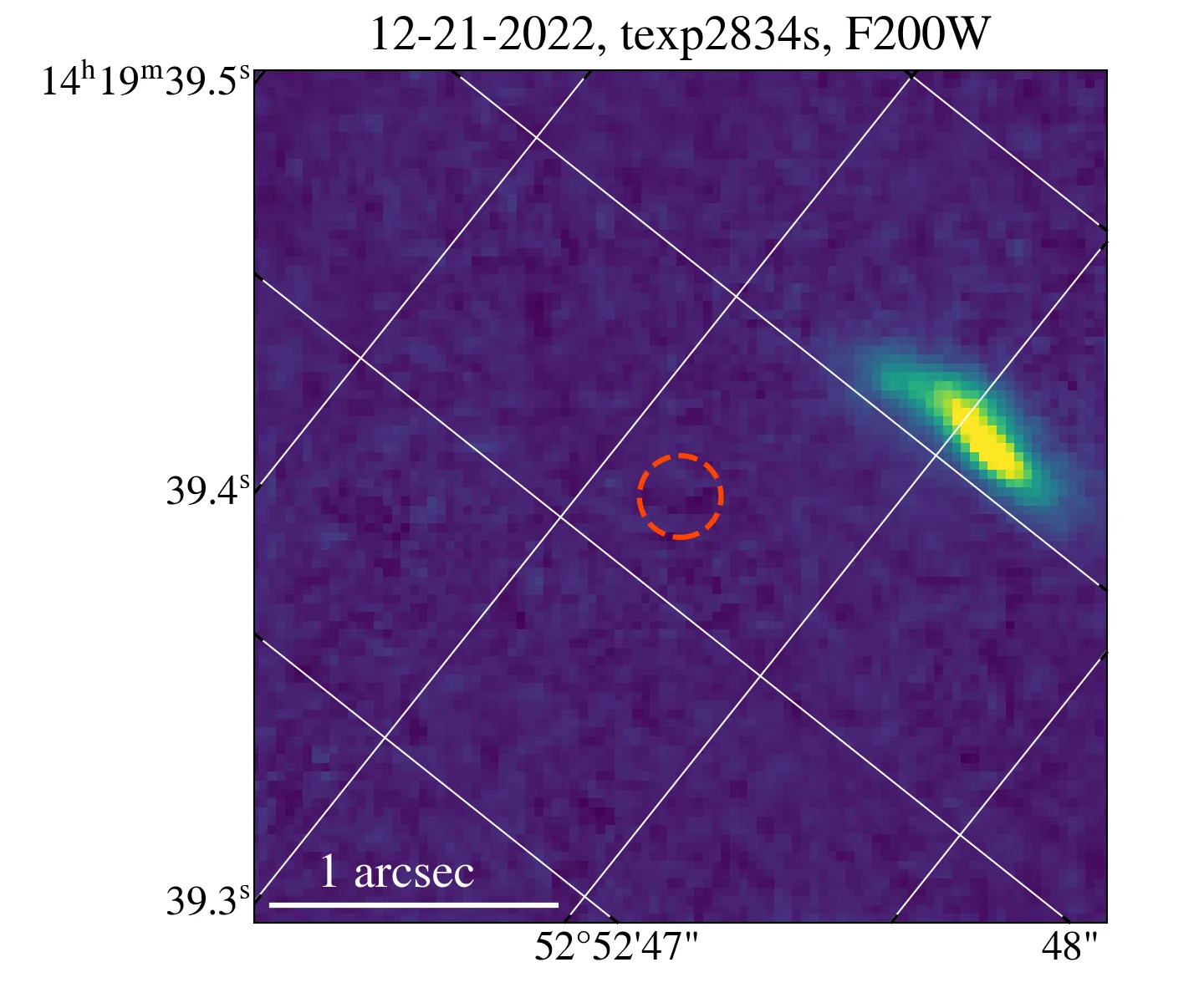
The hunter of ancient light, the James Webb Telescope, aimed its mirrors at a tiny patch of sky and caught a strange beacon. The object, with the working name beacon_1420-$5253_{4770}$, flashed and faded. At first, it was logged as a candidate for the most distant galaxy, as if we were seeing it just 300 million years after the big bang. But galaxies don't behave that way: they don't vanish in an intergalactic blink.
Astronomers tried on different cosmic explosion outfits for the beacon: they compared colors, brightness, how quickly the light dimmed, and the spectral pattern. The best fit was the dress of a Type Ia supernova — not in the familiar nearby cosmos, but at the edge of the observable universe. The distance is such that light took over 12 billion years to reach us. At that moment, the age of the universe was about 1.5 billion years — by cosmic standards, the universe had just left kindergarten.
The most interesting part is the disguise. In the supernova's spectrum, there are powerful absorption lines left by iron and other heavy elements. They carve out a chunk of radiation right where astronomers typically look for the characteristic break in brightness of distant galaxies. Thus, a cosmic explosion pretends to be a galaxy at the edge of the world. The discovery forces a recheck of already found candidates for the most ancient galaxies — maybe some of them are such werewolf flashes hiding in plain sight.
The beacon went dark, but its brief signal illuminated two paths: how quickly thermonuclear explosions ignite in the young cosmos, and how to more carefully search for the true first galaxies.
A Type Ia supernova at its peak shines like an entire galaxy of hundreds of billions of stars, so it can be seen over vast distances.
In Arthur C. Clarke's novel 'Rendezvous with Rama', people notice an object they first take for an asteroid, but it turns out to be something entirely different, a similar story of cosmic disguise.