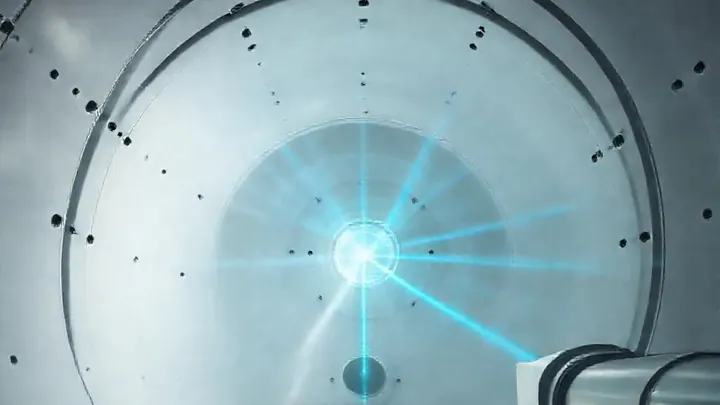
Reverberation mapping is an astronomical technique used to measure the size and structure of the region around a supermassive black hole at the center of an active galaxy. When the black hole's accretion disk emits a burst of light, some of that light travels directly to Earth, while some is absorbed by surrounding gas clouds and re-emitted as a delayed echo. By measuring the time delay between the direct light and the echo, astronomers can determine the distance of the gas clouds from the black hole. This technique has been crucial for measuring the masses of supermassive black holes and for understanding how they grow and interact with their host galaxies.
History
The technique was first proposed in the 1970s, with early theoretical work by Bel and Done, and later developed into a practical tool by Bradley Peterson and others in the 1980s and 1990s. It has since become a standard method in extragalactic astronomy.
How it works
The method relies on the fact that light travels at a finite speed. When the central source flares, the light from the flare reaches Earth first. The light that illuminates the surrounding clouds takes a longer path, so the re-emitted light arrives later. By monitoring the brightness of the galaxy's continuum (from the disk) and the brightness of the emission lines (from the clouds) over time, astronomers can cross-correlate the two light curves. The time lag between them corresponds to the light travel time from the black hole to the clouds. This gives a direct measurement of the radius of the broad-line region, which, combined with the velocity of the gas (from the width of the emission lines), yields the black hole mass via the virial theorem.
In practice
Reverberation mapping is used to measure the masses of supermassive black holes in thousands of active galaxies, which is essential for studying the co-evolution of black holes and their host galaxies.
Fun fact
The time delays measured are typically on the order of days to weeks, meaning that astronomers must observe the same galaxy repeatedly over long periods, often using dedicated monitoring campaigns with multiple telescopes.
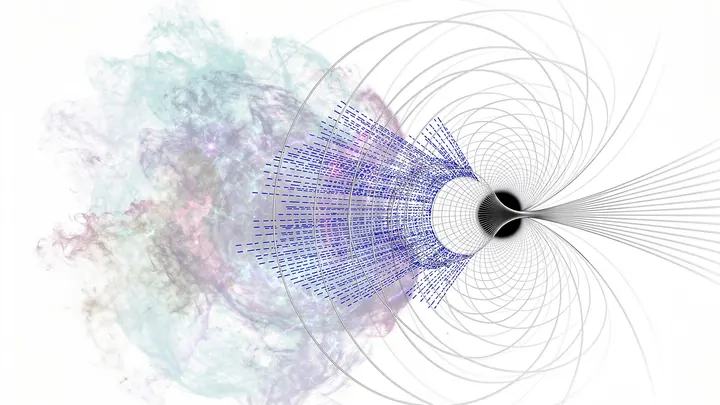
Radio waves from a distant pulsar travel through the interstellar medium, encountering invisible magnetic structures the size of the distance from the Sun to Earth. One such structure is a current sheet, where the magnetic field abruptly changes direction, like a compass needle flipping from north to south.
Six runners sprint down the track, and officials time their speed without noticing a tailwind. The wind blows at their backs, and the stopwatches show a better result than the truth. Roughly this is how six megamasers — natural cosmic lasers in distant galaxies — misled astronomers measuring the expansion rate of the universe.
You could send a short radio pulse toward a black hole and wait for the reflected echo. Intuitively, the shorter the signal, the better it would probe the finest details of spacetime right at the horizon: that region from which even light cannot return.
In the dark outskirts of our Galaxy, far from bright star clusters, millions of black holes lurk. They are invisible: they don't shine and don't noticeably accrete matter. Conventional search methods, designed for dense stellar fields, are useless here. A different approach is needed.
Astronomers have proposed using the very fabric of space as a detector.
A galaxy collision is like a slow dance in which two partners gradually draw closer. Hidden at the center of each is a supermassive black hole — an invisible flywheel with a mass of millions or billions of suns.
A black hole is a place from which nothing can escape. But some theories allow that deep inside, at the quantum level, it might bounce and turn into its opposite — a white hole, which only spews out matter and light.
A group of physicists built a computer model of such a transformation.
A swarm of tiny invisible particles, like a cloud of pollen, drifts through space. A black hole sits in its path. Some particles fall in and vanish forever; others swing around the trap and fly away. The physicists built a map showing exactly how much matter gets swallowed and how much survives.
Fast radio bursts — millisecond radio pulses arriving from distant galaxies — long remained a puzzle. Their colossal energy, compressed into instants, pointed to cataclysms on neutron stars, perhaps pulsars or magnetars.
At the center of galaxy M87, 55 million light-years away, lurks a black hole with a mass of 6.5 billion Suns. In 2019, the Event Horizon Telescope (EHT) gave us its first portrait: an orange donut with a dark core. But the donut is not the abyss itself.
A black hole is not a frozen void, but a living magnetic engine. Its 'heart'—the accretion disk, pulsates: inhale, matter spirals into the funnel, exhale — magnetic reconnection tears the field lines, and plasma shoots away from the horizon.
A powerful spotlight flickers on and off. Light reflects off surrounding clouds, and by measuring the delay of the reflected signal, you can figure out how far away the clouds are. That's roughly how astronomers study the hot corona — a scorching cloud of plasma above the black hole at the center of an active galaxy.
But there's a catch.
The merger of two black holes is the most powerful explosion in the Universe, yet we cannot see it. We only catch the shudder in spacetime — gravitational waves that carry information from the heart of the cataclysm. In December 2025, the LIGO detectors registered event GW250114.
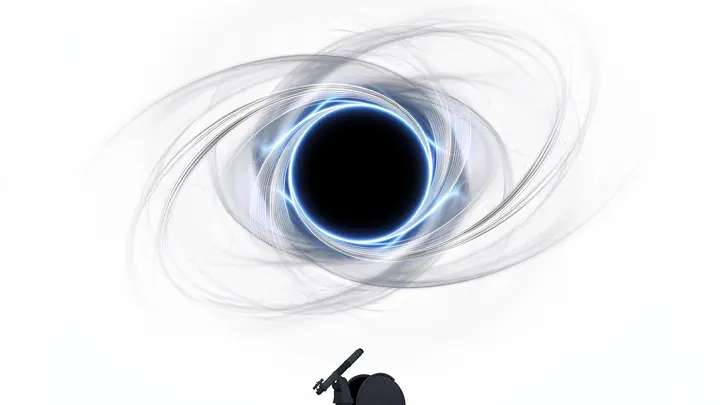
Light passing by a black hole swirls like water down a bathtub drain. The most intriguing part is the thin ring where rays can orbit forever, neither falling in nor escaping. This is the photon sphere — an invisible boundary that paints the hole's shadow on the sky.
An acoustic black hole is a fluid flow faster than sound, so sound waves can't escape. The boundary, the surface where the flow speed reaches the speed of sound, spawns pairs of phonons: sound quanta, one flying away, the other plunging inward.
After a merger, the newborn black hole emits a fading tremble — gravitational waves, similar to a ringing bell. By analyzing the overtones of this signal, spectroscopy can determine its mass and spin rate.
A giant black hole tore apart a star, leaving behind a lopsided disk of scorching gas — like a vinyl record warped by the heat. Now a tiny black hole (or a star) zips around and repeatedly pierces that disk. Each puncture is a bright X-ray flare.
Black holes come in lightweights, born from dying stars, and supermassive ones at galactic cores. The missing intermediate link had been hiding. Fast radio bursts, cosmic signals lasting milliseconds but carrying the energy of days of sunlight, helped crack the case. Think of these bursts as cries from the depths of the universe.
Dark matter is the great cosmic invisible. It neither emits, absorbs, nor reflects light, yet its gravitational grip is felt in every motion of galaxies. Seventy years ago Vera Rubin showed that the outskirts of galaxies rotate too fast — as if spurred on by an unseen shepherd.
Place two identical alarm clocks on a table and set them off at the same time. If one is on a slippery surface and starts to slowly slide, its timing will be thrown off, and within a minute they'll ring out of sync. That's roughly how the new method proposed by astrophysicists for supermassive black holes works.
Photographing the vicinity of a black hole is like shooting a fountain: a short exposure freezes the droplets, a long one blends everything into blurry streaks. Light from the superheated gas swirling around the hole reaches us along different paths. Some rays curve around it in an arc, others make multiple loops due to spacetime curvature.
A black hole is invisible, but it's betrayed by light from superheated matter swirling nearby. That light is like a double agent: on one side of its orbit, it blueshifts as it races toward us; on the other, it redshifts as it recedes.
When a massive star exhausts its fuel, the core collapse can spawn a supernova and a neutron star, but with enough mass, nothing halts the crush — a black hole is born.
In 2019, the Event Horizon Telescope gave humanity the first image of a black hole shadow — a fiery ring around the abyss at the center of galaxy M87. This gravitational self-portrait, painted by the light of infalling plasma, instantly became an icon of modern astrophysics.
A huge pond, with ripples spreading from two heavy stones circling each other. The stones draw closer, the ripples become more frequent and stronger, and soon the stones will collide. Gravitational waves are like those ripples, but not on water — in the very fabric of spacetime.
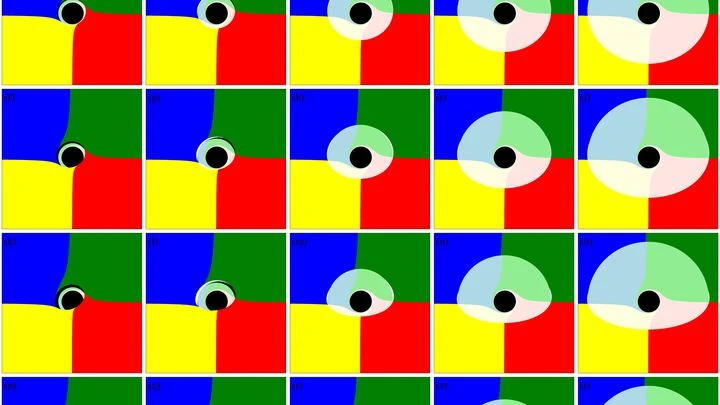
A black hole is not just a dark sphere in space. If there is gas and dust nearby, they swirl into a flat, glowing disk that gradually falls inward. This disk acts like a lamp, illuminating the hole itself, and against the bright background you can see its shadow — a dark silhouette with sharp edges.
But what if the disk is not flat but torn into pieces?
When two supermassive black holes circle each other before merging, they shake spacetime itself, like a speedboat racing across a lake leaves waves in its wake. These waves are called gravitational waves. They travel through the Universe and pass through everything, even the Earth.
When two black holes merge, space shudders with gravitational waves, and the newborn hole receives a powerful kick, like a cannon recoiling. In the centers of galaxies, it often slams into a gas disk — a swirling cloud of matter, like a cosmic bullseye.
A pebble dropped in a pond creates curved ripples, but from far away they appear as straight lines. Gamma-ray flashes from an evaporating black hole behave the same: a distant burst sends flat waves, while a nearby one arrives curved.
Images of distant galaxies are riddled with curved arcs and smears — light warped on its way to us. This effect, predicted by Albert Einstein, acts like a giant funhouse mirror: a massive galaxy cluster distorts the images of background sources.
If a supermassive black hole lives at the center of a galaxy, it heats the infalling gas to incredible temperatures. That gas glows, and we see it as a quasar — the brightest beacon in the universe. But how do you measure the size of the light source itself?
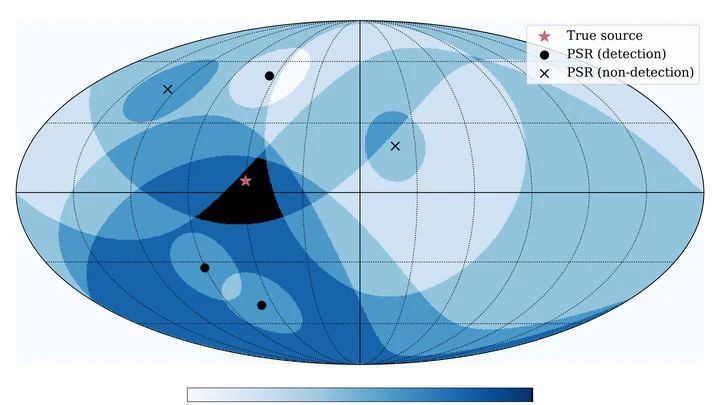
Imagine the hum of a crowded square (that's what the gravitational wave background of the Universe sounds like, as detected by a network of pulsars) neutron stars that emit regular radio pulses with the precision of atomic clocks.
At the center of our Galaxy lurks the supermassive black hole Sagittarius A* — a heavyweight that holds stars in its grip. Astronomers dream of finding pulsars near it: these cosmic lighthouses emit radio pulses with the precision of atomic clocks.
In the 2010s, astronomers noticed something remarkable: supermassive black holes at the centers of galaxies, despite vast differences in size and brightness, fall onto a single straight line when you plot their millimeter emission against X-ray emission and mass.
If you briefly flash light near a black hole, it will respond with a long echo, like a bell that keeps ringing after being struck. The light gets trapped near the hole, bouncing repeatedly off an invisible boundary: the photon sphere, where rays circle around like sound in a metal.
A black hole merger gives birth to a gravitational wave. Sometimes the wave’s path is blocked by a galaxy or a clump of dark matter, predicted by Zwicky and discovered by Rubin.
Primordial black holes, hypothetical objects that emerged in the first instants after the Big Bang from the collapse of superdense fluctuations, should have vanished long ago according to Stephen Hawking's classic prediction: they would completely evaporate via quantum radiation, much like a puddle of…
The Universe is filled with invisible mass, dark matter, which reveals itself only through gravity. One hypothesis suggests that dark matter consists of primordial black holes — objects formed in the extreme conditions just after the Big Bang.