Locked Up Forever: How Physicists Measured the Force That Holds Quarks express
The proton is not a solid ball but a tiny prison. Inside it, three quarks are locked up, and the gluon field keeps them from escaping — something like invisible threads that only grow stronger if the quarks try to move apart. For a long time, this property, known as confinement, remained almost mystical: it was observed in experiments, but the force acting on each quark could not be directly measured.
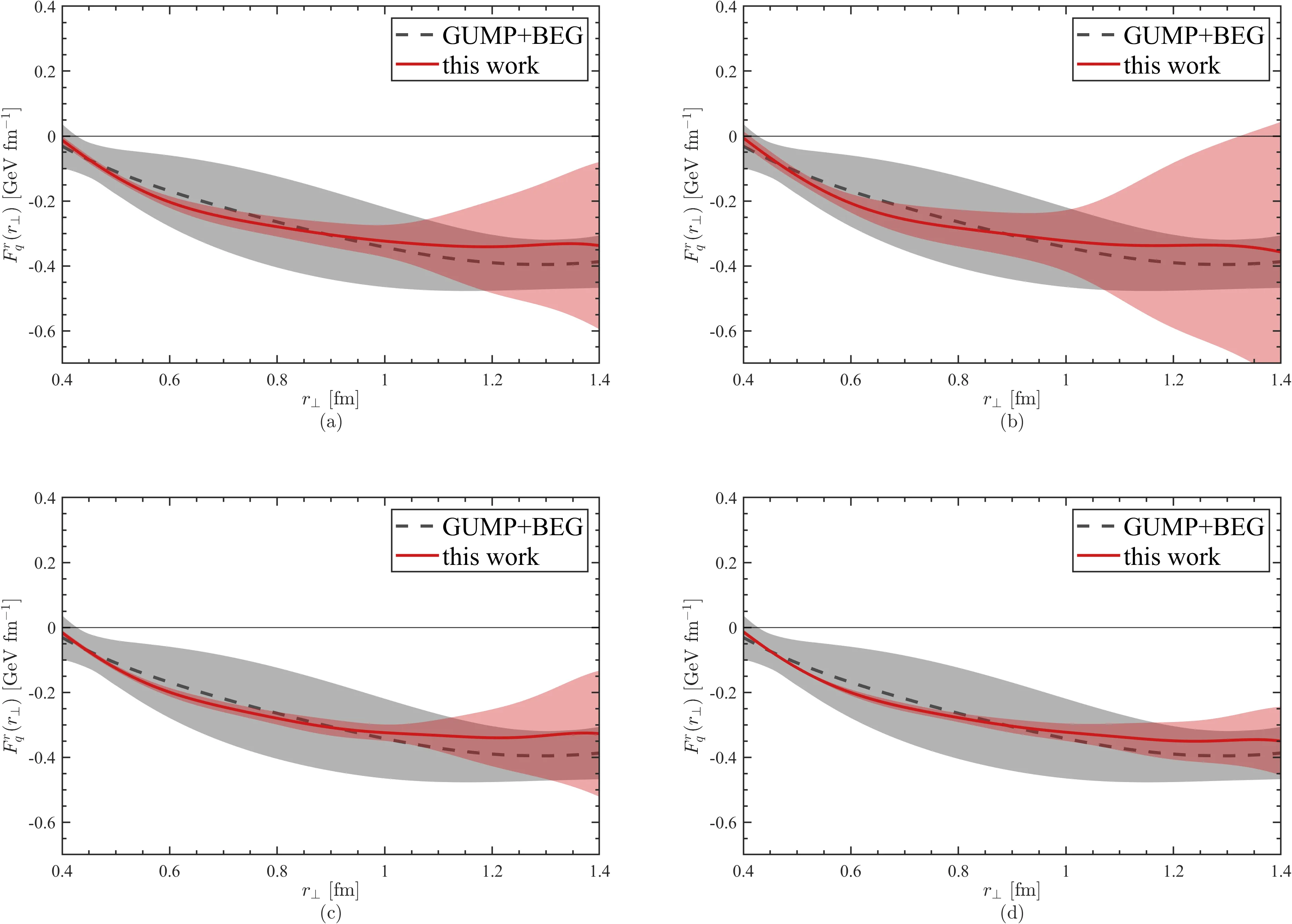
Recently, a group led by Xiangdong Ji proposed a way to estimate it, and obtained the first convincing numbers. In the new work, the authors improved the calculation. They incorporated results from so-called light-cone sum rules of quantum chromodynamics, like using readings from an additional instrument where ordinary accelerator data and lattice calculations are too imprecise. They also reformulated the problem: instead of fitting the answer to a pre-selected formula, they reconstructed the force as a blurred image — using a regularized inverse problem (a method that removes noise). This reduces dependence on assumptions.
This is not just a test of an idea. Confidence that confinement indeed works through a linear potential brings us closer to understanding the strongest bond in nature. And with future, more precise collider data, the uncertainty of the calculation could be reduced severalfold — making the 'photograph' of the proton's interior even sharper.
Original abstract
as written by the authors arXiv:2607.21952
Quark confinement, the fact that colored quarks are permanently bound inside color-neutral hadrons and have never been observed as isolated particles, remains one of the central issues of the Standard Model. Recently, Ji et al.\,\cite{Ji:2026lyj} proposed a framework to define and measure the force on quarks in the proton, obtaining strong evidence for a net confining force and thus opening a new perspective on the study of confinement. In this work, we improve this analysis by incorporating light-cone QCD sum rule results to supplement the limited experimental and lattice QCD information in the large-$$|q^2|$$ region. We further formulate the reconstruction of the quark force as a regularized inverse problem, thereby reducing the model dependence associated with the prescribed functional parametrizations used before. The resulting quark force provides a complementary, less parametrization-dependent determination and remains consistent with that implied by a linear QCD potential, which also supports the robustness of the framework proposed in Ref.\,\cite{Ji:2026lyj}. We also show that improved future inputs can substantially reduce the uncertainty in the reconstructed quark force.
If a quark could be pulled out of a proton, the energy expended would immediately create a new quark-antiquark pair, and the lone quark would again find itself confined, but in another particle.