Laser vs. Time Machine express
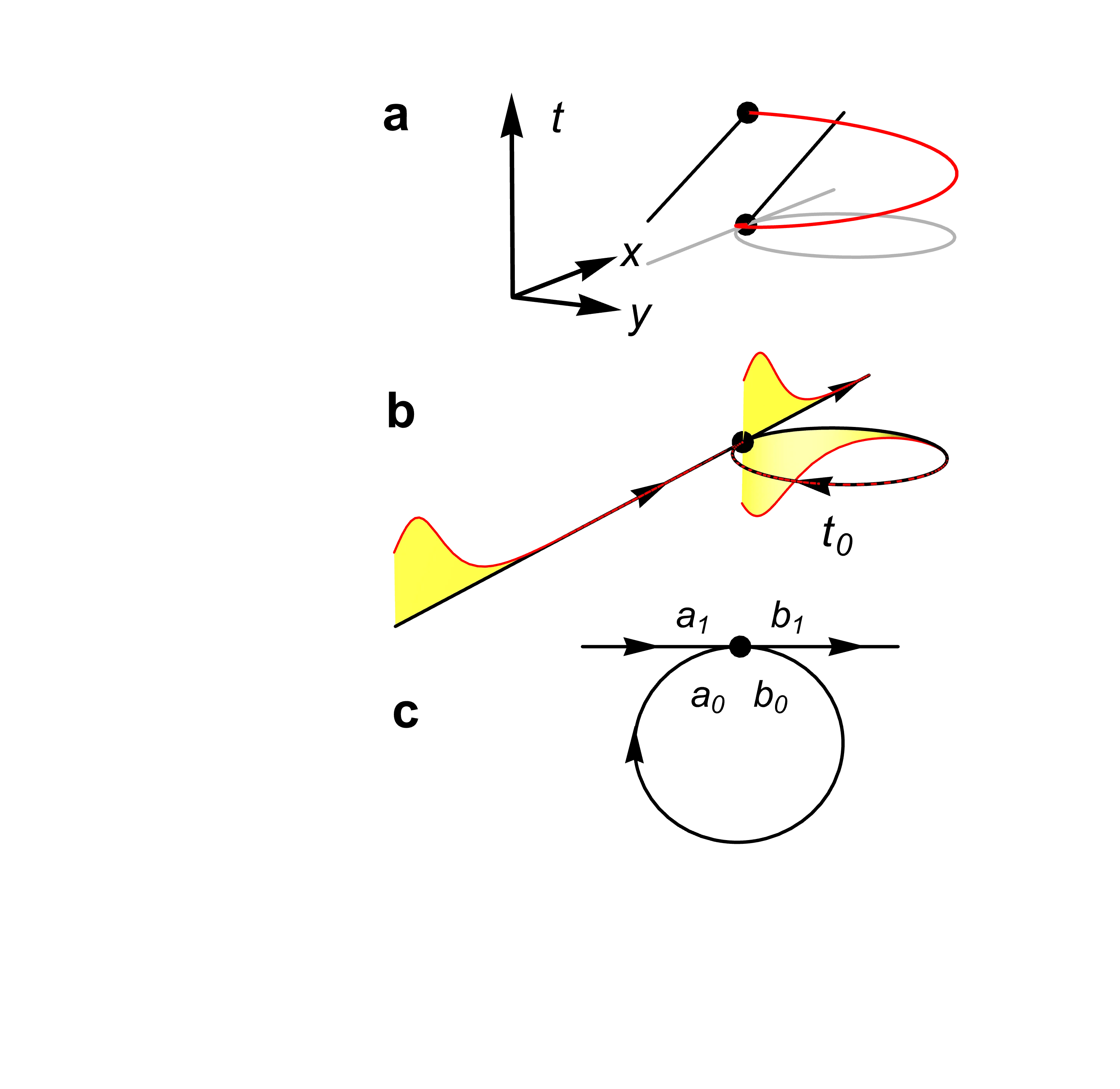
General relativity, which describes the structure of the universe, does not forbid closed timelike curves. But Stephen Hawking put forward the 'chronology protection' conjecture: quantum effects should destroy such curves, making time travel to the past impossible.
A new experiment proposes to test this idea using a laser. In it, light passes repeatedly through a gain medium, just as a hypothetical particle might loop around a closed timelike curve. The key point: above the lasing threshold, spontaneous emission (random flashes of light) is greatly amplified. These quantum fluctuations create a noise barrier that, according to calculations, makes time travel impossible.
The scheme relies on the connection between light amplification and the curvature of spacetime. In a laser, amplification creates conditions similar to those near a closed timelike curve. By measuring noise below the lasing threshold, one can observe the fundamental limit imposed by quantum mechanics. Thus, a lab device becomes a window into the physics of wormholes and time machines.
Original abstract
as written by the authors arXiv:2607.22056
Classical general relativity allows time travel, but Hawking [Phys. Rev. D 46, 603 (1992)] conjectured that quantum mechanics ultimately prevents it. Here we propose a feasible experiment to test Hawking's Chronology Protection Conjecture in optics. In this scheme, time travel is inherently related to lasing, and the amplified vacuum fluctuations above laser threshold establish the quantum limits of time travel
The idea that quantum fluctuations might destroy time loops is similar to how random interference in a radio receiver drowns out a weak signal. Only here, the 'interference' is a fundamental property of the vacuum that cannot be eliminated by any improvement in equipment.
The plot of the film 'Primer' revolves around the accidental discovery of time travel, and it is precisely quantum instability that could explain why it is so hard to control.