Quantum First Aid for Power Grids express
An electrical grid stuffed with power electronics resembles a huge orchestra without a conductor. Each converter, each line adds its own note, and sometimes the instruments start playing out of tune. Resonances emerge — invisible oscillations of current and voltage that can spiral out of control and bring the system down. The conductor needs to find the dangerous frequencies urgently, before the storm breaks. But the score for such a grid is a giant table of numbers (the admittance matrix) that doesn't fit in a classical computer's memory.
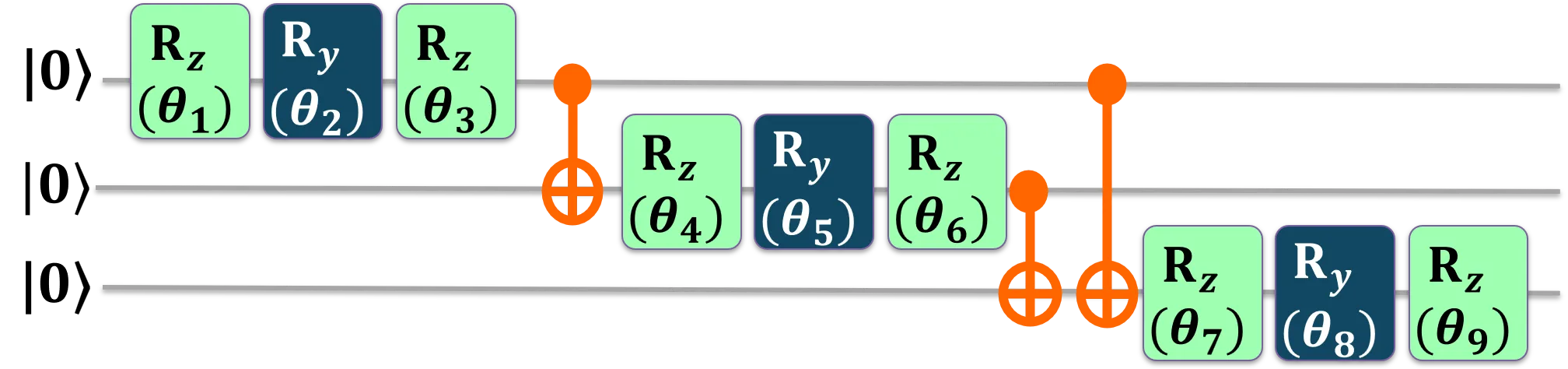
The traditional method, resonance modal analysis, requires repeatedly dissecting this table at every frequency step. As the grid grows, the computational load explodes. Classical algorithms drown in numbers. The authors propose handing the score to a quantum processor. It stores data not in bits but in qubits, shrinking the grid size logarithmically: a grid with a million nodes is described by just a few dozen qubits. It's like fitting a symphony onto a single page.
Tests on a standard 5-node system showed nearly perfect agreement with the classical benchmark. The quantum calculation identified the same critical frequencies as the time-tested method. Now the orchestra can not only be heard, but dangerous notes can be spotted in advance on the quantum score. This is not just a lab trick — the architecture is ready to scale. Continental grids that are currently beyond analysis could gain reliable protection from hidden electrical storms.
Original abstract
as written by the authors arXiv:2607.29582v1
The proliferation of power electronics in multi-terminal transmission grids has increasingly led to harmonic distortions and dynamic instabilities. While Resonance Mode Analysis (RMA) provides deep insights into these system resonances, evaluating the critical modes of large-scale grids presents a severe computational bottleneck. Classical iterative techniques must continuously diagonalize massively high-dimensional, non-Hermitian admittance matrices across a wide frequency spectrum, a process that rapidly exhausts classical memory and processing limits. To overcome this scaling barrier, we propose a novel quantum-classical hybrid methodology that natively maps the transmission grid's admittance matrix onto a Quantum Processing Unit (QPU). Because the grid's matrix is non-Hermitian, standard quantum eigensolvers are insufficient; thus, we employ the Real Variance-based Variational Quantum Eigensolver (RVVQE) algorithm to accurately extract the complex eigenvalues that represent the system's modes. Validated against a standard 5-bus transmission system, the quantum-derived critical-resonance modal impedances demonstrate near-perfect alignment with the exact classical frequency responses. Crucially, by encoding the grid's state logarithmically into quantum memory, this methodology bypasses classical RAM limitations. The successful implementation of the RVVQE framework not only bridges the mathematical topologies of dissipative electrical grids and open quantum systems but also provides a profoundly scalable architecture capable of diagnosing resonance instabilities in massive, continental-scale networks that currently exceed classical computational boundaries.
The modern power grid is one of the largest machines ever built by humanity. Its state is described by matrices with millions of rows and columns, and searching for resonances without quantum tricks is like sifting through every grain of sand on a beach to find one colored grain.
In Isaac Asimov's novel 'The End of Eternity,' technicians manipulated time using immensely complex calculations. Quantum analysis of power grids is a step toward controlling electricity with the same finesse.