Quantum Translator: From Atomic Language to Fiber-Optic express
The quantum networks of the future resemble the Tower of Babel: each node speaks its own dialect. Some store information in the polarization of a photon — the direction of oscillation of the light wave. Others use time bins: that is, when exactly the pulse arrives. And the wavelengths are completely different: atoms emit in the visible range, while optical fiber transmits infrared better. We need a universal translator.
Physicists have built such a bridge. A single calcium ion (⁴⁰Ca⁺) emits a photon at 854 nm, entangled with the ion's state. First, a quantum frequency converter shifts this photon to the telecom C-band—1550 nm. Here, attenuation in glass is minimal. Then an interferometer, similar to a Mach–Zehnder setup, converts the polarization qubit into a temporal one. Information about the direction of oscillation becomes information about which path the photon took — the short or the long one.
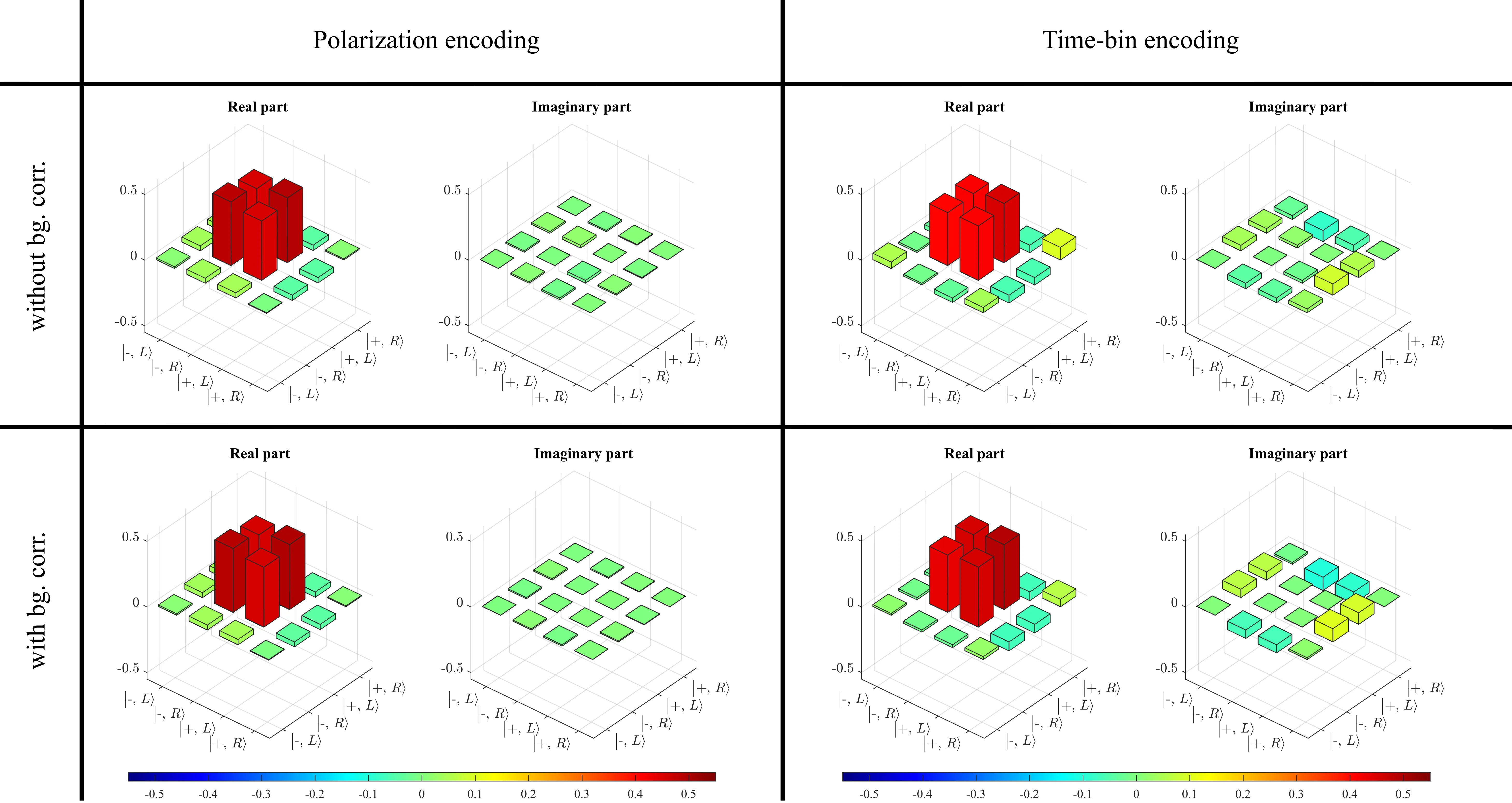
The final touch is quantum tomography. It reconstructs the full picture of the state and confirms that entanglement is alive. This technology will allow connecting atomic quantum memories directly to fiber-optic lines, without bulky intermediaries. The bridge between worlds has been built.
Original abstract
as written by the authors arXiv:2607.29609v1
A key enabling feature of future quantum networks is interoperability between platforms that operate at different wavelengths and with different qubit encodings. We demonstrate an interface that converts atom-photon entanglement from polarization encoding at an atomic wavelength to time-bin encoding in the telecom C-band. Atom-entangled photons at 854 nm are generated from a single $$^{40}$$Ca$$^+$$ ion. After quantum frequency conversion to 1550 nm, the photonic polarization qubit is converted into a time-bin qubit using a fiber-based Mach--Zehnder-like encoder. Full quantum tomography of the final state verifies that the process preserves entanglement with 96.3(4.2)% fidelity. Together with the independent work of Ferrari et al. [arXiv:2607.07805 (2026)], this is the first demonstration of polarization-to-time-bin conversion of photons entangled with a single atomic quantum memory. The telecom-compatible interface enables robust qubit transmission over optical fibers and provides a key building block for heterogeneous quantum networking architectures.
The 1550 nm wavelength is not chosen by chance: it is here that optical fiber has minimal losses — about 0.2 dB/km. Light traveling 15 km through such a cable will be attenuated by only half.