Mountains on Neutron Stars: How Magnetic Fields and Accretion Shape the Terrain ✛
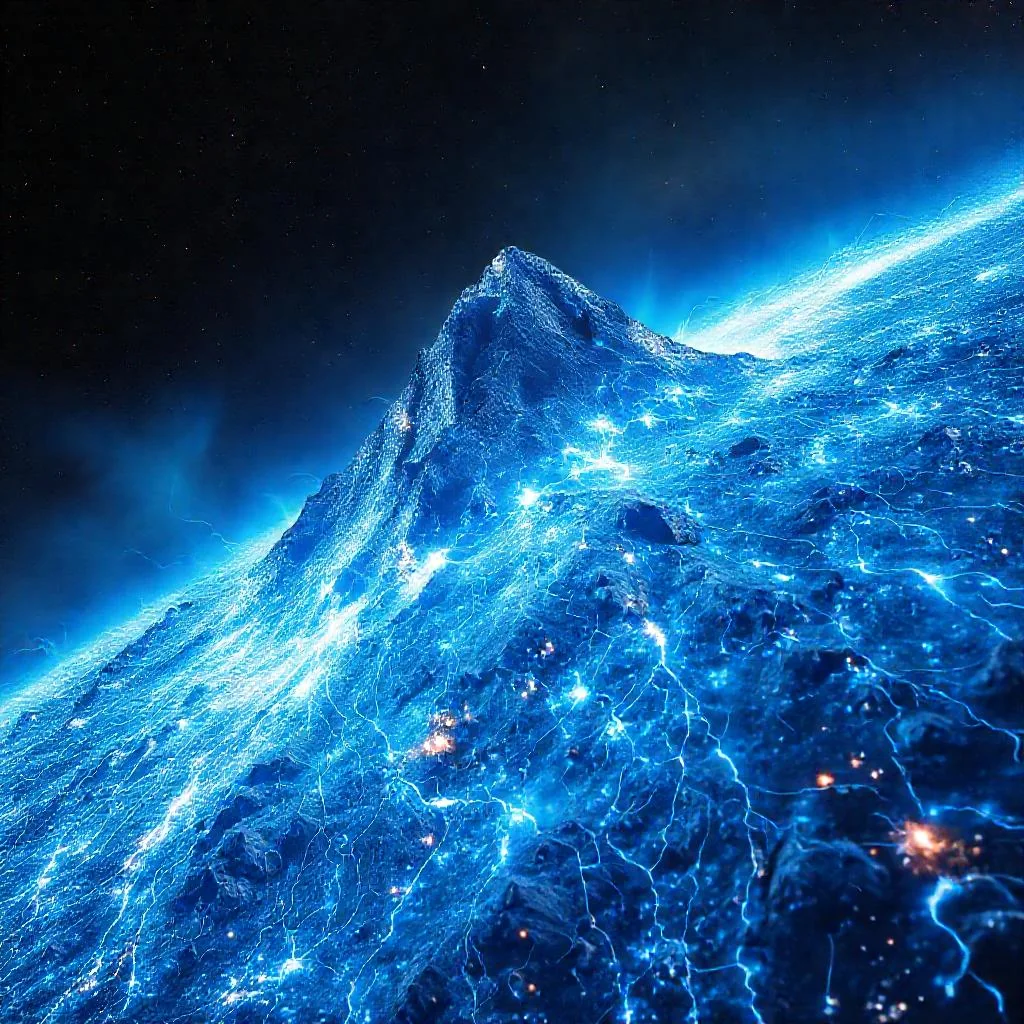
A sculptor shapes mountains from magnetic fields and heat, but the stone resists. A neutron star, the ultra-dense remnant of a supernova explosion, in a binary system pulls matter from its companion star. This infalling matter heats the star's crust unevenly, while the magnetic field tugs from within. Together, they create deformations: tiny "mountains" on the surface, causing the star to emit gravitational waves — ripples in spacetime.
Until now, these effects were considered separately: some models accounted only for magnetic stresses, others only for heating, and still others only for crustal elasticity. The new work for the first time brings them together into a single picture. The authors built a model of a neutron star with a mass of 1.4 solar masses, consisting of a liquid core, an elastic crust, and an ocean. The magnetic field is assumed to emerge from the poles, and its influence is accounted for via the force acting on charged particles. Crustal heating is calculated from heat transfer equations, including nuclear reactions.
The maximum deformation the crust can withstand corresponds to an eccentricity of about 7×10⁻¹¹. That's like a bump less than a millimeter high on a sphere with a radius of 12 kilometers — a perfectly polished billiard ball. Such "mountains" cause the star to emit continuous gravitational waves, but their amplitude is below the sensitivity of current detectors LIGO, Virgo, and KAGRA.
However, future third-generation detectors, such as the Einstein Telescope or Cosmic Explorer, will be able to hear them. The results will help select targets for searching for gravitational waves from neutron stars in low-mass X-ray binaries. The sculptor continues its work, but now we know how magnetic fields and heat shape the terrain on the hardest surface in the Universe.
The maximum deformation that a neutron star crust can sustain corresponds to a "mountain" less than a millimeter high on an object with a radius of 12 kilometers, like a bump on a perfectly polished billiard ball.