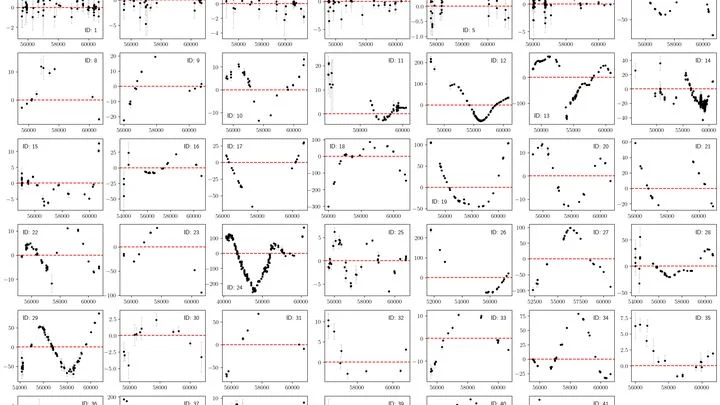
Transit timing variation (TTV) is a subtle but powerful observational technique in exoplanet science. When a planet transits its host star, the exact time of the transit can be measured with high precision. If another planet in the system gravitationally perturbs the transiting planet, the transit times shift slightly — earlier or later than a strictly periodic schedule. These variations, often of minutes to hours, encode information about the masses and orbits of the perturbing bodies, even if those bodies never transit themselves.
History
The first detection of TTVs was reported in 2010 for the system Kepler-9, using data from the Kepler space telescope. The theoretical framework was developed earlier, notably by Agol et al. and Holman & Murray in 2005.
How it works
The gravitational interaction between planets causes their orbits to deviate from perfect Keplerian ellipses. The transiting planet's orbital period and phase change over time, leading to a cumulative shift in transit times. By modeling these TTVs, astronomers can infer the mass and orbital parameters of the unseen perturber. The effect is most pronounced when the planets are in or near mean-motion resonances, where the gravitational tug is amplified.
In practice
TTV is used to discover and characterize exoplanets in multi-planet systems, especially low-mass planets that are hard to detect via radial velocity. It has also been used to measure the masses of planets in resonant chains like TRAPPIST-1.
Fun fact
TTV can sometimes reveal the presence of a planet that never transits, acting as a 'gravitational fingerprint' of an invisible world.
An atomic gravimeter works like a very precise scale for gravity: it tosses up a cloud of atoms and watches how fast they fall. But these instruments have a hidden flaw — the shape of the signal they produce is slightly skewed. This skew, like a ruler with a chipped edge, subtly shifts every measurement.
Two faint embers circle each other in the dark so closely that one begins to tear glowing chunks off the other. That is the picture of the system ZTF J1239+8347, caught by the Zwicky Transient Facility telescope.
Double stars lose speed like a figure skater who slows their spin by extending their arms. In a close pair, one star transfers mass onto a white dwarf. The magnetic field of the donor star, consisting mostly of hydrogen, entangles the outflowing gas and flings it away, as if the skater's arms were pulling the spin outward.
Eclipses in binary stars are like clockwork: a white dwarf (the dense remnant of a star) regularly passes in front of its companion, and the light briefly dims. But for most such pairs, the clock runs fast or slow by seconds over years. Astronomers measured these glitches in 43 systems and found a pattern.
When a planet approaches its star to a critical distance, tidal forces, the result of a sharp gradient in gravity between the near and far sides of the celestial body, tear it apart. This process ignites a cosmic funeral pyre: the planet's debris forms a glowing accretion disk around the star.
Cosmic rays are like a downpour pelting from all sides. But when the wind blows, the droplets change direction. In the same way, a solar storm, a cloud of magnetized gas from the Sun, bends the paths of these particles that normally rain down on Earth evenly. Cosmic rays are invisible messengers from distant galaxies.
In the vast darkness of interstellar space, the rogue planet WISE 0855 flickers with a barely perceptible heat glow, like a cooling ember. Its temperature is only a few dozen degrees above freezing — if life existed there, it would see a sunless sky, in an eternal icy haze.
Four hours and fifty-eight minutes. With a rhythm like a metronome, something passes in front of the white dwarf ZTF J1944+4557, dimming its light by a third, sometimes almost by half.
The three planets in the Kepler-51 system have long intrigued astronomers: they are Saturn-sized but less dense than water. These 'super-puff' worlds, with masses no more than ten Earths, are like cosmic dandelions — massive yet almost weightless. Their orbits are arranged like musicians in an orchestra, each playing its part, beating the rhythm with transits.