Mars Salt Crystals as Daytime Shelters for Water ✛
Context
Modern Mars poses a paradox for astrobiology: periods of high relative humidity coincide with the lowest temperatures, while warm daytime hours are extremely dry. Around this problem, our archive has gathered works on subsurface life, radiation fuel, Martian ice, and the search for water in rocks. This article stands somewhat apart: it does not seek water in the deep subsurface or in ice deposits, but proposes a mechanism for retaining microscopic moisture in the very top layer of the soil, inside salt crystals already found on the surface.
Methods
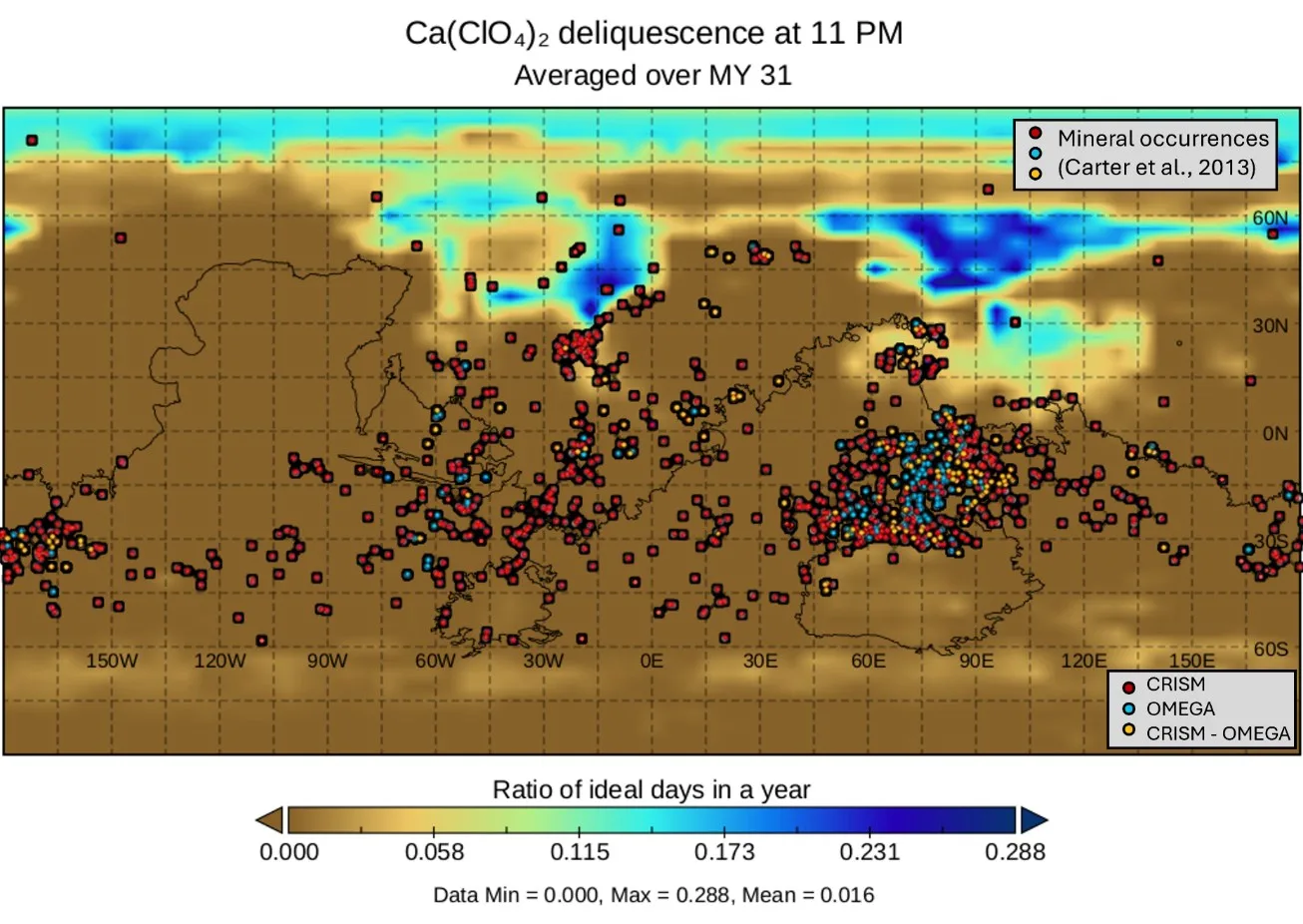
The authors calculated the volume change of salt crystals under daily temperature swings from 150 to 300 K. For NaCl, they used tabulated values of the volumetric thermal expansion coefficient and numerical integration via the trapezoidal rule. For gypsum and two polymorphs of MgSO₄, they used X-ray diffraction data on unit-cell volume changes. Deliquescence potential was assessed using data from the LMDZ GCM global climate model for Martian year 29: relative humidity over liquid and ice was computed at 2-hour intervals, and moments were selected when it exceeded the deliquescence threshold for Ca(ClO₄)₂ and CaCl₂ but did not reach ice nucleation conditions.
Results
The relative volume change of NaCl between 150 and 300 K is 1.64%. For gypsum, it is 0.87%, for α-MgSO₄ 0.50%, and for β-MgSO₄ 0.57%. For CaCl₂ solutions, the calculation gives 3.75% to 6.9% depending on concentration. Such changes can open and close microcracks in crystals. Deliquescence modeling shows that for Ca(ClO₄)₂, favorable conditions occur in the southern part of Acidalia Planitia, at some points up to 17–20% of sols per year, corresponding to 100–130 sols per Martian year. For CaCl₂, the region of possible deliquescence is narrower but also concentrated near Acidalia. Direct data on the thermal expansion of hydrated calcium perchlorates are lacking, so the authors consider the estimates for Ca(ClO₄)₂ preliminary.
Implications
The work offers a concrete physical mechanism that could explain how microscopic liquid water is retained in the near-surface layer of Mars during daytime hours. Unlike neighboring studies that consider either nighttime brine formation or radiation protection at depth, this one combines thermal expansion of salts with their ability to absorb moisture. If the mechanism is confirmed, salt crystals would become priority targets in the search for potentially habitable micro-environments on present-day Mars.
Future development
The topic could develop toward laboratory experiments with Martian analog salts under controlled temperature and humidity swings. Direct measurements of thermal expansion coefficients for hydrated calcium perchlorates and other hygroscopic salts will be needed. A separate direction is modeling water vapor transport through partially closed cracks to assess how long brine can persist inside a crystal.
Impact
The results are important for planning future life-detection missions on Mars and for interpreting data on salt and humidity distribution in the near-surface layer.
Next steps
Immediate next steps include measuring the thermal expansion of hydrated perchlorates in the laboratory and testing crack-closure rates under daytime heating in a chamber simulating Martian conditions.
Key open problems
For astrobiology, the key unresolved problem is whether liquid water can exist on present-day Mars long enough and at sufficiently high temperatures to support metabolism. This work links that problem to the physics of salt thermal expansion and proposes a testable mechanism for moisture retention. The question remains open whether organisms can survive the high ionic strength of perchlorate brines and low water activity.
The knowledge machine's view
This section is addressed to the author of the paper and their colleagues. Neighbouring works were found by meaning-based search across our archive, not by word overlap. We do not review: we show the field around the work.
What the work does
The authors address a paradox of present-day Mars: by day it is too dry for liquid water, and by night too cold for life. They propose a mechanism in which hygroscopic salts absorb moisture at night, and in the morning thermal expansion closes cracks in the crystals, trapping the brine until warmer times of day. Calculations for NaCl, gypsum, and magnesium sulfates show volume changes of 0.5–6.9% under daily temperature fluctuations. The climate model points to the southern part of Acidalia Planitia, where conditions for salt deliquescence occur 100–130 sols per year.
Where its strength is
The work combines thermal expansion of salts with their hygroscopicity, offering a concrete physical mechanism for retaining microscopic moisture in the near-surface layer. This sets it apart from neighboring studies that consider either nocturnal brine formation or radiation shielding at depth.
Where it could go next
- It might be interesting to compare the proposed mechanism with data on subsurface life that uses radiation as an energy source: if water is retained within salt crystals, radiation-chemical processes could also occur there, supporting microbial communities.based on: Mars's Subsurface Life: Radiation as Fuel arXiv:2606.23483
- Closely related is work on ionic liquids as alternative solvents: one could consider how low-eutectic salts (e.g., perchlorates) might form stable liquid phases at Martian temperatures, expanding the habitable window.based on: Ionic Liquids on Rocky Exoplanets: Life Without Water arXiv:2508.08437
- It would be interesting to test how the thermal expansion mechanism relates to observations of Martian ice at shallow depths: if ice is present in the soil, its daily phase transitions could influence crack dynamics in salts.based on: Martian Ice: A Find Just a Meter Deep arXiv:2602.18847
Worth trying
- Conduct laboratory experiments with NaCl and CaCl₂ crystals, simulating the diurnal temperature and humidity cycle, to measure actual volume changes and test whether cracks close.
- Use high-resolution data (e.g., thermal maps with 12-meter resolution) to identify sites in Acidalia where diurnal temperature swings are maximal and could amplify the effect.
- Assess how the presence of other salts (e.g., perchlorates) in the mixture affects the thermal expansion coefficient and deliquescence threshold, using thermodynamic models.
Why this may matter
If the mechanism is confirmed, salt crystals would become priority targets in the search for potentially habitable micro-environments on present-day Mars, potentially reshaping the strategy of future life-detection missions.
Nearby works in our archive
- Martian Ice: A Find Just a Meter Deepsimilarity 0.57
- Why a Tent on Mars Beats a Full-Blown Planetary Makeoversimilarity 0.57
- Martian Waves in Unisonsimilarity 0.53
- Mars's dense layer reveals the fate of rocky planetssimilarity 0.52
- Rogue Moons: Warmth Without a Starsimilarity 0.52
- Ionic Liquids on Rocky Exoplanets: Life Without Watersimilarity 0.52
- Mars's Subsurface Life: Radiation as Fuelsimilarity 0.51
The archive is sparse around this work: the closest review is only 0.57, against a usual 0.64. It looks like few have drilled nearby.
In the Atacama Desert, one of the driest places on Earth, cyanobacteria live inside halite crystals and obtain moisture precisely through salt deliquescence at night, when air humidity rises.
Key numbers
- NaCl volume change: 1.64%
- gypsum volume change: 0.87%
- CaCl₂ solution volume change: 3.75–6.9%
- favorable sols in Acidalia: 100–130 per Martian year
- daily temperature swing: 150–300 K