Ionic Liquids on Rocky Exoplanets: Life Without Water ✛
Context
The search for habitable worlds has long been limited to planets where liquid water can exist on the surface. However, many known exoplanets are too warm for water or have too thin an atmosphere. Alongside this work, the archive hosts studies on hydrogen atmospheres of scorching planets, rogue moons, magma oceans, and AI-driven exoplanet searches, all touching on the diversity of conditions on rocky bodies. This paper goes further: it proposes a concrete chemical mechanism that allows a surface to stay wet, but with ionic liquid rather than water.
Methods
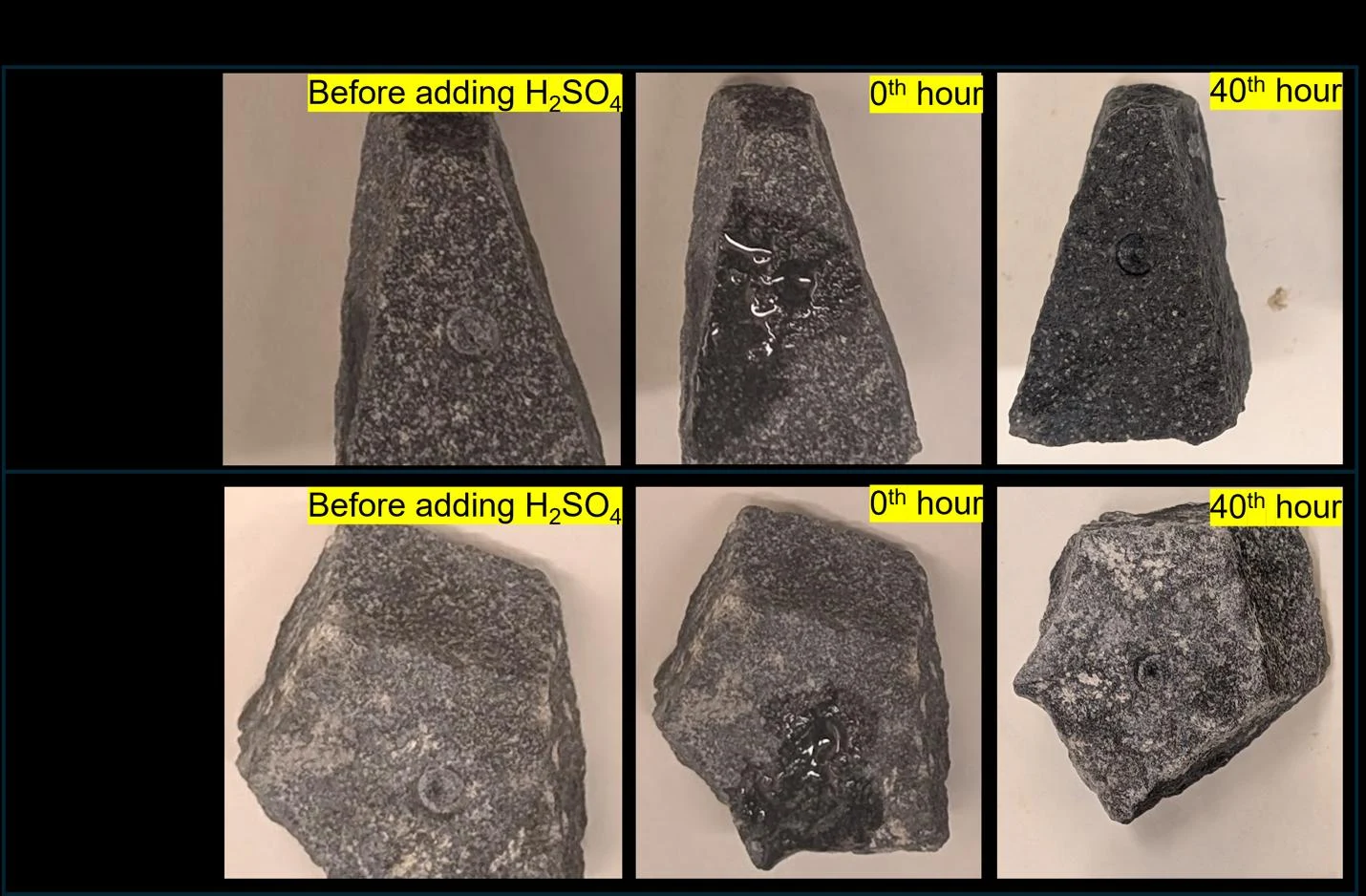
Ionic liquids were prepared by dissolving nitrogen-containing organic molecules (amino acids, nucleobases, amines) in concentrated sulfuric acid, then evaporating excess acid in a vacuum chamber at about 100 °C and 10⁻⁵ bar. Composition was confirmed by infrared spectroscopy (FTIR) and nuclear magnetic resonance (¹H NMR). Acidity was estimated by the Gutmann–Beckett method using ³¹P NMR. Thermal stability was measured by thermogravimetric analysis. To test the realism of the process, ionic liquids were also synthesized on basaltic rock surfaces under various conditions, including room temperature and pressure.
Results
Ionic liquids with hydrogensulfate anion (HSO₄⁻) and protonated organic cation formed for all 20 biogenic amino acids, as well as for many nucleobases and amines. Decomposition temperatures range from 180 °C to 346 °C, making the liquids stable at typical surface temperatures of warm exoplanets. Ionic liquids formed even from highly dilute solutions (20 mM) and in volumes on the order of 200 nanoliters. On basalt, they remained stable after evaporation of excess acid. The acidity of the resulting liquids is lower than that of pure sulfuric acid, but still high (acceptor number 98–117 vs. 122 for H₂SO₄).
Implications
This work introduces a new class of substances into planetary science, previously considered purely synthetic. Unlike neighboring studies focused on atmospheres or internal structure, here a concrete surface mechanism is proposed and tested in the lab. This is the first experimental demonstration that ionic liquids can form from widely available planetary materials. Such an approach broadens the boundaries of habitability: warm, waterless worlds can now be considered potentially suitable for life.
Future development
The topic could develop in several directions: studying the stability of ionic liquids to ultraviolet radiation and cosmic rays, searching for other possible anions and cations, and modeling planetary conditions under which ionic liquids could accumulate in significant amounts. Of particular interest is whether such liquids could support metabolic networks analogous to Earth's, and how they might be detected remotely.
Impact
The results will impact astrobiology, planetary science, and the chemistry of life's origins, as they offer an alternative solvent for biochemical processes. They may also interest exoplanet atmosphere specialists searching for biosignatures in unusual conditions.
Next steps
Immediate next steps are to investigate the radiation resistance of ionic liquids and their ability to support enzymatic reactions in a water-free environment. It is also important to assess how these liquids behave during prolonged contact with rocks under conditions simulating exoplanet surfaces.
Key open problems
For planetary science, a key unresolved problem is how to distinguish a habitable planet from an uninhabitable one if life is not water-based. This work directly relates to the question of possible alternative solvents and what chemical traces such life might leave in the atmosphere or on the surface.
The knowledge machine's view
This section is addressed to the author of the paper and their colleagues. Neighbouring works were found by meaning-based search across our archive, not by word overlap. We do not review: we show the field around the work.
What the work does
The authors synthesized ionic liquids from sulfuric acid and biogenic nitrogen-containing compounds (amino acids, nitrogenous bases, amines) under conditions mimicking the surface of warm rocky exoplanets with thin atmospheres. The resulting liquids are stable at temperatures up to 180–346 °C and can form even from highly dilute solutions and on basalt surfaces.
Where its strength is
This work provides the first experimental demonstration that ionic liquids can form from widely available planetary materials, opening up a new class of potentially habitable environments beyond the liquid-water paradigm.
Where it could go next
- It might be interesting to compare the proposed mechanism with studies of hydrogen atmospheres of scorched planets: if ionic liquids are stable at high temperatures, their formation could influence atmospheric composition and surface processes on hot super-Earths.based on: Hydrogen Atmospheres on Scorching Planets: The Volcano Secret arXiv:2510.07378
- Related work shows how hydrogen and magma generate water in planetary interiors; perhaps analogous geochemical cycles involving sulfuric acid and organics could sustain ionic liquids in the crust or mantle.based on: How Hydrogen and Magma Create Water Deep Inside Planets arXiv:2511.06507
- Since ionic liquids can persist at low pressure, they are worth considering for rogue moons that lack stellar heating but may have internal heat sources and suitable mineral compositions.based on: Rogue Moons: Warmth Without a Star arXiv:2602.05378
Worth trying
- Test whether ionic liquids form when sulfuric acid reacts with organic molecules in the presence of typical exoplanet minerals (olivine, pyroxene) and at lower temperatures.
- Assess whether such liquids could exist as thin films on the surface at pressures below 10⁻⁵ bar and how they affect the planet's albedo.
- Search for possible spectral signatures of ionic liquids in exoplanet atmospheres using JWST, drawing on data from hot Jupiters.
Why this may matter
If ionic liquids are indeed common on warm rocky planets, this significantly expands the list of potentially habitable worlds and could change strategies for searching for biosignatures in future missions.
Nearby works in our archive
- Rogue Moons: Warmth Without a Starsimilarity 0.57
- How Hydrogen and Magma Create Water Deep Inside Planetssimilarity 0.56
- A Needle in a Stellar Haystacksimilarity 0.56
- Hydrogen Atmospheres on Scorching Planets: The Volcano Secretsimilarity 0.54
- Icy Origins: Most Hot Jupiters Come from the Coldsimilarity 0.52
The archive is sparse around this work: the closest review is only 0.57, against a usual 0.64. It looks like few have drilled nearby.
The only known natural occurrence of ionic liquid formation on Earth is the detoxification of fire ant venom by the ant Nylanderia fulva: their venoms mix to form a viscous, non-toxic ionic liquid.
The idea of life in non-aqueous solvents echoes Isaac Asimov's novel 'The Gods Themselves', which describes beings living in an environment with chemistry completely different from Earth's.
Key numbers
- decomposition temperature of ionic liquids: 180–346 °C
- pressure during synthesis: 10⁻⁵ bar
- acceptor number of ionic liquids: 98–117
- minimum synthesis volume: 200 nanoliters
- evaporation time of sulfuric acid at 323 K and 10⁻⁵ atm: 1.3 months for a layer of 1 ml/cm²