How a radio telescope learned to image the sky in 5 microseconds ✛
A radio telescope made of thousands of antennas is like a giant ear that hears the whole sky at once. But an ear can't draw a picture. Previously, you had to multiply the signals from every pair of antennas, and the more antennas, the more pairs, just like handshakes at a party: ten guests produce forty-five handshakes, while a thousand guests produce nearly half a million. For a telescope with tens of thousands of antennas, that becomes overwhelming.
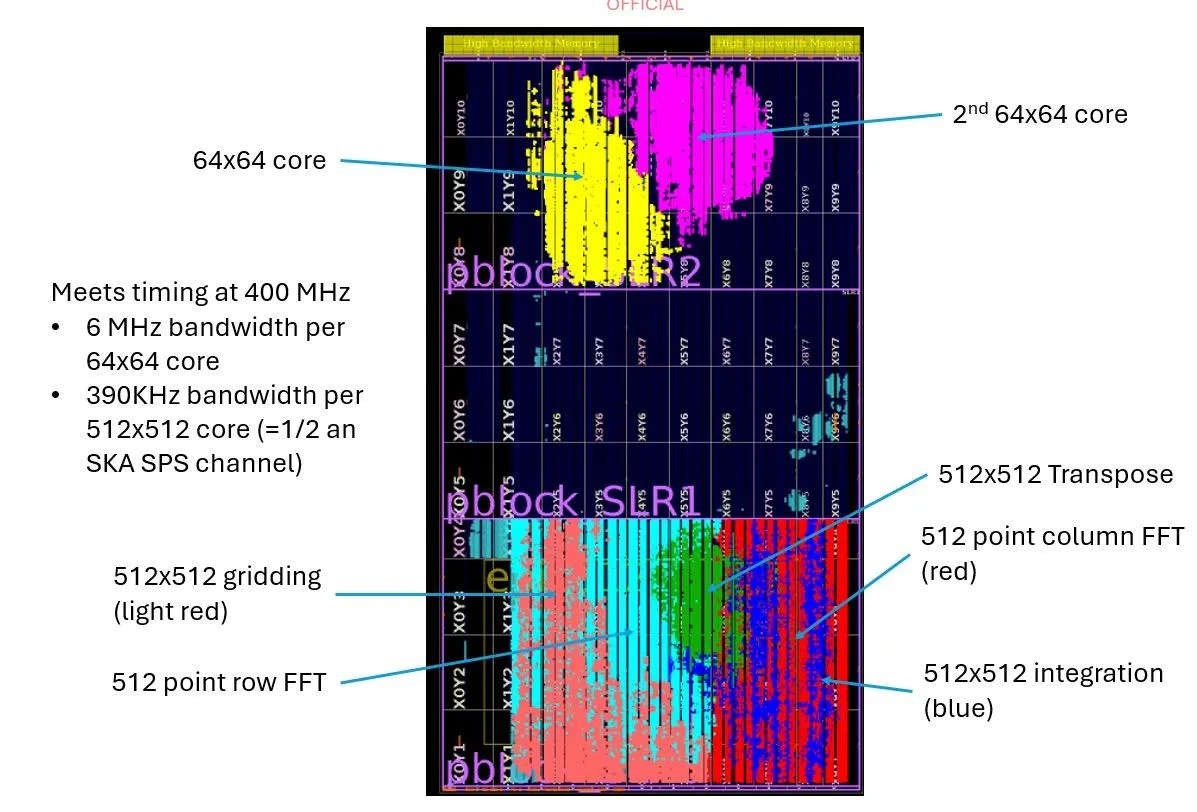
The authors ported this method to programmable logic, a chip that performs many operations simultaneously, like a factory with a thousand assembly lines. The prototype on an AMD Alveo V80 board takes signals from 256 antennas and outputs a 64×64-pixel sky frame every 5 microseconds. That's like photographing the night sky at 195,000 frames per second. Tests on synthetic data showed that all sources landed in their correct positions, including an artificially added flare.
Previously, it was unclear whether the method could scale to tens of thousands of antennas. Now it's shown that a single board can handle an array of 20,000 elements. The secret is that the chip performs Fourier transforms in parallel and with lower power consumption than graphics processing units. This isn't just a speedup; it's a change of approach: instead of storing millions of pairwise products, the image is computed directly. Already today, this method could be integrated into the SKA-Low telescope, which uses the same boards, for continuous all-sky monitoring.
The AMD Alveo V80 card used in the prototype is identical to the one already installed in the SKA-Low correlator and beamformer. That is, the same accelerator can both compute correlations and directly form images.
The idea of instantaneously 'photographing' the entire sky recalls the monitoring system in Carl Sagan's novel 'Contact', where an array of radio telescopes continuously scans the sky for signals. Only here, instead of searching for extraterrestrial intelligence, it is a hunt for fast cosmic explosions.