FPGA Turns a Radio Telescope into an Instant Camera ✛
A radio telescope with thousands of antennas is like a giant ear that hears the whole sky at once. But an ear cannot draw a picture: signals from every pair of antennas must be multiplied, and in an array of ten thousand elements there are already fifty million pairs. A classical correlator does exactly that, and its complexity grows as the square of the number of antennas. For the upcoming SKA-Low telescope with its tens of thousands of elements, this approach hits a wall.
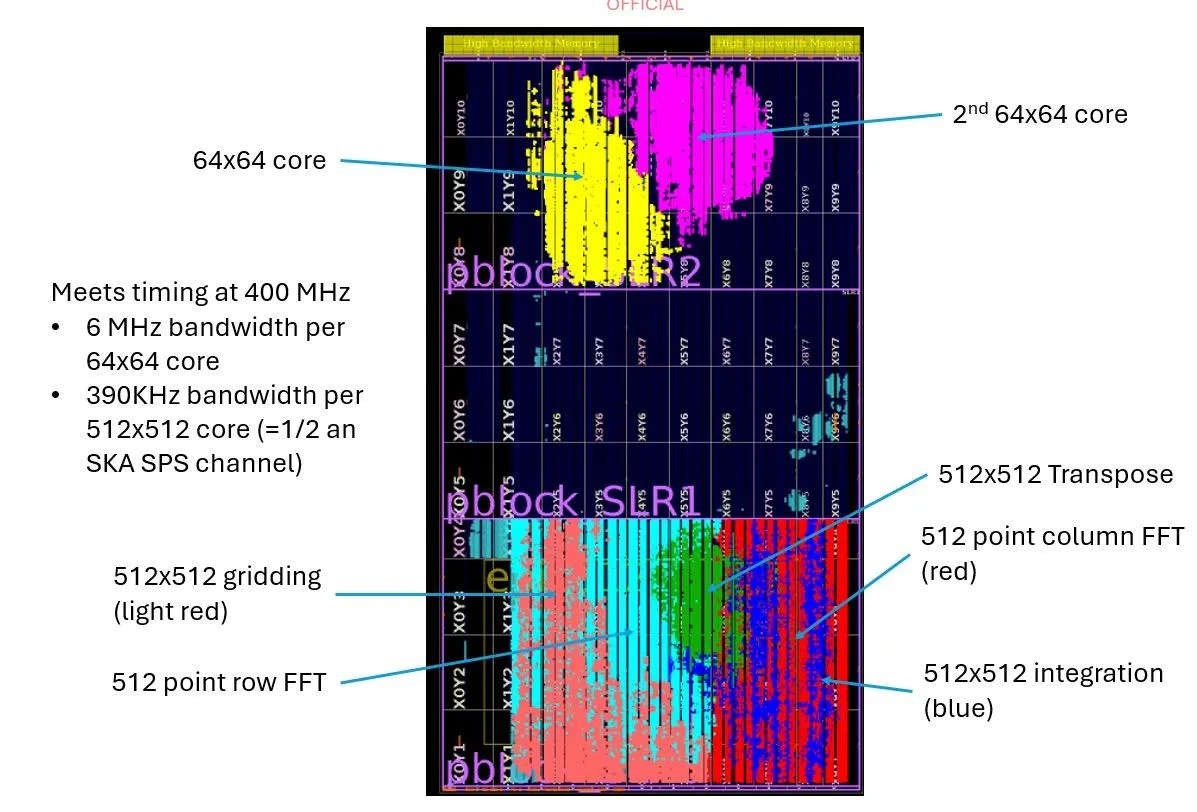
The authors of the paper ported this method to programmable logic (FPGA), a chip that executes many operations in parallel, like a factory with a thousand assembly lines. The prototype on an AMD Alveo V80 board takes digitized signals from 256 antennas, grids them onto a regular lattice, and applies a fast Fourier transform. As a result, a 64×64-pixel sky frame is born every 5 microseconds. That is like photographing the night sky at 195,000 frames per second.
Tests on synthetic data from the AAVS2 station (an SKA-Low prototype) showed that all sources landed in their correct positions, including an artificially injected flare. Resource estimates indicate that a single board can handle up to 20,000 antennas with two polarizations, which corresponds to 20–30 stations of the SKA-Low core. For comparison, a GPU implementation at LWA-Sevilleta produced frames every 80 milliseconds over a 19.2 MHz bandwidth. The new approach wins by several times in bandwidth and potentially by an order of magnitude in array size.
Previously, it was unclear whether the method could scale to tens of thousands of antennas and provide millisecond-level resolution. Now it has been shown that a single commercial board handles an array of 20,000 elements, producing frames every 5 microseconds. The secret lies in low-precision Fourier transforms on FPGAs, which run in parallel and with lower power consumption than on graphics processors. This is not just a speedup; it is a change of architecture: instead of storing correlations, the image is computed directly, drastically reducing memory requirements.
Instant photography of the entire sky is no longer science fiction. Already today, this approach can be integrated into the SKA-Low correlator for real-time, parallel monitoring of the sky. The next step is validation on real data from the AAVS2 station at the Murchison Observatory. If everything works, future radio telescopes will not count billions of pairwise products; they will simply film the sky, as a movie camera films a street.
The AMD Alveo V80 card used in the prototype is identical to the one already installed in the SKA-Low correlator and beamformer. That is, the same accelerator can both compute correlations and directly form images.
The idea of instantaneously 'photographing' the entire sky recalls the monitoring system in Carl Sagan's novel 'Contact', where an array of radio telescopes continuously scans the sky for signals. Only here, instead of searching for extraterrestrial intelligence, it is a hunt for fast cosmic explosions.