Why a Layered Material Remembers Charging
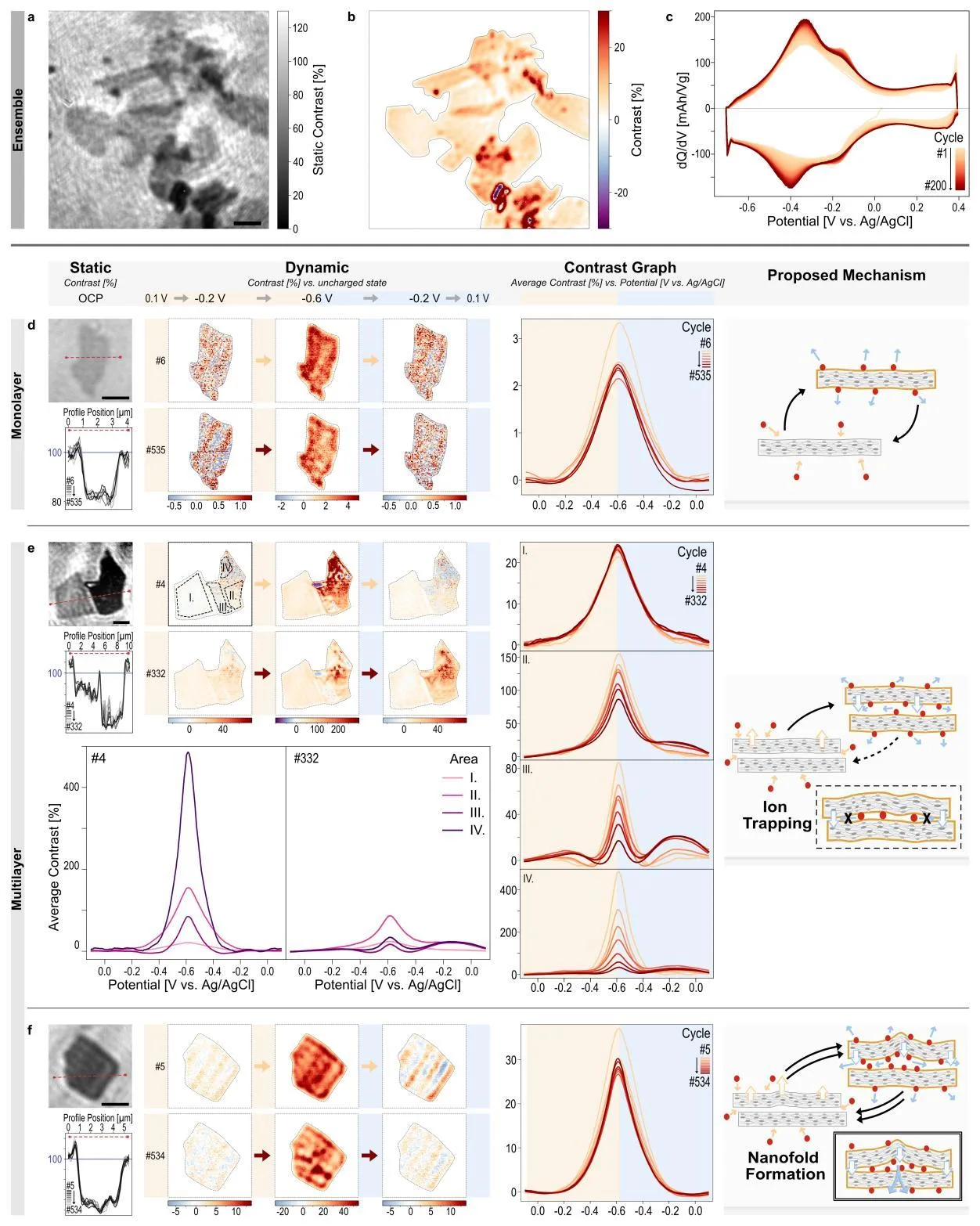
A book that is often flipped through remembers it: some pages lie flat, others curl up. Layered materials behave similarly when ions enter them. Scientists took MXene, a material made of layers of titanium carbide one atom thick, and tracked how it changes during charging and discharging.
They built a microscope that monitors light reflected from each flake. When ions entered between the layers, the flake expanded slightly, and the reflected light changed in brightness. From that brightness, they could tell how many layers were in the flake and how it breathed.
It turned out that single layers are almost perfectly reversible: when the charging rate increased tenfold, their response dropped by only 2%. But for stacks of six or more layers, the drop reached 36%. Ions in a thick stack have to squeeze between the sheets, like water through tightly pressed pages.
Repeated cycles divided the flakes into three types. Monolayers remained stable. Randomly stuck multilayer stacks accumulated deformation and lost reversibility, like pages that no longer close properly. Multilayers with orderly stacking formed folds that appeared during charging and disappeared during discharging.
Now it is clear why MXene electrodes behave unstably in the first cycles: they undergo reorganization, like a book finding a comfortable position. The method will help test the quality of batteries and supercapacitors, and understanding the stacking will help create materials that know from the start how they will be flipped through.
The optical contrast of a single Ti3C2Tx monolayer is so small that its change upon intercalation is equivalent to a thickness change of only a few angstroms, comparable to the size of a single hydrogen atom.