Layer Memory: How MXene Remembers Being Flipped Through
A stack of pages that has been flipped through many times remembers it: some sheets lie flat, others stick up, and creases remain here and there. Layered materials behave much the same way when ions enter them. In a new study, scientists watched individual flakes of MXene, a two-dimensional titanium carbide, and saw how the history of charge-discharge cycles alters their structure.
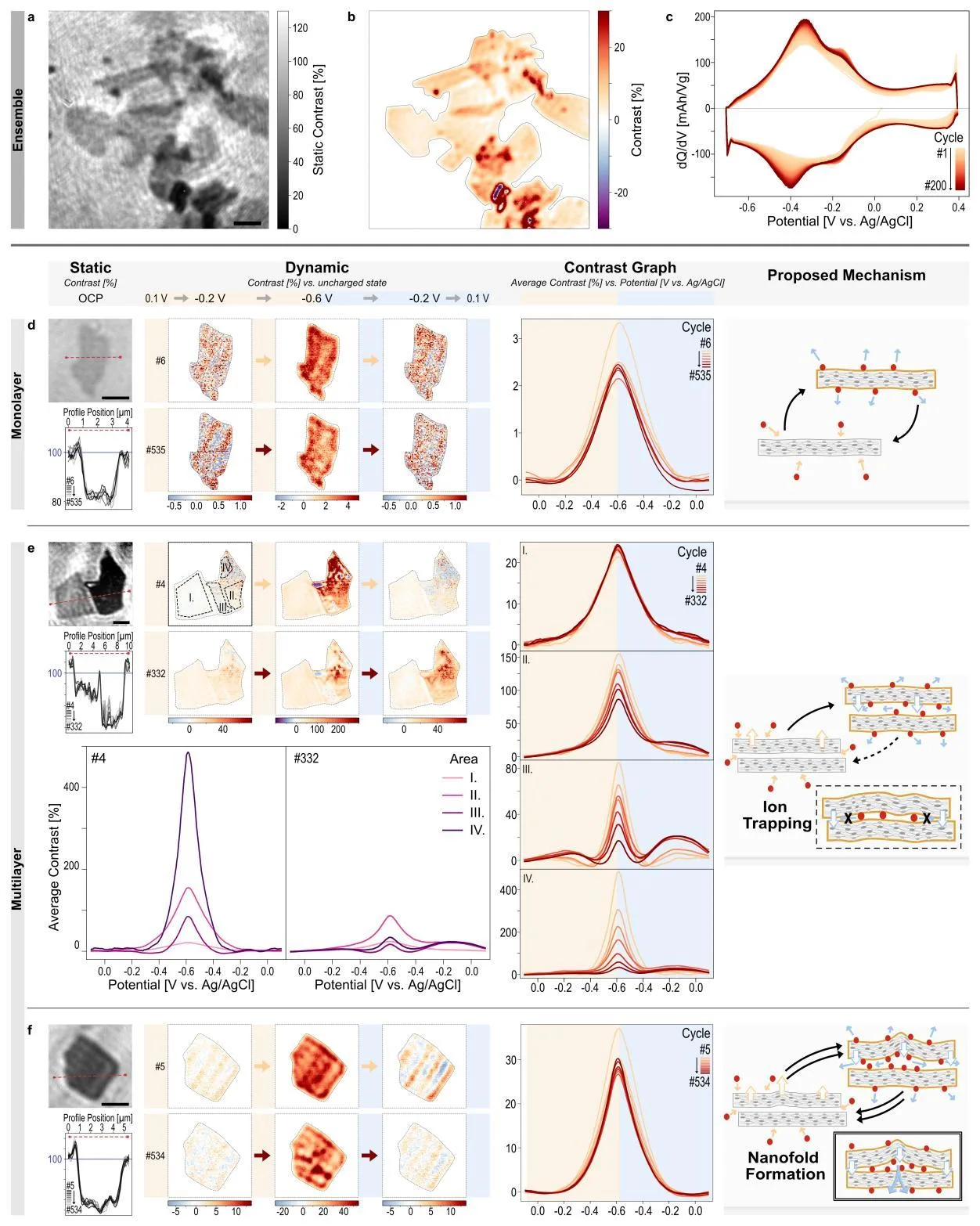
To do this, they built a microscope that tracks light reflected from each flake with precision down to millionths of a second. The samples were placed in a sulfuric acid solution and a current was passed through them. When protons slipped between the layers, the flakes expanded slightly, and the reflected light changed in brightness. From that brightness, they could tell how many layers were in a flake and how it breathed.
It turned out that single layers are almost perfectly reversible: when the scan rate was increased tenfold, their response dropped by only 2%. But for stacks of six or more layers, the drop reached 36%. This means that in thick stacks, ions have to navigate between sheets, like water seeping through the tightly pressed pages of a book.
Repeated cycles split the flakes into three types. Monolayers remained stable. Randomly stuck-together multilayers accumulated residual strain and lost reversibility, like pages that no longer close properly. But multilayers with orderly stacking formed reversible folds, which appeared during charging and completely disappeared when the potential returned.
Now it is clear why macroscopic MXene electrodes behave unstably during the first cycles: they undergo history-dependent reorganization. The method, combining optical monitoring of individual flakes with averaged diffraction, can be used to diagnose batteries and supercapacitors. And understanding the role of stacking will help design materials that know from the start how they will be flipped through.
The optical contrast of a single Ti3C2Tx monolayer is so small that its change upon intercalation is equivalent to a thickness change of only a few angstroms, comparable to the size of a single hydrogen atom.