Half a Billion Photons per Second from a Single Point
An assembly line spits out parts one by one per cycle. If the cycle is short and defects are few, the line runs fast. In quantum optics, a single-photon source plays the role of such a line: it must emit exactly one quantum of light per cycle, and the more cycles per second, the more photons go into the fiber. Danish engineers from Sparrow Quantum, together with physicists from Ruhr University Bochum, have built a line that makes 515 million steps per second, and more than half of the parts reach the end.
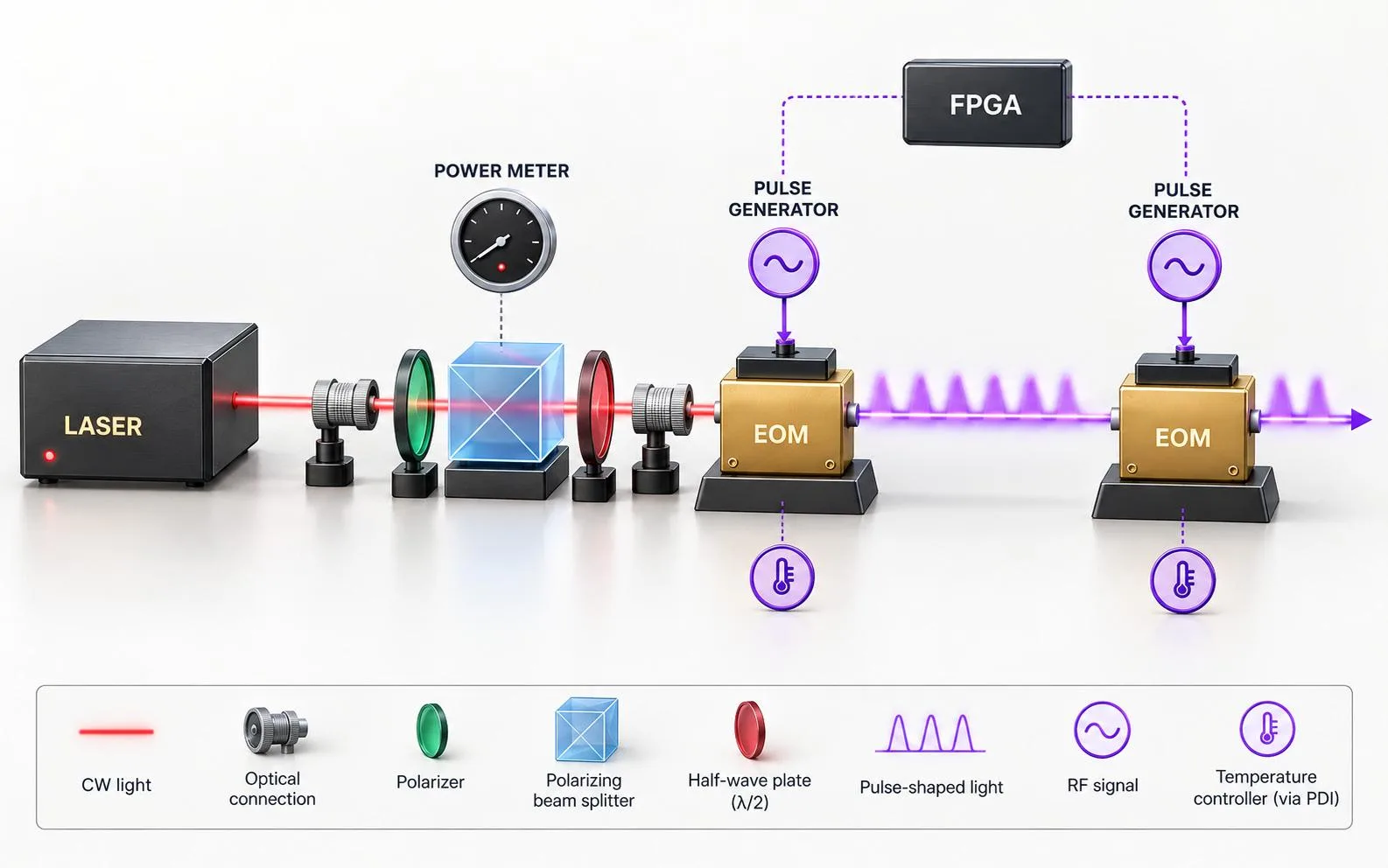
The heart of the line is a quantum dot, a tiny island of indium arsenide inside gallium arsenide. When a laser pulse hits it, it absorbs energy and, after 220 picoseconds, emits a single photon. This is the lifetime of the exciton, a bound electron-hole pair created upon absorption. Until the pair recombines, the dot stays silent. To keep the line from idling, laser pulses are carved at rates up to one gigahertz, one every nanosecond. For this, a continuous beam passes through two electro-optic modulators that open and close on command from a programmable chip.
System efficiency, the fraction of photons that actually enter the single-mode fiber, stays above half at all three tested rates: 56.2% at 80 megahertz, 53.8% at 500 megahertz, and 51.5% at one gigahertz. The purity of single photons, measured via second-order autocorrelation, was 3.98%, 3.63%, and 11.13%, respectively. This means that out of a hundred pulses, only a few produce two photons at once. After adding a filter at the lowest rate, purity improved to 2.80%, and the visibility of Hong-Ou-Mandel two-photon interference rose from 55% to 92%, at the cost of losing 12% of the light.
The most surprising part is the measurement method. The photon stream is so dense that its power can be measured with an ordinary industrial optical power meter, like those used by telecom engineers. At gigahertz rates, the power was 110 picowatts. That is nine million times weaker than a laser pointer beam, but the device handles it. Previously, counting photons required superconducting detectors that had to be cooled to near absolute zero. Now, a commercial device does the job in a few seconds.
A line that emits one photon per cycle can already speed up quantum key distribution over fiber links or serve as an optical power standard in metrology. The next step is to shorten the emitter lifetime to push clock rates beyond a gigahertz, or to split the stream into multiple channels for multiphoton experiments. Such a source does not require cryogenic detector cooling and works at room temperature, making it a candidate for the workhorse of future quantum networks.
An optical power of 110 pW is so tiny that an ordinary 1 mW laser pointer emits 9 million times more photons per second. Yet it can be measured with an off-the-shelf instrument in a few seconds.