Half a Billion Photons per Second from a Single Point
Context
Deterministic single-photon sources are the workhorses of photonic quantum technologies, from quantum key distribution to optical quantum computing. The throughput of almost any protocol grows linearly with the source's clock rate and falls exponentially with its inefficiency. Alongside this work on the archive are studies of single photons from optical cavities, silicon chips, and synchronized photon factories, all vying for speed and purity, but until now no one has crossed the half-gigahertz threshold of real fiber-coupled flux. This paper shows that quantum dots in photonic crystals can operate at the limit of their lifetime without sacrificing system efficiency.
Methods
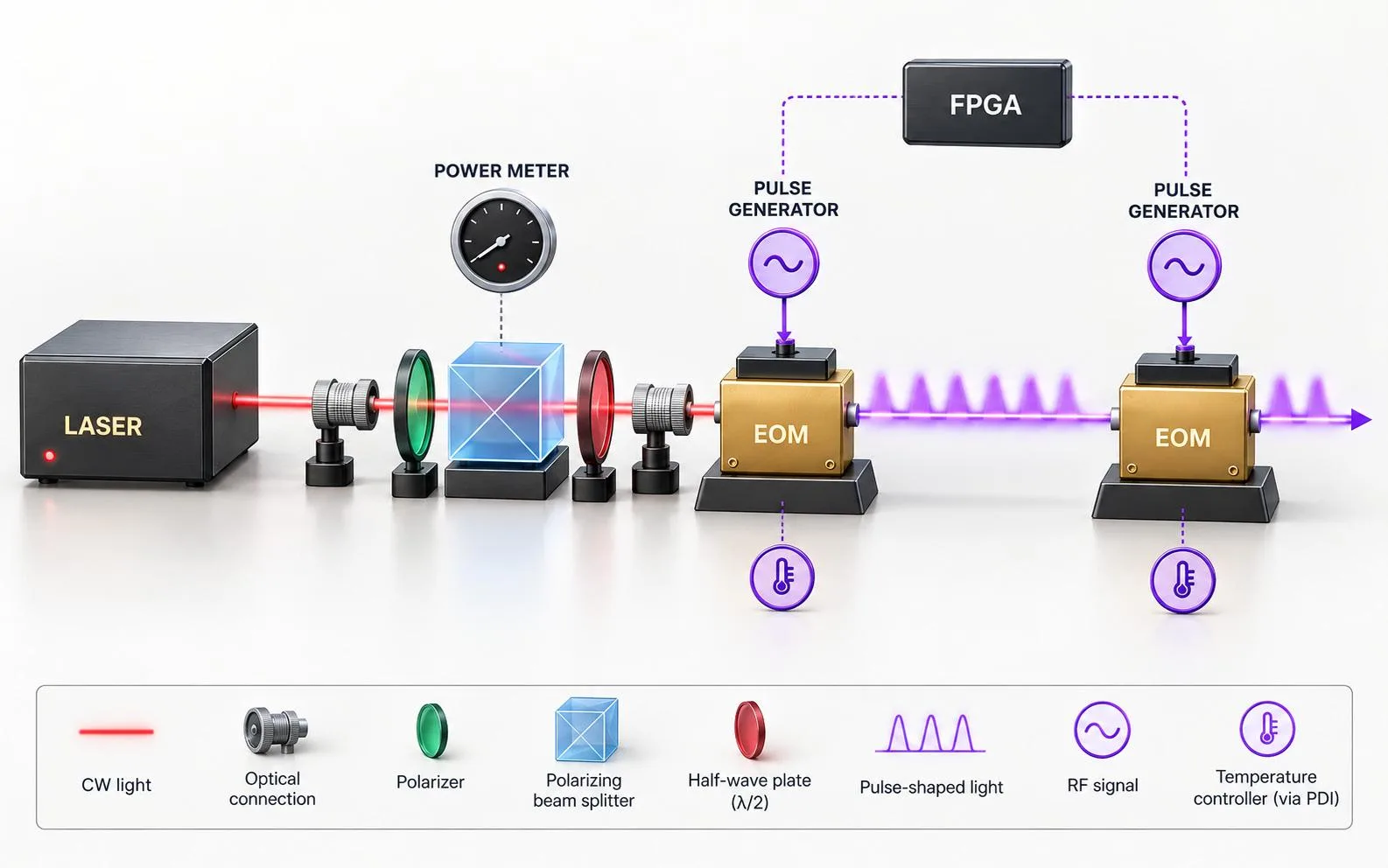
Laser pulses are carved from a continuous-wave laser with a linewidth below 1 kHz using two cascaded electro-optic modulators on lithium niobate. The modulators are biased at the minimum transmission point to maximize background suppression, and pulse duration is tunable from 40 to 100 picoseconds. The clock rate is set by a field-programmable gate array (FPGA) that drives a pulse generator. These pulses resonantly excite a neutral exciton in an InAs/GaAs quantum dot embedded in a photonic crystal waveguide. Importantly, the collection setup deliberately omits spectral filtering: all emitted light is measured, including the phonon wing. Intensity was verified through Rabi oscillations recorded with a commercial optical power meter.
Results
When excited at rates of 80 MHz, 500 MHz, and 1 GHz, the source shows monoexponential decay with a lifetime of 220 picoseconds. Single-photon purity, assessed via second-order autocorrelation g(2)(0), was 3.98%, 3.63%, and 11.13% respectively without spectral filtering. Hong-Ou-Mandel two-photon interference visibility reached 81.83%, 80.87%, and 55.14% under the same conditions. With filters added at 80 MHz, purity improved to g(2)(0)=2.80% and visibility to 92.30%, at the cost of losing 12% of the light. Optical power under a pi-pulse was 9.57 pW, 57.3 pW, and 110 pW, corresponding to system efficiencies of 56.2%, 53.8%, and 51.5%. At 1 GHz, the single-photon flux in the fiber reached 515 MHz, a record for solid-state sources.
Implications
This work stands out from neighboring studies because it is the first to combine gigahertz excitation with system efficiency above 50% while measuring the flux directly through optical power rather than photon counting. Neighboring works on single photons from cavities and silicon chips focus on purity or integration but do not achieve this combination of speed and useful fiber-coupled output. Here a practical limit is demonstrated: a quantum dot in a photonic crystal can emit photons at a rate limited only by the exciton lifetime, without efficiency dropping below half.
Future development
The next logical step is to shorten the emitter lifetime to push the clock rate above 1 GHz without pulse overlap. Another route is demultiplexing the stream into several spatial modes for multiphoton experiments. Integration with fast switches to create cluster states is also possible. Metrological use as an optical power standard looks promising as well, since the power is directly linked to photon number and frequency.
Impact
The result directly impacts the speed of quantum key distribution, where every lost photon reduces range and security. It also accelerates linear optical quantum computing and quantum-enhanced machine learning, which require streams of indistinguishable photons.
Next steps
The immediate task is to test the source in multi-hour operation at 1 GHz and measure parameter drift. Then demultiplexing into 4-8 channels for generating multiqubit states should be attempted.
Key open problems
A persistent open problem in quantum optics is scaling sources to thousands of identical emitters on a chip. This work solves part of the puzzle by showing that a single emitter can deliver enough flux for protocols with moderate photon numbers, but universal computing still requires arrays with high uniformity.
An optical power of 110 pW is so tiny that an ordinary 1 mW laser pointer emits 9 million times more photons per second. Yet it can be measured with an off-the-shelf instrument in a few seconds.
Key numbers
- single-photon flux: 515 MHz
- optical power: 110 pW
- exciton lifetime: 220 ps
- system efficiency: 51.5%
- HOM visibility without filter: 55.14%