Z. Liu

6 articles · 30 co-authors · latest: 2026-09-04
64 citations · h-index 2 · 110 papersData: Semantic Scholar

We have retold 6 papers by this author. 1 of them with a full read. most often about: Cooper pair, spectroscopy, neutron star. 30 co-authors across our retellings.

Links in the knowledge graph
HEP Experiment2026-02-141 minarXiv:2602.13569express
Hunting Ghost Particles: What Belle II Saw
At Japan's KEK laboratory, electrons and their antimatter counterparts, positrons, collide inside the Belle II detector. In such collisions, new particles are born for a fleeting moment. Among them is J/ψ, a bound state of a charm quark and its antiquark.
Nuclear Experiment2026-02-271 minarXiv:2602.23776express
Precision Scales for a Stellar Explosion
When matter accumulates on the surface of a neutron star, the ultra-dense remnant of a dead star, an explosion occurs, akin to a giant thermonuclear bomb. In this inferno, nuclei of elements not found on Earth are born within seconds. To understand which ones, their masses must be known with great precision.
Nuclear Theory2026-03-072 minarXiv:2603.07069express
The Magic Number 32: How Nuclear Halves Give Away Their Secret
Inside an atom's nucleus, protons and neutrons stack in layers, like spectators in a packed hall. When a layer is full, the nucleus becomes especially stable — physicists call these 'full rows' magic numbers. One of them, 32, has long been elusive: in nuclei with 32 neutrons, its effect is weak, and in some neighbors it seems absent altogether.
Galaxies2026-04-101 minarXiv:2604.09347express
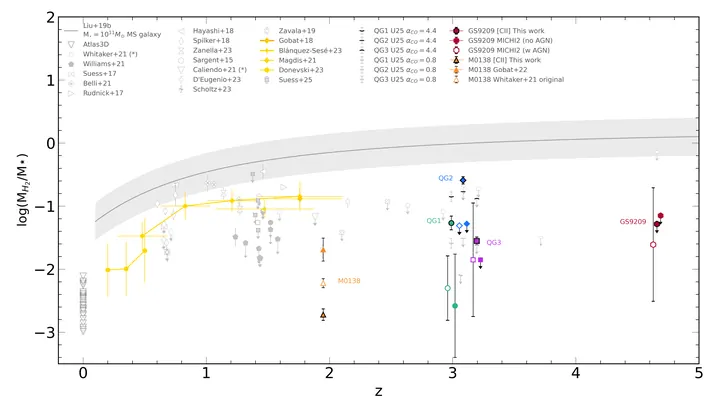
Dead Galaxies That Still Breathe
Five galaxies that long ago stopped igniting new stars look like houses with darkened windows. But the ALMA radio telescope and the James Webb Space Telescope peered inside and saw that in these 'sleeping' houses, a fire still smolders.
Galaxies2026-06-092 minarXiv:2606.10271express
The Wind That Snuffs Out Stars
A vast city lights new streetlamps every night. But then a hurricane sweeps in, rips all the fuel from the warehouses, and the lamps go out one by one. Something similar has been spotted by astronomers in a galaxy whose light has traveled 12.5 billion years to reach us.
Half a Billion Photons per Second from a Single Point
An assembly line spits out parts one by one per cycle. If the cycle is short and defects are few, the line runs fast. In quantum optics, a single-photon source plays the role of such a line: it must emit exactly one quantum of light per cycle, and the more cycles per second, the more photons go into the fiber.
