A Dust Grain on a Swing over a Sawtooth Hill ✛
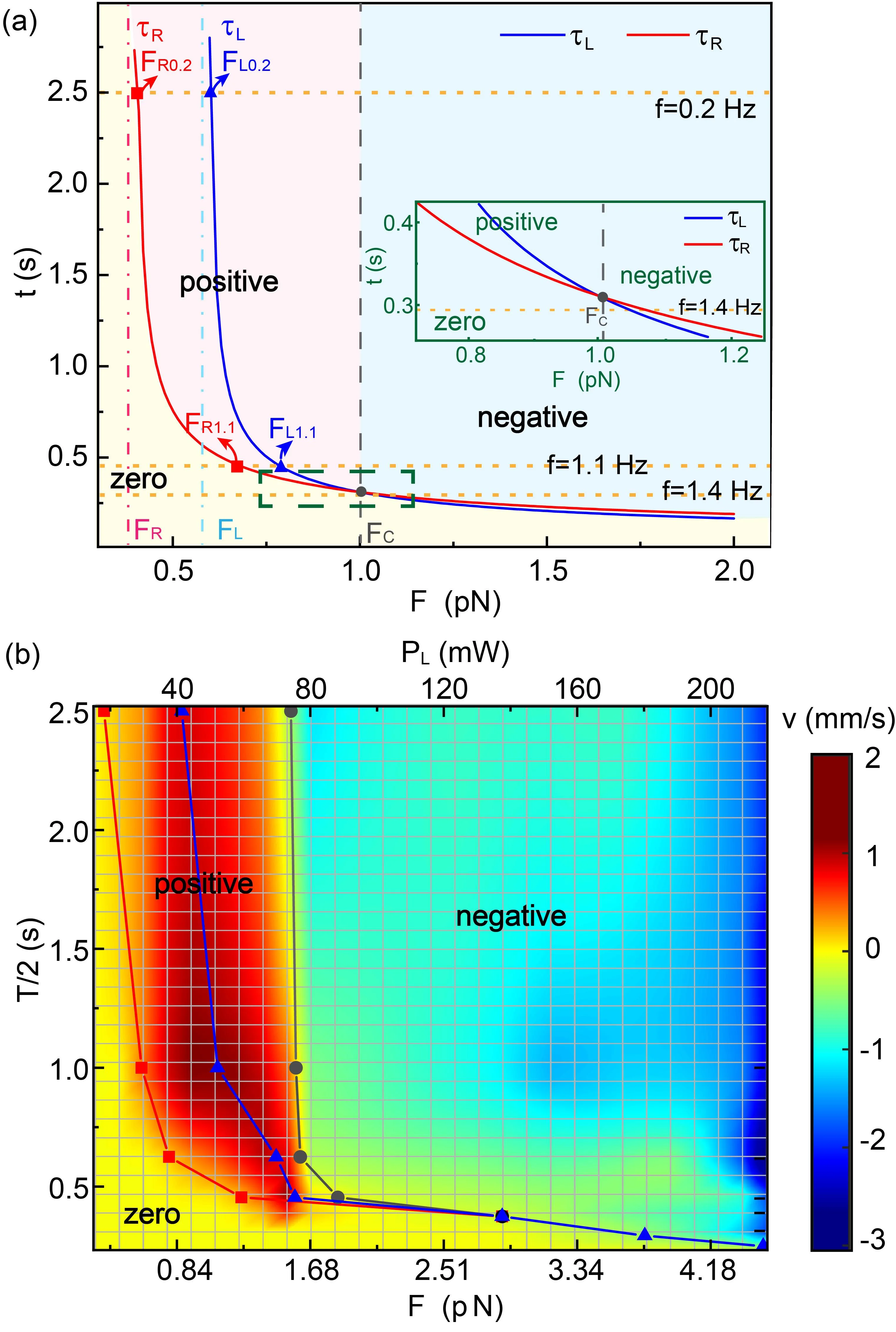
A swing that rocks on a sawtooth hill behaves strangely: without kicks, it gets stuck in the first dip, but with rhythmic pushes it can move uphill, downhill, or stay frozen in place. That is exactly what physicists saw when they placed a single dust grain in a trap with a sawtooth bottom and started pushing it alternately with laser beams.
Earlier, similar experiments were done with electrons in crystals or molecules in narrow channels, but there the particle is not visible to the eye. Here, the dust grain was filmed from above with a camera, and every step was plain to see. The trap was made from a plate with grooves 3 mm deep and a period of 5 mm: the dips had one steep side and one gentle side. Two lasers shone toward each other, but not simultaneously; they alternated, and the strength of their kicks varied from very weak to strong.
When the kicks were barely noticeable, the dust grain jittered inside one groove and did not leave. As soon as the light was intensified, it started hopping over the gentle edge and ran in one direction. With even more force, it also overcame the steep edge, but more slowly; then the displacements in both directions balanced out, and the particle shuffled in place. Eventually, the kicks became so powerful that the grain more often slipped off the steep slope, and it was carried in the opposite direction. Frequency also played a role: with rapid laser switching, forward motion disappeared completely, and the particle immediately began to back up.
The physicists built a model where the trap potential is drawn as a broken line, and the particle has two thresholds: 0.51 pN for the gentle slope and 1.15 pN for the steep one. The model accurately predicted at which forces and frequencies the particle would run forward, stop, or turn around. This is the first direct test of such a "rocking ratchet" for a weakly damped particle, where friction hardly interferes.
Now the dust grain on a swing has become a benchmark for testing theories of motion in nonequilibrium systems. The same principle could be used to separate microparticles by size: larger ones would get stuck where smaller ones slip through. And although factory conveyor belts are still far away, a single dust grain on a sawtooth hill has already shown how to turn random kicks into controlled running.
The 13 μm dust grain in the experiment moved at speeds up to 0.95 mm/s, which corresponds to 73 of its own diameters per second. For comparison, a person 1.8 m tall running at such a relative speed would be moving at 475 km/h.