Dusty Plasma as a Rocking Ratchet ✛
Context
Ratchets generate directed motion from a force that is symmetric on average, by combining spatial asymmetry with a periodic drive. Such systems have been studied in optical lattices, semiconductor nanostructures, and nanofluidic devices, but there it is difficult to see and control an individual particle. Dusty plasma offers direct visual access to the motion of micron-sized particles and allows precise setting of the potential and force. Related papers on the arXiv include studies of plasma instabilities, beam focusing, and waves in inhomogeneous plasma, but none of them provides a direct experimental realization of a rocking ratchet for a weakly damped particle.
Methods
In a chamber with argon plasma, the lower electrode had sawtooth grooves with a depth of 3 mm and a period of 5 mm. Above the grooves, an asymmetric potential landscape was formed, into which a polystyrene sphere with a radius of 13 μm was placed. Two counter-propagating laser beams with a wavelength of 532 nm alternately illuminated the particle, creating a square-wave force with zero mean. The beam intensities were balanced with a gradient filter, and the switching frequency was set by a pair of phase-shifted choppers. The particle motion was recorded from above with a camera at 30 frames per second.
Results
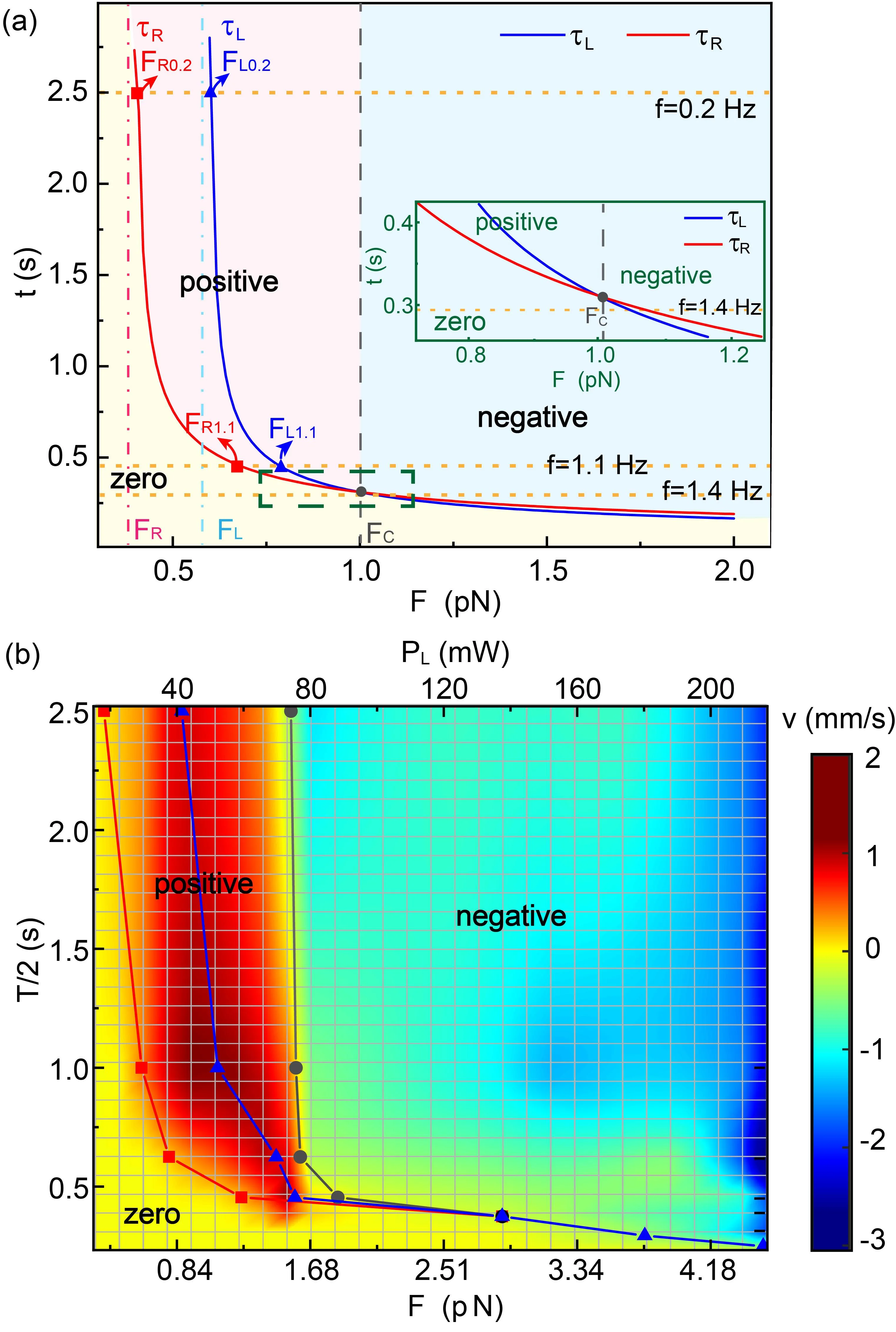
At a frequency of 0.2 Hz and a small force (0.36 pN), the particle oscillated within a single well and showed no macroscopic displacement. At 0.86 pN, it moved only in the easy direction, giving a positive current with a speed of 0.95 mm/s. At 1.25 pN, the particle crossed the barrier in both directions, and the speed dropped to 0.63 mm/s. At 1.53 pN, the displacements in the two directions became equal (13.43 mm each), and the current was zero. At 1.61 pN, the displacement in the hard direction exceeded that in the easy direction, and the current became negative (−0.79 mm/s). At frequencies of 1.4 and 1.7 Hz, positive current was not observed at all: as the force increased, the current went directly from zero to negative. A model with a piecewise-linear potential and two depinning thresholds (0.51 pN to the right and 1.15 pN to the left) reproduced the phase diagram with three regimes.
Implications
This work differs from neighboring plasma studies in that it provides the first direct experimental test of the rocking ratchet model for a weakly damped particle with a controlled potential. Unlike studies of instabilities and waves, the focus here is on the transport of a single particle rather than collective effects. The result shows that the direction of the current is determined by a simple condition: the force must exceed a threshold, and the half-period must be longer than the time to climb the slope. This makes dusty plasma a benchmark system for testing theories of nonequilibrium transport.
Future development
One could investigate the influence of thermal noise, potential shape, and particle size on transport. The authors mention the possibility of chaotic dynamics and a 'devil's staircase' with more precise parameter control. Studying collective effects for several particles and particle separation by size using a ratchet are promising directions.
Impact
The results may be useful for manipulating microparticles in plasma technologies, for example, for selective size-based particle separation. They also provide a simple model for analyzing transport in biological and nanofluidic systems.
Next steps
Test the model at different gas pressures and particle sizes to clarify the role of friction. Investigate the behavior of several particles in a single channel and the influence of initial conditions on the current.
Key open problems
For plasma physics, the question of how neutral gas and collective interactions affect the transport of individual particles remains open. This work does not consider thermal noise or multiple hops between wells, which are important in real conditions.
The knowledge machine's view
This section is addressed to the author of the paper and their colleagues. Neighbouring works were found by meaning-based search across our archive, not by word overlap. We do not review: we show the field around the work.
What the work does
In a dusty plasma experiment, a microparticle was held in a sawtooth potential and alternately pushed by two counter-propagating laser beams. Depending on the amplitude and frequency of the kicks, the particle moved forward, stood still, or moved backward. A simple model based on the competition between the escape time from the well and the half-period duration quantitatively reproduced the experimental phase diagram.
Where its strength is
This work provides the first direct experimental test of the rocking ratchet model for a weakly damped particle in a controlled potential, demonstrating dusty plasma as a benchmark system for studying nonequilibrium transport.
Where it could go next
- It might be interesting to examine the connection between the observed transport and collective modes: in the archive nearby there is an analysis of how waves in plasma learn to live with inhomogeneity, so perhaps one could see how a single particle interacts with wave perturbations in an inhomogeneous potential.based on: How Plasma Waves Learn to Live with Inhomogeneity arXiv:2607.16779
- Nearby there is a work on how particles get stuck in a labyrinth; one could transfer the idea of a complex potential to dusty plasma and see how transport changes with multiple wells or a random landscape.based on: How Particles Get Stuck in a Maze arXiv:2603.04048
- Another move is to compare with optimal transport strategies for active particles from a neighboring analysis: there they look for the cheapest way to drag a particle, and perhaps one could optimize the kick parameters for maximum current.based on: The cheapest way to drag an active particle arXiv:2603.17798
Worth trying
- Try adding a weak random perturbation to the periodic force and check whether the directed current persists.
- Use two particles and see how interaction through the screened potential changes the depinning thresholds.
- Measure the particle velocity distribution in different regimes and compare with model predictions.
Why this may matter
Such experiments could become a foundation for precise tests of nonequilibrium transport theories and, in the long run, for controlling the motion of micro-objects in plasma and colloidal systems.
Nearby works in our archive
- What a Cosmic Hurricane Sounds Likesimilarity 0.56
- How Plasma Waves Learn to Live with Inhomogeneitysimilarity 0.54
- How to Wake Up Plasma with a Proton Bunchsimilarity 0.54
- Cosmic Blender: How Electrons Outrun Protonssimilarity 0.54
- Cosmic Plasma in a Boxsimilarity 0.53
- How Particles Get Stuck in a Mazesimilarity 0.53
- The cheapest way to drag an active particlesimilarity 0.52
The archive is sparse around this work: the closest review is only 0.56, against a usual 0.64. It looks like few have drilled nearby.
The 13 μm dust grain in the experiment moved at speeds up to 0.95 mm/s, which corresponds to 73 of its own diameters per second. For comparison, a person 1.8 m tall running at such a relative speed would be moving at 475 km/h.
Key numbers
- Depinning threshold to the right: 0.51 pN
- Depinning threshold to the left: 1.15 pN
- Maximum positive speed: 0.95 mm/s
- Maximum negative speed: −0.79 mm/s
- Frequency range: 0.2–1.7 Hz