Brendan O'Connor

5 articles · 30 co-authors · latest: 2026-06-08
4 citations · h-index 2 · 3 papersData: Semantic Scholar

We have retold 5 papers by this author. most often about: gamma-ray burst, X-ray radiation, fast radio burst. 30 co-authors across our retellings.

Links in the knowledge graph
High Energy2026-01-201 minarXiv:2601.14137express
X-ray Thunder After Gamma-ray Lightning
The Einstein Probe space telescope detected a celestial storm: after a short (0.4-second) gamma-ray burst — a cosmic lightning bolt — came a long roll of X-ray thunder. It lasted nearly 10 minutes. This is the first direct proof that such explosions leave a lingering X-ray afterglow.
High Energy2026-02-101 minarXiv:2602.10180express
Invisible Black Hole Shreds Star in a Galactic Suburb
The center of a galaxy is a bustling metropolis where a giant black hole often snatches inattentive stars. But telescopes caught a flare in a quiet suburb, tens of thousands of light-years from the core. This gave away a wandering black hole — an invisible predator, flung out of the center after an ancient galaxy collision.
High Energy2026-04-062 minarXiv:2604.05046express
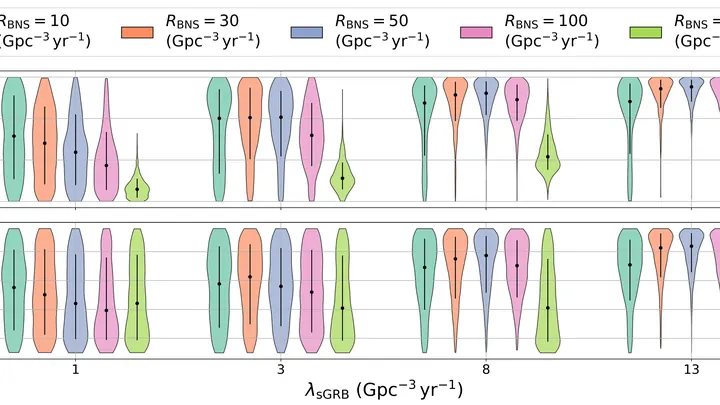
Cosmic Sirens: How Gamma-Ray Bursts Reveal Neutron Star Mergers
Two neutron stars collide, and the space around them ripples like the surface of a pond after a stone is thrown. Huge gravitational wave detectors catch these ripples. If the collision also launches a narrow beam of gamma rays, space telescopes see it as a short gamma-ray burst.
Cosmology2026-04-092 minarXiv:2604.07983express
Cosmic Lens Amplified a Star's Explosion a Hundredfold
A distant lamp shines through uneven glass. The glass bends the rays, and instead of one flame on the wall, several appear — some brighter, some fainter. In much the same way, a massive galaxy bends the light of an exploded star. There was one explosion, but the images show four glowing points.
High Energy2026-06-081 minarXiv:2606.09992express
The Star That Couldn't Become a Gamma-Ray Burst
A shockwave erupts from the star's surface, and for a brief moment, a blinding flash of ultraviolet and X-rays is born. This very event, named EP260321a, was spotted by the Einstein space telescope in March 2026. The light took about 450 million years to reach Earth.