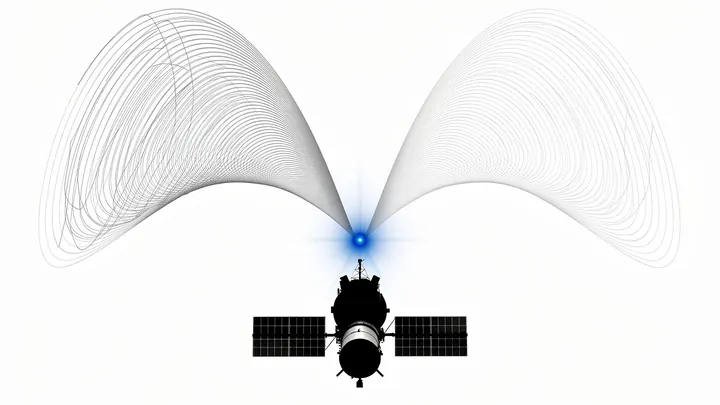
A standard ruler is a physical object or scale whose intrinsic size is known, allowing astronomers to measure cosmic distances by comparing its apparent angular size. This is a fundamental tool in cosmology, as it provides a way to map the universe's expansion history and test models of dark energy. The concept is central to studies of galaxy rotation, large-scale structure, and the homogeneity of the universe on vast scales.
History
The concept of using known-size objects to measure distances dates back to early astronomy, but the modern cosmological standard ruler—baryon acoustic oscillations—was first proposed in the 1990s by multiple groups, including Eisenstein, Hu, and Tegmark, building on earlier work by Peebles and Yu.
How it works
The method relies on the simple geometric relation between an object's true size, its distance from the observer, and its apparent angular size. If you know the true size of a 'ruler'—such as a galaxy, a cluster, or a feature in the cosmic microwave background—you can calculate its distance by measuring how large it appears in the sky. In practice, astronomers use standard rulers like baryon acoustic oscillations (the regular spacing of galaxies imprinted by sound waves in the early universe) or the turnoff point in stellar populations.
In practice
Standard rulers are used in large galaxy surveys like the Sloan Digital Sky Survey and the Dark Energy Spectroscopic Instrument to measure the expansion rate of the universe and constrain dark energy properties.
Fun fact
The 'standard ruler' of baryon acoustic oscillations has a characteristic length of about 150 megaparsecs—roughly 490 million light-years—which is the distance sound waves traveled in the plasma of the early universe before it cooled.
In the heart of an old city stands a clock tower whose hands have never been adjusted since it was built. By how far it runs slow, you can calculate how much time has stretched since then. In space, the role of such towers is played by relic galaxies — dense stellar systems that formed in the first few billion years and have since neither merged with neighbors nor given birth to new stars.
The cosmological principle – the notion that the Universe is homogeneous and isotropic on large scales – has guarded our understanding of the world since the time of Edwin Hubble and Georges Lemaître, whose ideas formed the basis of the Big Bang model.
The cosmological orchestra doesn't tune to a single tuning fork. There are two groups of instruments: one listens to the hum of the young universe — the cosmic microwave background, while the other reads notes from mature galaxies and supernovae.
The Universe resembles a dense forest: up close, individual galaxy-trees are visible, gathered into groves, but from a distance everything merges into a solid green canopy. The boundary beyond which the cosmos becomes homogeneous is called the angular scale of homogeneity: it's the size of a patch of sky from which galaxies are distributed evenly.
Astronomers occasionally spot interstellar objects — rocky chunks or comets from other star systems. Most look ordinary, but some puzzle us with their shape, speed, or shine. To stop guessing, scientists applied the Loeb scale: from 0 (plain rock) to 5 (technosignature — an artificial signal from space).
In galaxy clusters, invisible dark matter serves as the framework holding star systems together. Its shape is betrayed by a faint glow — stars ripped from galaxies by tidal forces. This stellar 'broth' fills the cluster like a liquid taking the shape of its container: it envelops the clumps of dark matter, creating a precise cast of their outlines.
Light from a streetlamp passing through blinds flickers: the stripes shift, and brightness rises and falls. From that rhythm, you can guess how wide the lamp is. The new method for measuring stars works similarly: instead of capturing a sharp image, astronomers monitor the "twinkling" of light collected by two or more telescopes simultaneously.
There's no tool to measure distances to faraway galaxies, but nature left a clue: after the Big Bang, sound waves created rhythmic clumps of matter. Today, this is noticeable as a slight preference for galaxies to be at a certain distance from each other — a built-in ruler.
Galaxies in the Universe are not scattered randomly: neighboring ones move in the same direction, like a school of fish, while distant ones each go their own way. Where the boundary between 'together' and 'apart' lies has been unclear until now.
The galaxy NGC 1560 is a modest island of stars and gas ten million light-years away. Its rotation curve, first measured in 1991, became an icon for those seeking an alternative to dark matter. The plot of rotation speed versus radius shows bends that seem to exactly mirror the bends in the distribution of ordinary matter.