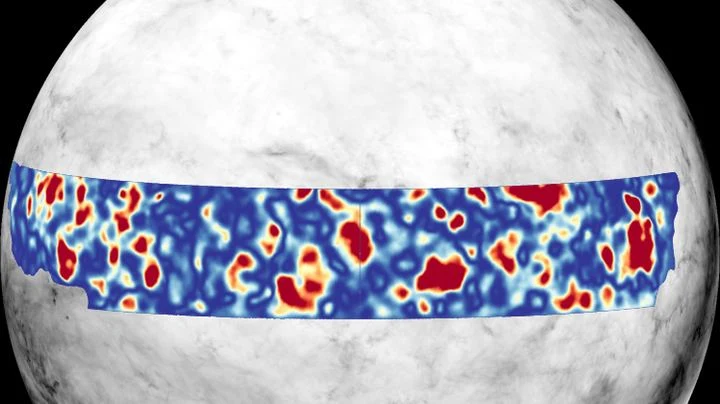
In 1967, Rainer K. Sachs and Arthur M. Wolfe showed that gravitational redshift explains the main anisotropies of the CMB. Before that, cosmologists puzzled over the origin of the microwave sky's patchiness. The idea is simple: a photon leaving a gravitational well loses energy, while one falling into a well gains it. But at the time of CMB emission, the wells were shallow, and photons escaped almost freely, slightly cooled. The total temperature change is proportional to the difference in gravitational potential at the emission point and on Earth. Since Earth is in a very weak field, the main contribution comes from the potential at the last scattering surface. It's like launching balls from different depths of a pool: the deeper, the slower the ball emerges to the surface.
History
In 1967, Rainer Sachs and Arthur Wolfe first described the mechanism of temperature fluctuations in the microwave background due to gravitational redshift. Their paper 'Perturbations of a Cosmological Model and Angular Variations of the Microwave Background' laid the foundation of modern CMB physics. Later, in the 1980s, with the development of inflationary cosmology, the effect became key to predicting the primordial perturbation spectrum. Measurements by satellites COBE, WMAP, and Planck confirmed the contribution of the Sachs–Wolfe effect with high precision, including the integrated version linked to dark energy.
How it works
The effect is used to extract information about dark matter distribution at recombination and constrain dark energy models via the integrated Sachs–Wolfe effect. It works within linear perturbation theory in GR under the condition of small fluctuation amplitudes. On small angular scales, other effects dominate (acoustic oscillations, Silk damping). The integrated effect is noticeable only in the presence of dynamical dark energy, making it a sensitive probe of cosmic expansion.
In practice
CMB maps use the Sachs–Wolfe effect to look back to the recombination epoch and test inflation models.
Fun fact
Thanks to the Sachs–Wolfe effect, astronomers can 'weigh' the most distant galaxy clusters without even seeing them: from the temperature of spots, they estimate the gravitational potential at recombination.
Imagine a lottery where instead of money, you win black holes. Each ticket is a random spot on the sky, and the prize is a gravitational wave from the merger of two giants. The chance of hitting the jackpot is minuscule, but if you do, the wave is heard across the entire universe.
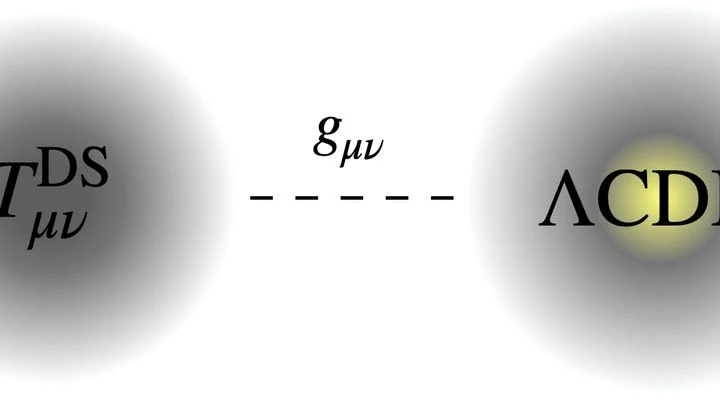
Space is expanding, and that expansion is accelerating. But what if, in the first instants after the Big Bang, gravity behaved differently? The authors of a new study added an invisible field to Einstein's equations that siphons energy from ordinary matter and radiation.
Light escaping a massive body loses steam. Its frequency dips slightly, and its color shifts toward red. Physicists call this gravitational redshift. In classical theory, it's all clear, but the moment you bring quanta into the picture, trouble starts.
Previously, this shift was modeled as a kind of mode mixer — a device that entangles different states of light.
Light escaping a massive body loses steam. Its frequency dips slightly, and its color shifts toward red. Physicists call this gravitational redshift. In classical theory, it's all clear, but the moment you bring quanta into the picture, trouble starts.
Previously, this shift was modeled as a kind of mode mixer — a device that entangles different states of light.
In the first moments after the Big Bang, the universe underwent a rapid expansion — inflation. Space stretched faster than light, and quantum jitters of the vacuum turned into real particles. This is how dark matter, the invisible substance that holds galaxies together, could have been born.
When two black holes merge, ripples spread across the fabric of spacetime — gravitational waves. But what if one of them isn't a run-of-the-mill black hole but something else — an exotic compact object?
A cloud of waves collapses under its own gravity. While it's loose, everything goes by the book: the field oscillates gently in nearly flat space, and approximate formulas work perfectly. But add just a bit more energy, and the picture changes.
Physicists used a numerical model to catch the moment when simple calculations stop describing reality.
A thrown stone sends ripples across water. A gravitational wave is the same kind of ripple, but in spacetime. It is produced, for example, by the merger of two black holes. In classical physics, this ripple is eternal: once created, it travels through the Universe without fading.
380 thousand years after the Big Bang, the universe cooled enough for light to decouple from plasma. That cosmic microwave background still pervades space, like the first chord of a symphony, the echo of a fiery beginning.
In the first moments after the Big Bang, cosmic symmetry breaking divided the hot plasma into regions with different vacuums — the lowest energy states of a field.
A cold, black mirror — that's what the sea of dark energy, the invisible substance driving the expansion of the universe, looked like for billions of years. But the DESI spectrograph has caught a faint ripple.
The LIGO detectors caught the signal GW250114—a gravitational wave from the merger of two black holes. After the main burst, a decaying 'tail' remained — direct waves from the newborn hole's horizon. It was expected that their damping would reveal the gravitational strength at the horizon's surface. But the measured value came out smaller.
The cosmic microwave background is not just a faint glow with a temperature of 2.7 K. It's a snapshot of the Universe 380,000 years after the Big Bang, when the primordial plasma finally became transparent to light. But for theoretical physicists, what came before is far more interesting.
The early universe resembled an overcrowded hall where heavy particles collided and decayed at a deafening pace. Among them could have been scalar leptoquarks — particles that simultaneously latch onto a quark (a building block of matter) and a lepton (such as an electron).
The cosmic microwave background is the petrified light of the first moments. Shortly after the Big Bang, microscopic quantum fluctuations were stretched by inflation to the scales of galactic superclusters.
Imagine a skyscraper assembled not from individual bricks but from entire studio apartments. That's exactly how the Au₆Te₁₂Se₈ crystal is built: its nodes are not atoms but superatomic clusters of gold and chalcogens that behave as single quantum objects.
When massive bodies accelerate (say, two stars orbiting each other) the space around them doesn't stay calm. It trembles like the surface of a pond after a stone is thrown. These tremors are called gravitational waves. They carry energy away, and the source gradually loses mass.
At the center of attention is a black hole with two points of no return: the outer and inner horizons. Beyond the outer horizon, space and time swap roles, but the journey is not over. Further in, at the inner horizon, gravity has another surprise in store.
Light passes through a crumpled film — and comes out slightly altered. In much the same way, gravitational waves born in the early universe feel the lumpy distribution of galaxies and dark matter.
A dead star with a magnetic field billions of times stronger than Earth's is a magnetar. Its crust cracks, sending a powerful X-ray burst into space. But some of that light doesn't reach us in its usual form. In an ultra-strong field, photons can turn into gravitational waves — the trembling of space itself.
Gravitational waves are ripples in the very fabric of spacetime, akin to vibrations of a giant cosmic string. Conventional detectors like LIGO and Virgo pick up low-frequency "notes"—disturbances from mergers of massive black holes of stellar masses.
An old photograph taken at the moment of the universe's birth has been carrying its light to us for nearly 14 billion years. This snapshot is the cosmic microwave background, the cooled echo of the Big Bang. It captures the tiny inhomogeneities from which galaxies later grew.
In the usual picture, a black hole is a featureless pit in spacetime. But if a shell of matter vibrates around it, the gap between the edge of the abyss and this shell becomes a resonant cavity.
In the early Universe, primordial black holes emerged — objects no larger than an atom but with the mass of a mountain. They gradually evaporate and, before disappearing, should produce gravitational waves — ripples in spacetime. If they were all identical, they would pop simultaneously, like popcorn kernels: the roar would be deafening.
A stone drops into a pond, and ripples spread across the water. If a protruding branch blocks the ripples' path, part of the wave reflects, and part bends around the obstacle. Gravitational waves, ripples in spacetime itself, behave similarly when passing by galaxy clusters or black holes.
Imagine a huge layered cake, where the layers of dough are space and the filling is a special region resembling an invisible wall. This wall is not made of bricks but of energy, and it could be as thick as the entire universe. If such a wall exists, it should stretch the dough layers differently: those lying along it spread apart faster, while those across it spread slower.
Ancient light, traveling 14 billion years, reaches us from all directions. At first glance, it looks perfectly smooth, but if you look closely, tiny fluctuations appear, like ripples on a still pond. Those ripples aren't random noise; they're an encoded history of the universe.
Two ocean liners sail at night without lights. One was built in a shipyard from steel plates, the other seems to have grown by itself from foam and waves. By ear they are almost indistinguishable, but an experienced hydroacoustician will catch the difference in the hum of the propellers and the contours of the hull.
Moving clumps of galaxies and invisible dark matter create wakes in the afterglow of the Big Bang, like boats stirring a pond. This wake, the moving lens effect, is so subtle it shifts the light’s temperature by only a few millionths of a degree: comparable to detecting a candle’s heat from across a continent.
A flashlight beam glides over uneven glass. The glass is massive galaxy clusters, and the flashlight is ancient light born shortly after the big bang. Passing by such clusters, light doesn't just bend around them like water around a rock. Its path shifts slightly sideways, and the amount of shift depends on how the light is 'twisted'—right or left.
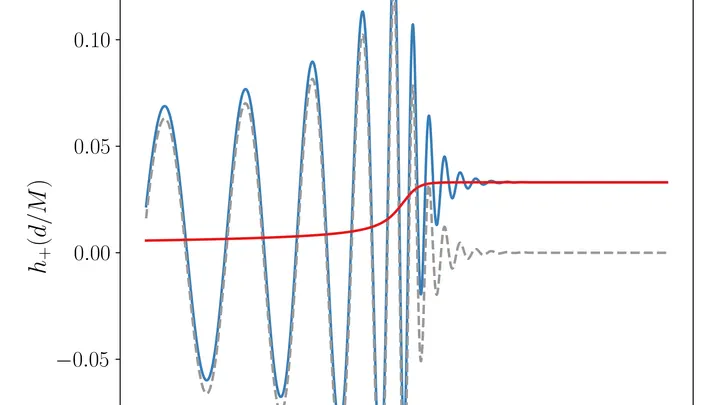
A black hole collision isn't just a burst of gravitational waves; it also leaves a lasting trace: an eternal curvature of spacetime — gravitational memory. Like a boat on water leaves a lingering wake, the cosmos 'remembers' the catastrophe.
A pond with ripples spreading from a fallen stone. So it is on cosmic scales: a sudden burst of energy in the dark sector, an invisible substance that emits no light, creates ripples in the fabric of space. These ripples alter the path of light particles traveling to us from the very birth of the cosmos.
The authors of the new study built a mathematical framework to describe these distortions.
A tuning fork, once struck, makes neighboring strings vibrate. Much the same happens with a cloud of ultralight particles (also called axions) around a rapidly spinning black hole. The hole, like a motor, spins up the particles, and they begin to emit gravitational waves — a trembling of space itself.
A figure skater glides across the ice, gradually approaching the center of the rink. A slight twist of the torso, and the smooth spiral breaks, the trajectory becomes unpredictable. Something similar happens when a small black hole with its own rotation (spin) falls toward a giant black hole.
A thrown stone arcs along a clean trajectory, but an electron's position in an atom is smeared out like fog. The transition from one to the other is a puzzle. New work shows that the fuzziness disappears not because of an observer, but because of the particle's own gravity.
Take two heavy balls and place them a meter apart: they attract each other with a force that weakens by a factor of four when you double the distance. Newton discovered this law, and it works in a room, in the solar system, in a galaxy. But does it still hold when we're talking about hundreds of millions of light-years?
Astronomers found a way to test this directly.
In 2015, two giant facilities in the United States caught the shiver of space — a gravitational wave from the collision of black holes. Since then, such signals have been caught regularly, but the detectors themselves are enormous: their arms stretch for kilometers.