An Event Takes Shape
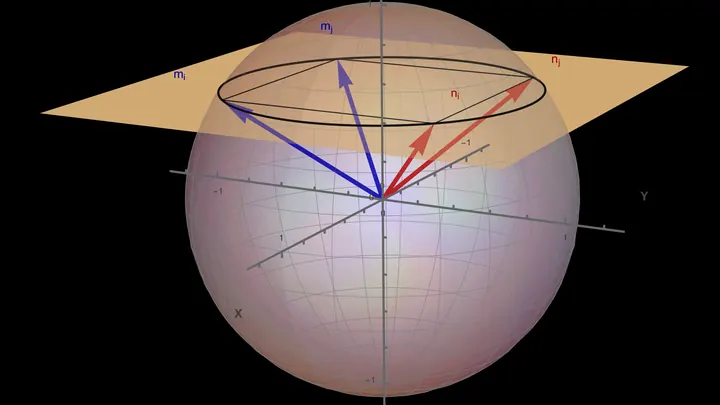
In the familiar picture of the world, an event is a point on the map of spacetime: 'here and now,' with no size or internal structure.
spacetime interval — from formula anatomyThe spacetime interval is a quantity in special relativity that measures the 'distance' between two events in four-dimensional spacetime. Unlike ordinary spatial distance, the interval is invariant under Lorentz transformations, meaning all observers agree on its value regardless of their relative motion. It is defined as Δs² = c²Δt² − Δx² − Δy² − Δz², where c is the speed of light.
The concept was introduced by Hermann Minkowski in 1908, who reformulated Einstein's special relativity in terms of a four-dimensional spacetime geometry. Minkowski's insight was crucial for the later development of general relativity.
The sign of Δs² determines the causal relationship between events: if Δs² > 0, the events are timelike-separated (one can causally influence the other); if Δs² < 0, they are spacelike-separated (no causal connection); if Δs² = 0, they lie on a light cone. The interval is the analog of the Pythagorean theorem in spacetime, but with a minus sign for spatial coordinates, reflecting the different geometry of spacetime.
The spacetime interval is fundamental in particle physics for analyzing decay processes and collisions, and in GPS satellite systems, where relativistic corrections are essential for accurate positioning.
The minus sign in the interval is why the geometry of spacetime is called 'pseudo-Riemannian'—it behaves like Euclidean geometry but with a flipped sign for time, leading to the famous 'light cone' structure.
| ds^2 | variable | spacetime interval — spacetime interval metre squared |
| dt | variable | coordinate time differential — time differential second |
| dr | variable | radial coordinate differential — radial coordinate differential metre |
| dΩ^2 | variable | solid angle element squared — solid angle element squared |
| ρ | variable | metric function of r and t — metric function |
| λ | variable | metric function of r and t — metric function |
| r | variable | radial coordinate — radial coordinate metre |
| ds^2 | variable | Spacetime interval squared — spacetime interval metre squared |
| \Phi(r) | variable | Redshift function — redshift function |
| b(r) | variable | Shape function — shape function metre |
| r | variable | Radial coordinate — radial coordinate metre |
| t | variable | Time coordinate — time coordinate second |
| d\Omega^2 | variable | Solid angle element squared — solid angle element |
| d | operator | Exterior derivative — differential operator |
| ds^2 | variable | spacetime interval — spacetime interval metre squared |
| dt | variable | coordinate time differential — time differential second |
| dr | variable | radial coordinate differential — radial coordinate differential metre |
| dΩ^2 | variable | solid angle element squared — solid angle element squared |
| r | variable | radial coordinate — radial coordinate metre |
| t | variable | coordinate time — coordinate time second |
| G | constant | Newton's constant of universal gravitation — gravitational constant = 6.67430e-11 cubic metre per kilogram per second squared |
| c | constant | speed of light in vacuum — speed of light = 299792458 metre per second |
| M | constant | mass of the central object — mass kilogram |
| d | operator | infinitesimal change — differential |