Scientist

Ilya Prigogine

1917–2003 · Thermodynamics, Physical chemistry, Complex systems
Belgian physical chemist of Russian origin who made significant contributions to non-equilibrium thermodynamics. He introduced the concept of dissipative structures, showing how ordered systems can arise from chaos.

Biography

Graduated from the Free University of Brussels. Worked there and at the University of Texas at Austin. Nobel laureate in Chemistry in 1977. Advocate of an interdisciplinary approach.

Key discoveries

💡 Prigogine was an avid pianist and believed that music helps to understand the irreversibility of time.
"He believed that the future is not given, and time is not just an illusion but a construction."
Concepts
Phase transition
Scientists
Steven WeinbergAndré-Marie AmpèreLars OnsagerGustav KirchhoffRobert HermanRudolf ClausiusJosiah Willard GibbsRoy Kerr

Related articles

Noise as Glue for a Broken Climate Vase
For thirty years, climatologists have been gathering the shards of a broken vase. Each climate model is its own shard, and they all promise different warming by 2100, from 1.5 to nearly 6 degrees. The spread does not shrink no matter how much the models are improved.

stat.ME2017-06-182 minarXiv:1706.05661
An Orchestra Where Every Instrument Enters on Its Own Schedule
An orchestra plays a complex piece, and each group of instruments enters on its own schedule. The violins might slow down while the woodwinds keep the same tempo, and the percussion might suddenly burst into a roll. The conductor hears everything at once, but pinpointing the exact moment when the flutes, not the cellos, changed rhythm is nearly impossible.
The Planet's Pulse with an Irregular Rhythm
Every few years, the Pacific Ocean takes a deep breath. Warm water that usually piles up near the coasts of Indonesia spreads eastward toward South America, and the trade winds that had been pushing it west temporarily ease. This inhale and exhale is called El Niño–Southern Oscillation, or ENSO.
q-bio.PE2021-07-022 minarXiv:2107.05740
Dengue Waves: What Links the Fever to the Ocean and the Foliage
Every year in Costa Rica, dengue fever arrives like the rainy season: people expect it, they prepare for it, but the exact rhythm of outbreaks has remained a mystery. In some cantons, the disease flares up every year; in others, every two or three years.
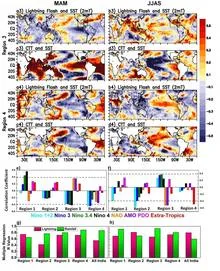
Echoes of Distant Oceans: How Seasonal Lightning Can Be Predicted from Slow Currents
Every year, lightning kills thousands of people, especially in the tropics, where thunderstorms are most intense. In India, the share of lightning deaths among all victims of natural disasters is rising, despite an overall decline in fatalities from cyclones and floods. One might think that lightning is too fast and too local to predict months ahead.
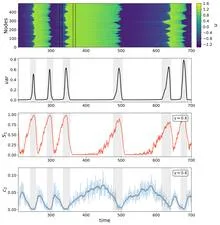
A Network That Rings Before the Lurch
A fisherman pulls on his net and listens to it ring. Each strand quivers in its own way, but before a strong tug, all the strands begin to vibrate in unison. So it is with complex systems: before a sharp state jump, the individual parts suddenly start to oscillate in concert, and that synchrony betrays the coming jump.
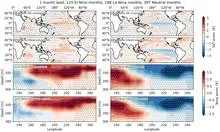
Ocean and Atmosphere Learn to Speak the Same Language
Two dancers stand facing each other but cannot see each other's faces. One is the atmosphere, fast and noisy, forgetting its moves after just a couple of weeks. The other is the ocean, slow and heavy, remembering every touch for months. For the dance to work, they need to learn to lead each other while only looking at their partner's hands.
Three Voices of the Pacific: How a Neural Network Learns to Hear Each One Separately
The ocean hums like a crowded hall: in one corner, voices argue about decades; in another, about years; in a third, about the changing seasons. To pick apart these voices, climatologists used to rely on filters they tuned themselves, letting through only slow waves or only fast ones. But the Pacific plays by its own rules: a warm patch off the coast of Peru can be a brief spike or part of a long-term rearrangement.
Biological Physics2025-10-071 minarXiv:2510.05792express
Cells Communicate with Light
Living cells continuously exchange light signals — a billion times fainter than daylight. It's like a whisper picked up by ultra-sensitive instruments. A healthy cell whispers rhythmically, a cancerous one — haltingly, but with a long memory of previous flashes.
The Finest Needles Listen to the Human Brain
Silence in the operating room. The surgeon slowly lowers a needle thinner than a human hair into the patient's brain. At its tip is not a point but a whole palisade of nine hundred sixty microscopic microphones. Each one listens to its own tiny patch of gray matter.
Instrumentation2026-01-161 minarXiv:2601.11415express
How Gravitational Waves Help Us Listen to Bearings
A neural network originally trained to distinguish real gravitational waves from noise in a gravitational wave detector recognizes bearing wear from vibrations without retraining.
q-bio.BM2026-01-161 minarXiv:2601.11450express
How a client protein reshuffles the contents of cellular droplets
Inside a living cell, there are tiny liquid droplets where proteins gather together, like ingredients in a drop of vinaigrette. Some proteins form the droplet's scaffold, while others, clients, don't create the droplet themselves but happily jump in and change its composition.
Biological Physics2026-01-221 minarXiv:2601.16151express
Switch Proteins: How a Cell Reads DNA
A cell is like a kitchen where thousands of recipes (genes) are collected in one thick book (DNA). The chef-protein Klf4 flips through the pages and decides which recipe to cook today. But how does it find the right line among billions of letters? Previously, researchers thought the protein looked for a short 'password'—a few consecutive letters.
Geophysics2026-01-311 minarXiv:2602.00421express
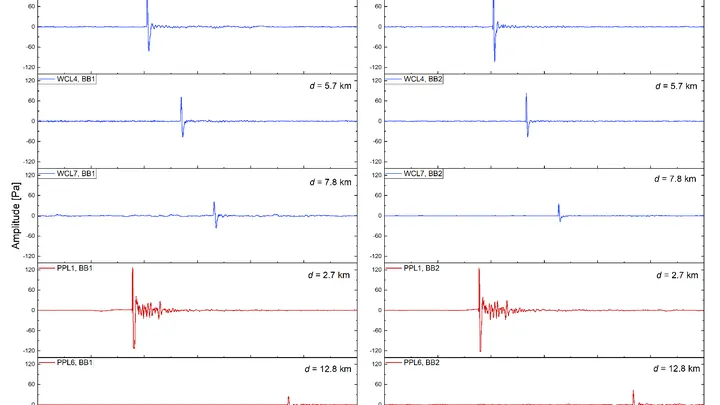
Wind Changes the Voice of an Explosion
The same explosion can sound different: it all depends on which way the wind is blowing. In 2024, researchers set off charges equivalent to ten tons of TNT twice and recorded the sound with a network of 31 microphones spread over a radius of 23 kilometers. The source was identical, but the acoustic pictures turned out to be quite different.
Gamelan Hears El Niño: How Javanese Scales Turn Climate Chaos into Sound
The bronze plates of a gamelan do not sound according to a single tuning standard: each orchestra on Java keeps its own tuning, and two neighboring ensembles may play the same melody in slightly different intervals.
Medical Physics2026-02-191 minarXiv:2602.17553express
The Brain's Pulse Delivers Drugs
Fluid flows in the narrow gaps between brain cells. It doesn't stay still: each heartbeat pushes it forward, and breathing adds its own waves. This was seen in images ten years ago, but only now have researchers calculated how this pulsing accelerates molecules. If you drop ink into a stream, it drifts with the current. But if the stream speeds up and slows down, the ink spreads wider.
The Brain's Wiring: How White Matter Orchestrates Thought
The brain is like a sprawling city: districts-regions communicate via streets-neural pathways. If traffic lights at an intersection fail, traffic grinds to a halt. Similarly, in the brain, when bundles of nerve fibers (white matter) malfunction, distant regions stop working in concert, and thought stalls.
q-bio.QM2026-02-281 minarXiv:2603.00678express
Genetic Precision Without Stability
You can edit a cell perfectly, and it still turns out useless. The gene is fixed exactly as planned, yet the cell behaves unpredictably: it drifts, changes fate, loses safety. It's like fixing one gear in a watch, but the watch still runs wrong because the whole mechanism is out of sync. Previously, a cell was viewed as a list of independent parts.
Machine Learning2026-02-282 minarXiv:2603.00786express
How the Brain Rewires Itself in Alzheimer's Disease
The brain isn't one big computer: it's more like an orchestra, where different groups of musicians play their parts. Neural networks for memory, attention, or emotions are constantly talking to each other. In Alzheimer's disease, this orchestra starts to go off-key: some groups fall silent, others play out of sync.
Signal Processing2026-02-281 minarXiv:2603.16891express
AI Reads Cardiograms Around the Clock
An electrocardiogram is like a long strip of paper on which the heart leaves its signature. A doctor studies it to catch rhythm disturbances, but when the recording lasts for days, the strip stretches for miles. The eye tires, attention wanders, and rare but dangerous irregularities can slip by. AI-HEART works like a tireless assistant that scans the entire strip without a break.
Medical Physics2026-03-042 minarXiv:2603.03832express
A Heart in Your Hand: Seeing Arrhythmia Without Surgery
The heart doesn't contract all at once but as a wave: an electrical signal travels through the muscle, and behind it, like ripples spreading on water, a contraction rolls through. In arrhythmia, this wave goes awry: it stalls in one spot, loops in another, and the pump starts working in a disorganized way.
EEG Can't Tell Remission from Healthy
Depression is sometimes sought in the brain's electrical waves. The logic is simple: if a disease has stages (acute, maintenance, recovery) then the signals should change gradually, like volume when you turn a knob. Researchers took EEG recordings from 74 people: 24 in the acute phase, 23 in the maintenance phase, and 27 healthy.
The Neuron City: Why Some Brains Think Fast and Others Slow
A mouse brain contains about 70 million neurons, and the connections between them are far from evenly distributed: some cells have only a couple of dozen contacts, while others have thousands. It's like a city with quiet alleys and bustling squares. But until now, it was unclear how this unevenness affects the brain's actual function.
Tissues Find Their Rhythm
A piece of dough, when pulled from the sides, doesn't stretch evenly: in one spot it thins and tears. Living tissue behaves similarly, but instead of a tear, shear bands appear — narrow zones where cells begin to slide past each other, like cards in a deck when cut.
Machine Learning2026-03-141 minarXiv:2603.13850express
EEG Predicts Who Will Benefit from Nerve Stimulation
A patient with schizophrenia comes in for a procedure that feels like a mild tingling in the ear. The doctor switches on a small electrical stimulator attached to the earlobe, and after a few weeks, some people find their apathy and withdrawal receding, while others see no change at all. Until now, predicting this was impossible.
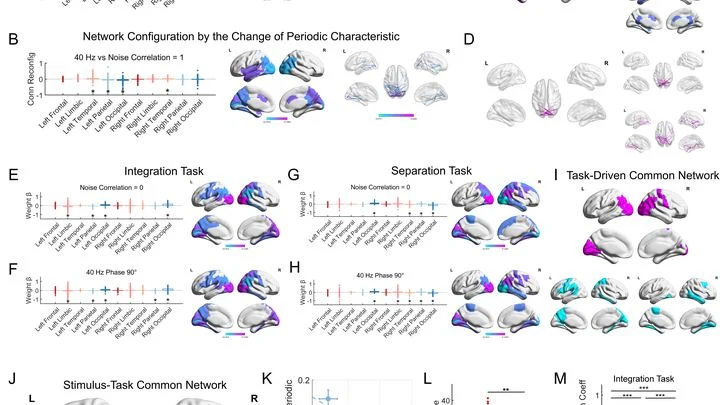
Brain on a Wave: How Phase and Amplitude Reveal Disease
A resting brain is not silent: its regions talk to each other, and these conversations can be eavesdropped on with a scanner. Usually, scientists track signal strength — how loudly each area 'sounds.' But a conversation also has rhythm: some areas light up simultaneously, others with a delay.
Geophysics2026-03-161 minarXiv:2603.14844express
The Ocean Listens Through Fiber Optics
Thousands of kilometers of fiber-optic cables lie on the ocean floor. They carry internet traffic, but the cables themselves sense the slightest vibrations in the water and the seabed. If you listen closely to such a cable, you can hear a blue whale singing or the ground trembling thousands of kilometers away.
The Ocean Whispers Early: Neural Network Hears the Atlantic Winter Three Months Ahead
The ocean does not shout about its intentions. It whispers: a warm patch off the coast of Peru, a cold tongue near Hudson Bay, a barely perceptible shift in a current. The atmosphere does not respond immediately, and by winter Europe may get either mild slush or Siberian frosts.
Machine Learning2026-03-202 minarXiv:2603.20442express
The Quiet Signal Before the Strike
A stroke hits suddenly, but before the strike, the brain sends quiet signals. Blood vessels stop smoothly regulating blood flow, like a thermostat that starts overheating or overcooling a room without reason. This imbalance is invisible on ordinary wearables, but it can be caught by listening to several body rhythms at once.
How Cells Build a Growth Boundary
A colony of cells is like a city that grows from its outskirts: new houses appear where there's more space. Inside, it's crowded, and construction stalls. Similarly, cells divide more often at the edge, where neighbors squeeze them less. Scientists modeled this without any chemical commands — only mechanics. In the model, each cell is a ball that presses on others.
How bacterial genes assemble into living droplets
In a growing bacterium, genes that run protein factories don't drift solo. They clump into liquid droplets, like oily smears in water — no membranes, but sharp boundaries. The NusA protein fuels this condensation. When it piles up, it glues neighboring DNA stretches together, forcing them into foci.
How the Brain Conducts Speech
Speech is like an orchestra where every note must sound at just the right moment. The brain turns a thought into a chain of sounds in a fraction of a second, and until now it was unclear how it manages this hierarchy — from individual sounds to syllables to whole words.
Biological Physics2026-04-092 minarXiv:2604.08316express
How Cell Motors Set Droplet Size
Inside a cell, there are tiny liquid droplets, like oil droplets in water. They form from proteins and RNA and serve all sorts of purposes, from storing molecules to speeding up reactions. But if droplets start merging with each other, you'd end up with one big puddle, which would wreck the cell's organization.
How Chlorine Conducts a Seizure
A neuron that has just calmed down is like a pianist lifting their hands from the keys. But inside, silent work continues: tiny pumps push chloride ions outward, returning the instrument to a state of readiness. If the pumps fall behind, chloride builds up, and then an inhibitory signal meant to quiet the cell suddenly starts exciting it.
q-bio.QM2026-04-172 minarXiv:2604.16642express
Cells Huddle Together or Scatter
An orchestra without a conductor. Each musician plays their own part, and the overall volume builds, but the melody falls apart — violins rush ahead, brass lags behind. Cells behave much the same way when their DNA is modified: they may shift, but some move far, while others stay put.
Medical Physics2026-04-182 minarXiv:2604.16981express
The Retina Tells on the Brain
A flashlight shines into the eye, and the retina responds with electrical impulses, like an echo, but not of sound, of light. This echo can be recorded, and it reveals not only how the eye is working but also how the brain is. After all, the retina is a piece of the brain that has been pushed out to the periphery.
Scales That Hear an Echo in a Drop
Quartz microbalances are thin plates that vibrate at a frequency of five million times per second. When a drop of liquid lands on the plate, the vibration changes: from these changes, you can determine the drop's mass and its elasticity.
Ringing in the Ears: How the Brain Gives Itself Away on an EEG
A person hears a ringing that isn't there. The doctor asks them to describe it — loudness, pitch, persistence. But it's subjective: one might say "like a mosquito," another "like steam from a kettle." We need a way to see tinnitus directly, in the brain itself.
The Brain's Conductor: How the Parietal Region Switches Modes
The brain constantly juggles tasks: it reacts to a sharp sound, solves an equation, or drifts into daydreams. Scientists have long suspected that switches between different "scenarios" of neural network activity underlie this, but extracting them from the chaos of electrical signals was difficult.
q-bio.OT2026-04-261 minarXiv:2604.23773express
Microbial network rewires when the host falls ill
The microbial community in the gut is like an orchestra: what matters is not only the musicians but how they play together. When disease strikes, it's not just the lineup of microbes that changes: their interconnections shift too. Researchers built interaction networks of microbial genes in healthy and sick individuals.