Argon is a noble gas element with atomic number 18, known for its chemical inertness and abundance in the Earth's atmosphere (about 0.93% by volume). In the context of the double ionization experiment, argon serves as a target gas: when exposed to intense laser pulses, its atoms can be stripped of two electrons simultaneously, a process that reveals intricate quantum mechanical details about electron correlation and the dynamics of strong-field ionization.
History
Argon was discovered in 1894 by Lord Rayleigh and William Ramsay, who isolated it from air. Its role in strong-field physics experiments became prominent in the late 20th century with the advent of intense femtosecond lasers.
How it works
In the experiment, a focused laser beam is directed into a chamber containing argon gas. The intense electric field of the laser can suppress the Coulomb barrier, allowing one or more electrons to escape via tunneling. For double ionization, the two electrons can either be removed sequentially (one after the other) or non-sequentially, where the first electron's recollision with the ion helps eject the second. Argon's relatively high ionization potential and its closed-shell electronic structure make it a clean and convenient target for studying these processes.
In practice
Beyond fundamental physics, argon is used in laser technology, as a shielding gas in welding, and in the detection of dark matter in experiments like DEAP-3600, where its scintillation properties are exploited.
Fun fact
Argon is the third most abundant gas in the Earth's atmosphere, yet it was not discovered until the 1890s because it is completely unreactive and transparent, making it invisible to the chemical tests of the time.
Forty light-years away lives a star that went unnoticed for a long time: TRAPPIST-1 emits two thousand times less light than the Sun. But it turned out to have seven Earth-sized planets, three of which orbit in the zone where water could remain liquid. Yet little was known about the star itself, about its chemical kitchen.
An extra electron in a molecule is like a passenger barely hanging onto the step of a departing train. Such a 'passenger' turns the particle into an anion — a negative ion. Studying it is tough: the bond is weak, the electron cloud is diffuse, and any jolt can knock the electron off.
In 1,433 pairs of galaxies scattered across the sky, astronomers noticed an unusual pattern. Neighbors located 'above' or 'below' a massive stellar system contain up to a quarter more oxygen than those lying in the plane of its disk.
Massive gas outflows from active galactic nuclei are a key regulator of galactic evolution. They sweep out the interstellar medium, quench star formation, and dictate the growth of supermassive black holes.
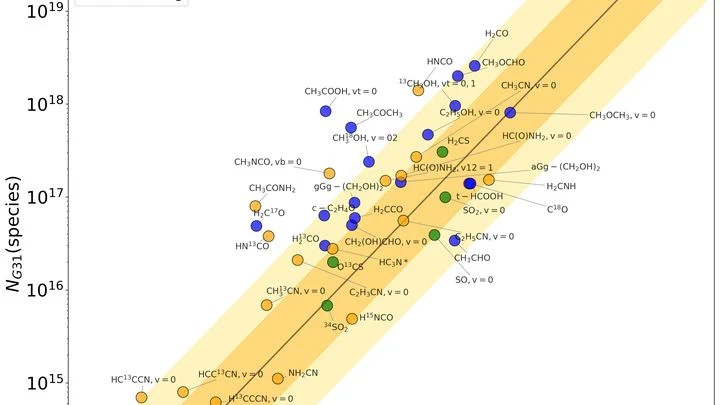
In an oven, a huge loaf of bread is baking. Inside the dough, there is a tiny, hottest spot: that's where the future loaf begins to rise. A hot molecular core (a region the size of the Solar System, where gas is heated to hundreds of degrees and compressed to billions of times the density of ordinary clouds) works in much the same way.
A tiny diamond with a defect — a nitrogen atom next to a vacancy in the crystal lattice. This defect, the NV center, acts like a magnetic needle: under green light, it glows red, and the brightness of that glow depends on the direction of its magnetic field.
A pool of the purest water, into which tiny, almost invisible droplets occasionally fall. Each leaves a barely perceptible ripple, and capturing it requires years of patience. That is what the hunt for solar neutrinos looks like in the DEAP-3600 detector — a huge vat of liquid argon hidden deep underground.
Diamond is the hardest natural material and usually does not conduct electricity. But if you add a few foreign atoms to its crystal lattice, it can become a semiconductor, like silicon in computer chips.
An electron flying through a gas is like a swimmer trying to cross a crowded pool. Each collision with an atom changes its course and speed. In dense argon gas, there are so many collisions that a simple description no longer works.
Physicists measured electron mobility — how easily electrons drift under an electric field.
A laser strikes a strontium atom, and two electrons fly out at once. Previously, it was thought that in such double ionization each electron acts on its own: one is knocked out first, the second later, randomly.
The gas in a galaxy glows like a neon sign, and by the color of that glow, astronomers can tell how hot it is. The logic is simple: the more heavy elements (which astronomers call metals) in the gas, the better it cools. So galaxies rich in metals should have cooler gas. But new observations show the opposite.
In the dark chamber of the detector, argon waits. When an invisible particle (say, a dark matter candidate) flies through, it gives the argon nucleus a gentle shove. The nucleus is knocked out of place, and charges are born around it. Exactly how many charges is no trivial question: physicists use that number to tell what kind of visitor dropped by.
A quasar is a supermassive black hole at the center of a galaxy that devours matter and shines brighter than all the stars around it. Some of that energy goes into radio emission, which, it was thought, could heat or expel cold gas — the raw material for new stars.
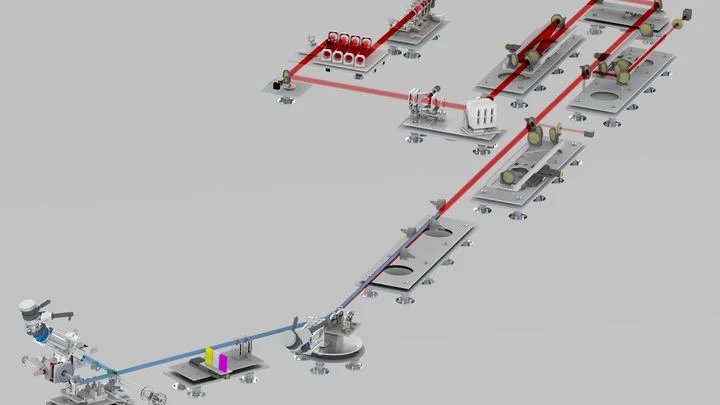
An ordinary camera flash lasts a thousandth of a second. The new setup at the ELI ALPS laboratory in Hungary produces flashes a billion times shorter. Each flash consists of a few hundred oscillations of the light wave, packed into a time interval in which light travels a distance smaller than the thickness of a human hair.
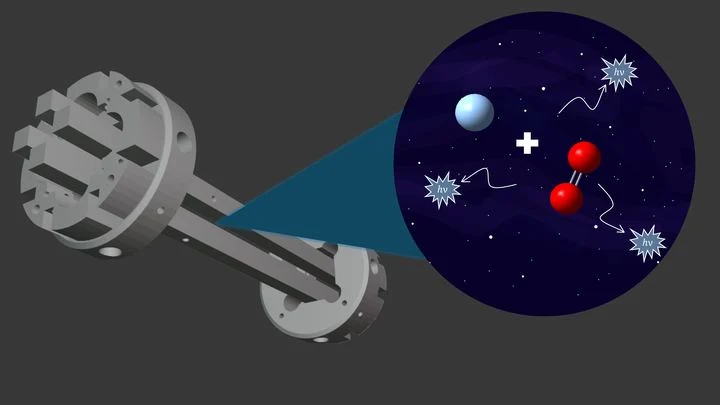
In the cold, sparse clouds of space, particles rarely meet, but sometimes an ion and a neutral molecule pass close enough to stick together. As they do, they emit light, like a muted flash carrying away excess energy. This process is called radiative association, and it is responsible for the formation of many molecules in interstellar space.
An oven with three racks, each baking a different dish: that's the image that comes to mind when you look at the galaxy I Zw 18. The top rack is blazing at 21,200 kelvins, the middle one at 17,290, and the bottom at 16,170.
A drop of ink in a glass of water quickly spreads, tinting the whole liquid. Similarly, electrons in a metal move freely, like molecules in a gas. But when a magnetic impurity, an atom with its own magnetic moment, enters this medium, something strange happens.
Like long-distance runners, atomic nuclei, from light helium to heavy iron, race toward us across the Galaxy. At the finish line, in a detector on a high-altitude balloon, we see that heavy nuclei arrive a bit more exhausted than light ones. The difference is small, but it repeats from flight to flight.
In the stream of charged particles flying toward us from the depths of the Galaxy, iron turned out to be the odd one out. The ATIC-2 instrument, lifted on a balloon over Antarctica, compared how the fraction of nuclei from sulfur to chromium relative to iron changes with energy.
In the stream of cosmic rays, particles flying toward us from the depths of the Galaxy, titanium is rare. Its nuclei are almost indistinguishable from iron: both are heavy, and both leave similar tracks in detectors.