Axions are hypothetical elementary particles that could explain dark matter and solve a long-standing puzzle in particle physics known as the strong CP problem. They are predicted to interact extremely weakly with ordinary matter, making them notoriously difficult to detect. Neutron stars, however, offer a unique natural laboratory: their intense magnetic fields — the strongest known in the universe — can convert axions into detectable electromagnetic radiation, typically in the radio or X-ray band.
History
The axion was proposed in 1977 by Roberto Peccei and Helen Quinn to explain why the strong nuclear force preserves CP symmetry, with the particle itself named by Frank Wilczek and Steven Weinberg. The idea of using neutron stars for axion detection gained traction in the 2010s, with detailed predictions published by researchers such as Christopher Dessert and Benjamin Safdi.
How it works
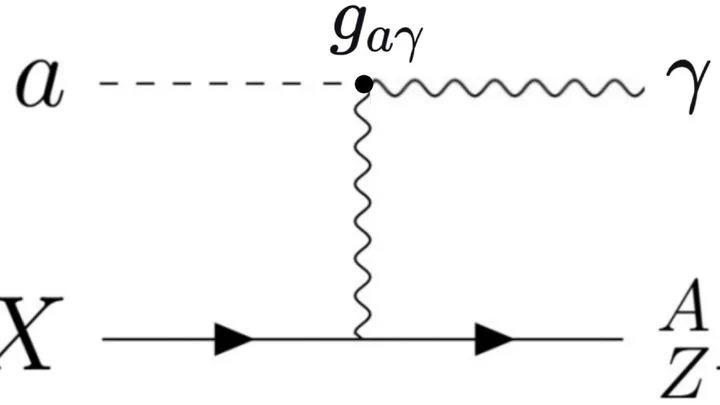
In the presence of a strong magnetic field, an axion can convert into a photon (and vice versa) through a process called the Primakoff effect. Near a neutron star, axions produced in the star's core or in the surrounding magnetosphere would traverse the magnetic field, and a fraction would convert into photons. These photons would emerge with energies matching the axion mass, creating a narrow spectral line that telescopes can search for. The conversion probability depends on the field strength and the path length, which is why neutron stars — with fields up to 10^15 gauss — are prime targets.
In practice
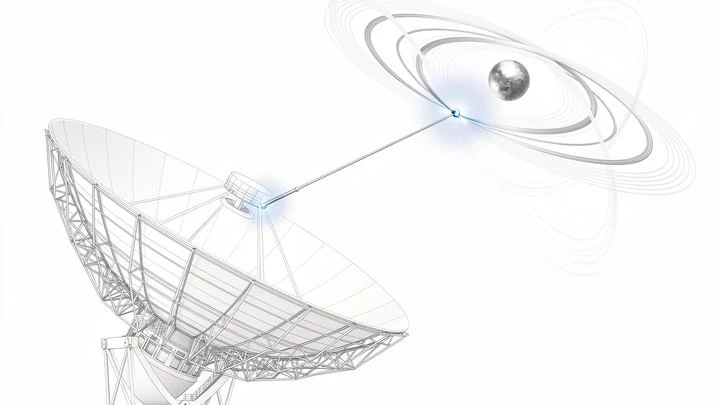
Searches for axion-induced radio signals from neutron stars are ongoing using observatories like the Green Bank Telescope and the Effelsberg Telescope, aiming to detect dark matter axions or axions produced in stellar interiors.
Fun fact
If axions exist, they would be so light that a single cubic centimeter of dark matter axions would contain roughly 10^14 particles, yet their combined mass would be only about 10^-18 grams.
The orchestra plays, though no one sees the conductor. The musicians are charged particles in the pulsar's magnetosphere, and the score is the electric and magnetic fields generated by the spinning superdense star.
The antiproton beam hits the plate, and each impact bursts into a shower of charged particles. In the GBAR experiment at CERN, this picture is captured not by a sophisticated detector but by an ordinary industrial camera without a lens, pressed against the vacuum window from the outside.
Inside the Sun, reactions can produce light, almost undetectable particles called axions. One such reaction yields axions with an energy of 5.49 MeV, as if each one carried the energy of a tennis ball moving at 100 km/h. These particles pass freely through Earth, but occasionally they might collide with a xenon atom.
An extra electron in a molecule is like a passenger barely hanging onto the step of a departing train. Such a 'passenger' turns the particle into an anion — a negative ion. Studying it is tough: the bond is weak, the electron cloud is diffuse, and any jolt can knock the electron off.
The early Universe resembles a boiling cauldron, where particles and antiparticles are born and die in equal numbers. But today, all around us is only matter — stars, planets, ourselves. How did a tiny excess of one part in a billion emerge from the initial equality? One answer hides in the oscillations of a heavy field, like a rock that the tide alternately submerges and exposes.
In the distant Cigar Galaxy, there is an unusual beacon. It doesn't shine in the usual sense: its rays are born in a scorching cloud around a black hole that is devouring matter from a companion star. Such objects are called ultraluminous X-ray sources. Their X-ray brilliance is so intense that it outshines entire galaxies.
This cloud, the corona, is like a boiling cauldron.
Some 123 parsecs from Earth, in the constellation Corona Australis, drifts the neutron star RX J1856.5-3754. Its diameter is about 12 kilometers, smaller than Moscow's Ring Road, but its surface temperature reaches 460 000 kelvin. The star emits a slow, almost inaudible exhalation.
Deep underground, in the silence of a cryostat (a cooled container), lie crystals of lead that once belonged to an ancient Roman ship. This material barely emits background radiation — over two thousand years, unstable isotopes have decayed, leaving it perfectly clean for hunting the rarest events.
A lighthouse at sea doesn't just rotate: its lamp itself dims and brightens on its own. Magnetic white dwarfs, the ultra-dense remnants of stars like our Sun, behave in much the same way. Their powerful magnetic fields can convert light into axions — hypothetical particles that could explain the Universe's hidden mass.
A handful of sand in your fist: the grains press against each other, and your hand can't squeeze any further. Ordinary matter behaves similarly. But in a neutron star, compression is billions of times stronger — atoms are crushed, electrons are squeezed into protons, and nearly all space is filled with neutrons.
A neutron star is the collapsed core of a massive star, squeezed to the size of a city. A teaspoon of its material weighs as much as a mountain. But inside this superdense sphere, a surprise may lurk: under unimaginable pressure, neutrons break apart into quarks, giving the star a new, more compact core.
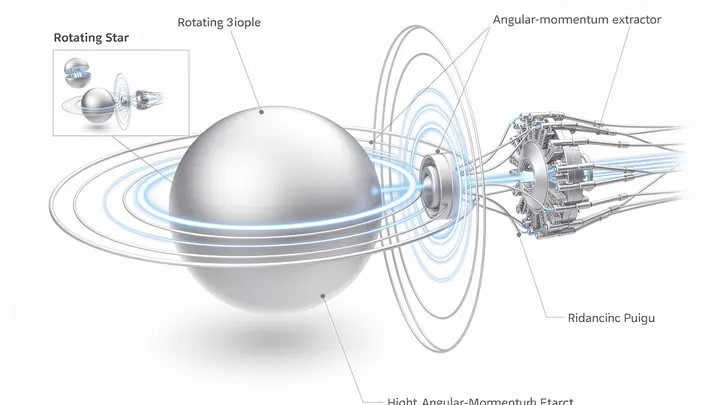
For decades, SETI has hunted for Dyson spheres — hypothetical shells that capture a star's light stars and re-radiate it in the infrared. But the cosmos remains silent. Perhaps an alien intelligence operates more elegantly: instead of collecting light, it tames the rotation of a sun, like a giant flywheel.
Neutron stars — remnants of supernovae — are among the densest objects in the Universe. Their central density exceeds nuclear density many times over, and gravity is surpassed only by black holes.
The story began with a puzzle: in the 1930s, Fritz Zwicky noticed that clusters of galaxies behave as if an enormous invisible mass is hidden within them. Half a century later, Vera Rubin confirmed that stars on the outskirts of galaxies rotate too fast to be held by visible matter alone.
Neutron stars are cosmic 'ice cubes' of unimaginable density: a tablespoon of their material would outweigh Mount Everest. It was a mystery what lay in their cores: ordinary neutron matter (a giant atomic nucleus) or exotic quark matter, where particles are not bound into neutrons.
Listening to the cosmos requires patience and a finely tuned ear. Astronomers chose the most sensitive low-frequency instrument for this: the OVRO–LWA antenna array — 352 dipole antennas scattered across two and a half kilometers of California desert.
The Universe doesn't just expand — it resonates. After the Big Bang, stretched strings remained in its fabric — thin as a proton, yet heavy as a mountain range. Their oscillations give birth to gravitational waves, and in this radiation, like in a musical score, the history of fundamental symmetries is encoded.
Atomic nuclei are not always like billiard balls. Some are elongated, like cigars, others are flattened. But xenon-129 resembles a potato — a bumpy triaxial ellipsoid.
Tiny invisible bullets pass straight through the Sun, barely noticing its matter. These are axions — hypothetical particles so light and elusive that they are often compared to ghosts.
In a vast hall, a hundred tuning forks are set out. Each one is a pulsar — an ultra-dense stellar remnant spinning at a furious rate, sending out radio pulses more precisely than any clock. When a low-frequency sound wave sweeps through the hall, all the tuning forks start to go slightly out of tune at the same moment.
Two tin nuclei collide at about two-thirds the speed of light. For an instant, a hot, dense cloud forms, and protons fly out in all directions. If you catch pairs of protons and measure how often they fly off in the same direction, you can work out the size of that cloud. This method is called femtoscopy: it works like a microscope for nuclear scales.
In 1987, astronomers saw a supernova flare up in a neighboring galaxy — the Large Magellanic Cloud. It was a rare gift: the explosion was close enough to catch not just light but also neutrinos, those nearly undetectable particles that pass straight through Earth.
Imagine a tiny coin hidden inside a perfect safe, but the walls are so thin that the coin sometimes slips right through, leaving a barely audible sound. Axions are like those coins — except instead of metal, they're particles, and instead of a safe, they're ordinary matter. They barely notice obstacles, making them incredibly hard to catch directly.
In a noisy city, you try to hear a cricket. It's quiet, and cars are humming all around. To catch its chirp, you set up a sensitive microphone and hit the noise-cancellation button. That's roughly how physicists hunt for axions — hypothetical particles that could be the very dark matter holding galaxies together.
When a massive star dies, a supernova explosion occurs, so powerful that a single flash outshines an entire galaxy. In this fire, billions of axions are born — invisible particles that leave almost no trace. Every second, trillions of these tiny things fly right through each of us, completely unnoticed.
Neutron stars are the compressed cores of dead stars — city-sized objects with staggering density. Some of these stars become pulsars, cosmic lighthouses emitting strictly periodic radiation pulses.
In collisions of heavy nuclei, a fireball of thousands of particles is born. Among them are pions and kaons, two kinds of light particles that look very much alike. To understand what happens in this fireball, physicists need to know exactly how many of each particle flew out.
In the dark chamber of the detector, argon waits. When an invisible particle (say, a dark matter candidate) flies through, it gives the argon nucleus a gentle shove. The nucleus is knocked out of place, and charges are born around it. Exactly how many charges is no trivial question: physicists use that number to tell what kind of visitor dropped by.
In the binary system Cyg X-2, a neutron star pulls matter from a normal companion star. The infalling gas spirals in, heats up to millions of degrees, and shines brightly in X-rays. Astronomers pointed two space telescopes, IXPE and NuSTAR, at this object and, for the first time, measured in detail how polarized that light is.
At Hungary's Institute for Nuclear Research, ATOMKI, physicists noticed something odd: in the decays of excited atomic nuclei, pairs of electrons and positrons sometimes fly apart at an unusual angle. It's as if an invisible mediator particle briefly appears and disappears between them.
Neutrinos are ghost particles: predicted by the Standard Model, they barely interact with matter. Catching them is like trying to hear a whisper in the roar of a waterfall.
Inside a neutron star, matter is squeezed so tightly that a teaspoon of its material would weigh as much as a mountain. We can't directly see what happens to particles under such conditions, but stars tell us about themselves through gravitational waves and light when two such stars merge.
Cosmic rays are elementary particles carrying colossal energy that pierce the intergalactic void. When two such particles smash head-on, the energy density at the point of impact could be enough to collapse into a black hole the size of an atomic nucleus.
The cosmic electron spectrum is like fingerprints at a crime scene. Particles arriving from the depths of the Galaxy carry in their energies the traces of those that produced them. For a long time, the picture was blurred: instruments with wide energy bins, like out-of-focus photographs, did not reveal details.