Juri Poutanen

5 articles · 30 co-authors · latest: 2026-08-11
596 citations · h-index 13 · 98 papersData: Semantic Scholar

We have retold 5 papers by this author. most often about: neutron star, polarimetry, polarization. 30 co-authors across our retellings.

Links in the knowledge graph
High Energy2026-01-161 minarXiv:2601.11718express
Neutron Star's Light Is More Polarized Than Expected
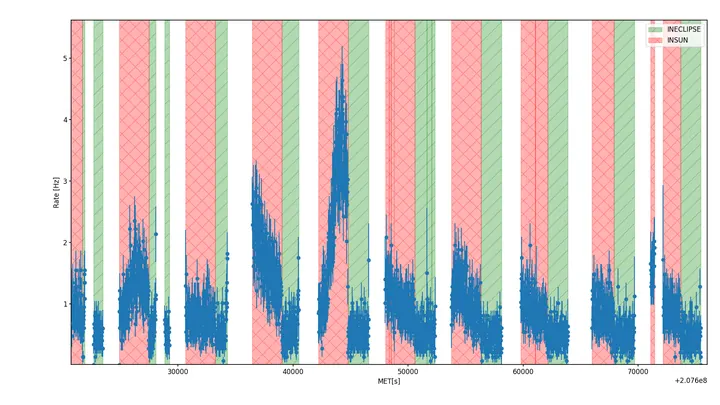
In the binary system Cyg X-2, a neutron star pulls matter from a normal companion star. The infalling gas spirals in, heats up to millions of degrees, and shines brightly in X-rays. Astronomers pointed two space telescopes, IXPE and NuSTAR, at this object and, for the first time, measured in detail how polarized that light is.
High Energy2026-02-221 minarXiv:2602.19200express
A Cosmic Blow with No Straight Lines
The edge of the supernova remnant RCW 86 is where the shock wave from a star's explosion slams into the surrounding gas. The IXPE telescope looked at the southwestern part of this boundary in X-rays and tried to catch polarization — the way these rays oscillate.
High Energy2026-03-031 minarXiv:2603.02780express
A Pulsar That Changes Polarization Like a Chameleon
The X-ray pulsar Centaurus X-3 is a neutron star that spins rapidly and emits pulses of X-ray light like a lighthouse. Scientists pointed three space telescopes at it and studied the polarization of its emission — how the electric field of the light wave oscillates.
High Energy2026-04-171 minarXiv:2604.16650express
Stellar Ash
A neutron star is the remnant of an exploded star, compressed to the size of a city. On its surface, a thermonuclear fire sometimes erupts: accumulated gas explodes like a giant hydrogen bomb. After the burst, ash remains — a mixture of heavy elements that rises to the surface and forms a hot atmosphere.
High Energy2026-08-112 minarXiv:2608.10733express
A Cooling Magnetic Star
The light of a distant lighthouse does not go out all at once: first it flares brightly, then slowly fades into darkness. That is how the X-ray pulsar 4U 0115+63 behaves — a neutron star that periodically brightens when gas from a companion ordinary star falls onto it.