Hua Feng

6 articles · 30 co-authors · latest: 2026-07-20
176 citations · h-index 8 · 35 papersData: Semantic Scholar

We have retold 6 papers by this author. 2 of them with a full read. most often about: primordial black hole, Accretion disk, supernova remnant. 30 co-authors across our retellings.

Links in the knowledge graph
X-ray shell reveals supernova explosion in microquasar SS 433
North of the microquasar SS 433, an arc has emerged in the soft X-ray band. Faint and diffuse, yet stubbornly tracing contours already familiar from radio observations. Astronomers studied its spectrum and saw gas heated to eleven million kelvin. Gas that could not have been heated by the jets or the accretion disk wind.
High Energy2026-01-072 minarXiv:2601.03696express
Black Hole Pulse: Two Humps in X-ray Light
The black hole in the binary system Swift J1727.8-1613 flickers in X-rays like a campfire in the wind. But if you look closely at the rhythm of this flickering, you can see distinct 'humps'—bursts at specific frequencies, like drumbeats in the noise of a crowd.
High Energy2026-03-031 minarXiv:2603.02780express
A Pulsar That Changes Polarization Like a Chameleon
The X-ray pulsar Centaurus X-3 is a neutron star that spins rapidly and emits pulses of X-ray light like a lighthouse. Scientists pointed three space telescopes at it and studied the polarization of its emission — how the electric field of the light wave oscillates.
Superconductivity2026-03-211 minarXiv:2603.20757express
Multilayer Bridges for Superconducting Electronics
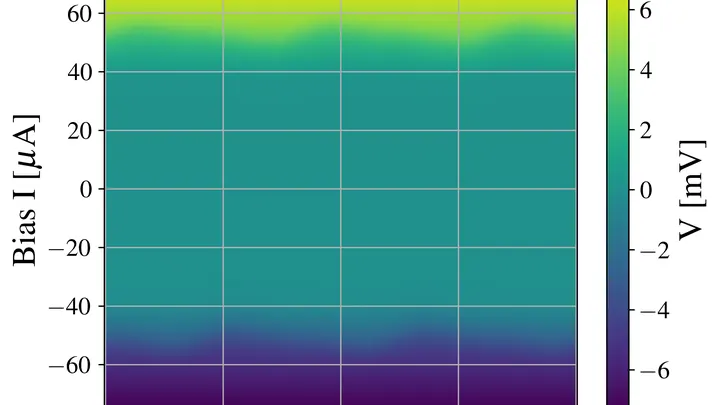
Superconducting circuits often rely on Josephson junctions — places where current flows without resistance through a thin barrier. Typically, this barrier is an oxide layer, but its properties are hard to control at the nanoscale. In this new work, the barrier is a thin layer of niobium or titanium nitride sandwiched between niobium layers.
High Energy2026-06-082 minarXiv:2606.10014express
Cosmic Pressure Cooker: Unraveling the Mystery of Little Red Dots
Ten billion years ago, the universe was speckled with strange crimson sparks. The JWST spotted them in images at distant redshifts — compact sources blazing like entire galaxies yet no larger than a tiny central region. Astronomers nicknamed them “little red dots.” Their nature long defied explanation.
