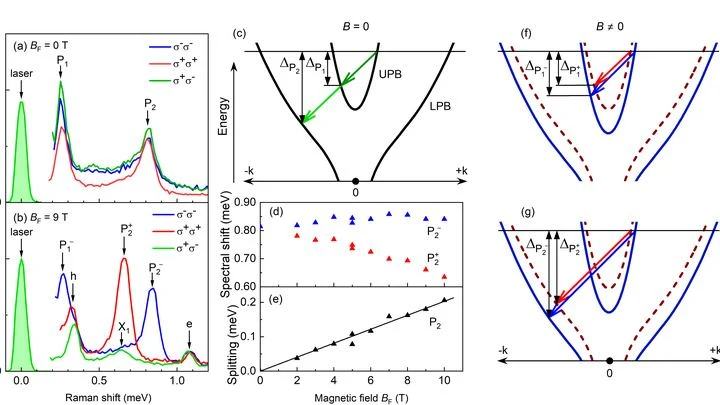
A laser beam hits a shiny crystal, and comes back different: slightly shifted in color, with a different polarization. In a magnetic field, this transformation of light becomes especially noticeable.
A beam of circularly polarized light hits a MAPbI3 perovskite crystal. The electrons inside start behaving like tiny spinning tops, their axes aligning along the beam. This phenomenon is known as optical spin orientation.
An electron is like a tiny spinning top — it's constantly rotating. This property is called spin, and it's crucial for quantum technologies. But under normal conditions, the environment quickly disrupts the rotation, like a top stumbling on gritty sand.
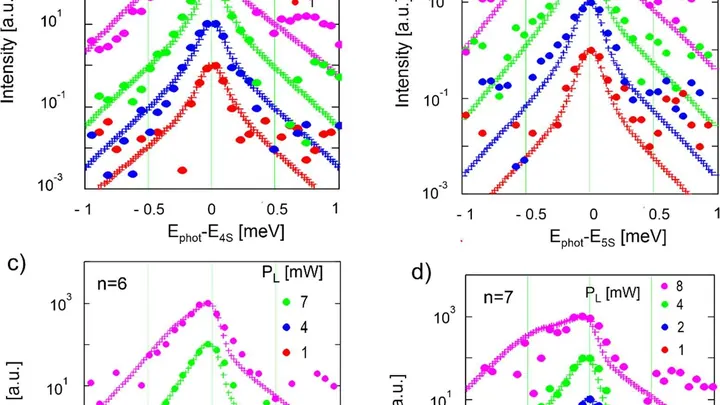
A copper oxide crystal looks like a dark red pebble. But when a short laser pulse hits it, pairs are born inside: an electron and a 'hole'—a place where an electron is missing. Such a pair is called an exciton and behaves almost like a hydrogen atom: the particles circle each other, bound by electric attraction.