Electron Spin Sings in a Magnetic Field express
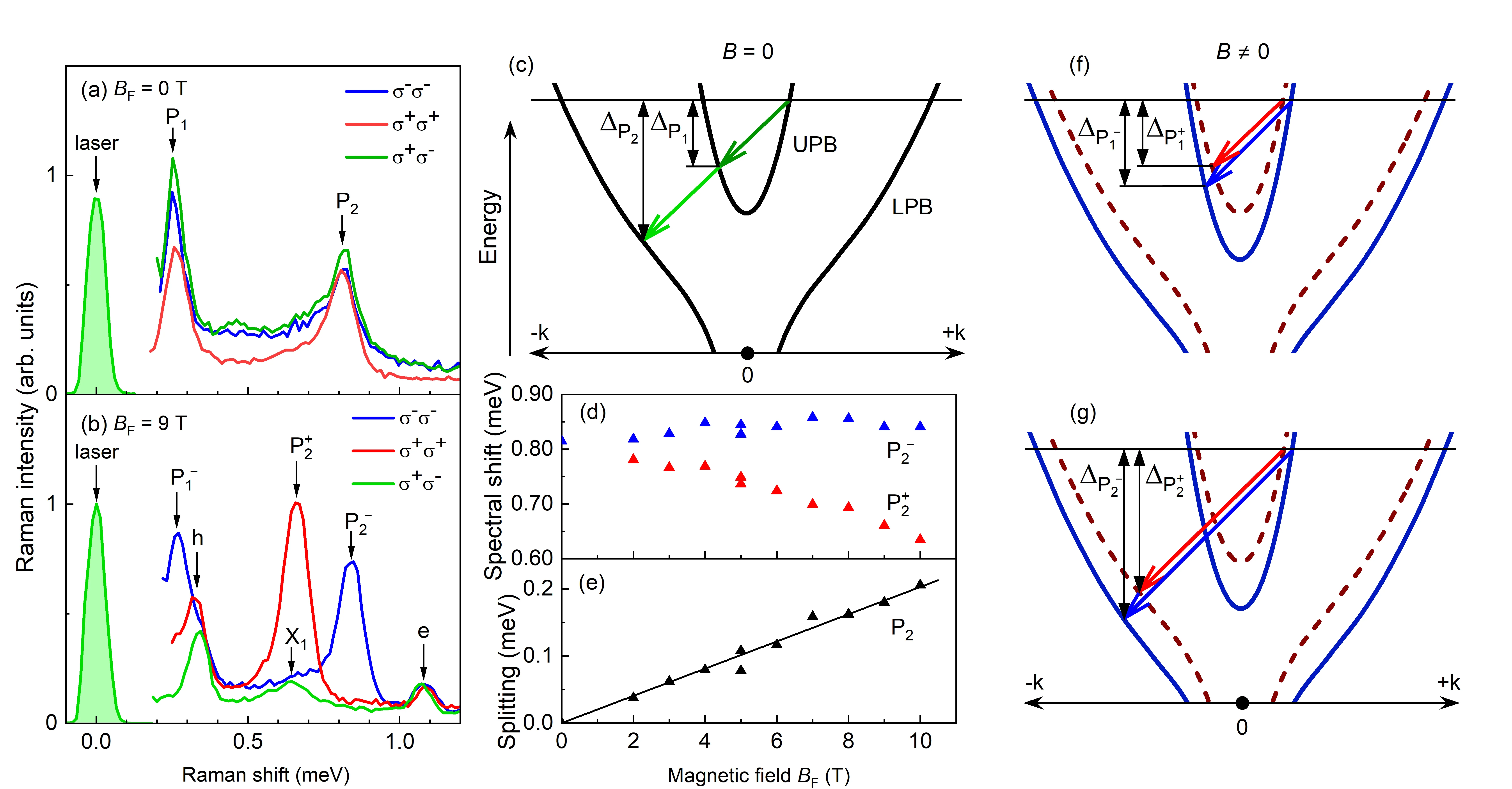
A laser beam hits a shiny crystal, and comes back different: slightly shifted in color, with a different polarization. In a magnetic field, this transformation of light becomes especially noticeable. That's exactly what physicists saw when they aimed a laser at a CsPbBr3 crystal (a compound of cesium, lead, and bromine) inside a magnet with a field up to 10 tesla — about 200,000 times stronger than Earth's field.
Light in the crystal creates pairs: a negative electron and a positive "hole"—a place where an electron is missing. Together they form a particle of light-matter — an exciton-polariton. The electron and the hole have their own rotation, spin: like a top that can spin one way or the other. The magnetic field splits their energy levels, and the light they emit or scatter reveals this splitting through a frequency shift.
The authors measured how strongly the spin "responds" to the magnetic field — for the electron, the hole, and the exciton. It turned out that the response depends on the field direction: the crystal is anisotropic, like a piece of wood that splits more easily along the grain than across it. From the light scattering data, they calculated the g-factors — numbers that show the strength of the spin's interaction with the field.
The scattered light spectra revealed not only single spin flips but also double ones: the exciton interacts with two electrons at once, flipping both spins simultaneously. Processes involving trions—"excitons with a trailer" of an extra electron or hole — were also detected. These details matter: they show how spins communicate with each other in the crystal.
Why does this matter? The electron spin is a candidate for the role of a "coin" in future quantum computers and ultrafast memory. The ability to read and control spins in perovskites, materials already used for cheap solar cells, opens the way to devices where information is stored not by charge but by the direction of a particle's rotation.
Electron spin is often compared to a spinning top, but in reality the electron is a point particle, and it has nothing to "spin" in the ordinary sense. It's an intrinsic property, like eye color.
In the series 'The Expanse', ships use magnetic fields for radiation shielding, but there they don't read spins, they just deflect particles.