Excitons in Copper Oxide: When 'Atoms' Get Crowded express
A copper oxide crystal looks like a dark red pebble. But when a short laser pulse hits it, pairs are born inside: an electron and a 'hole'—a place where an electron is missing. Such a pair is called an exciton and behaves almost like a hydrogen atom: the particles circle each other, bound by electric attraction.
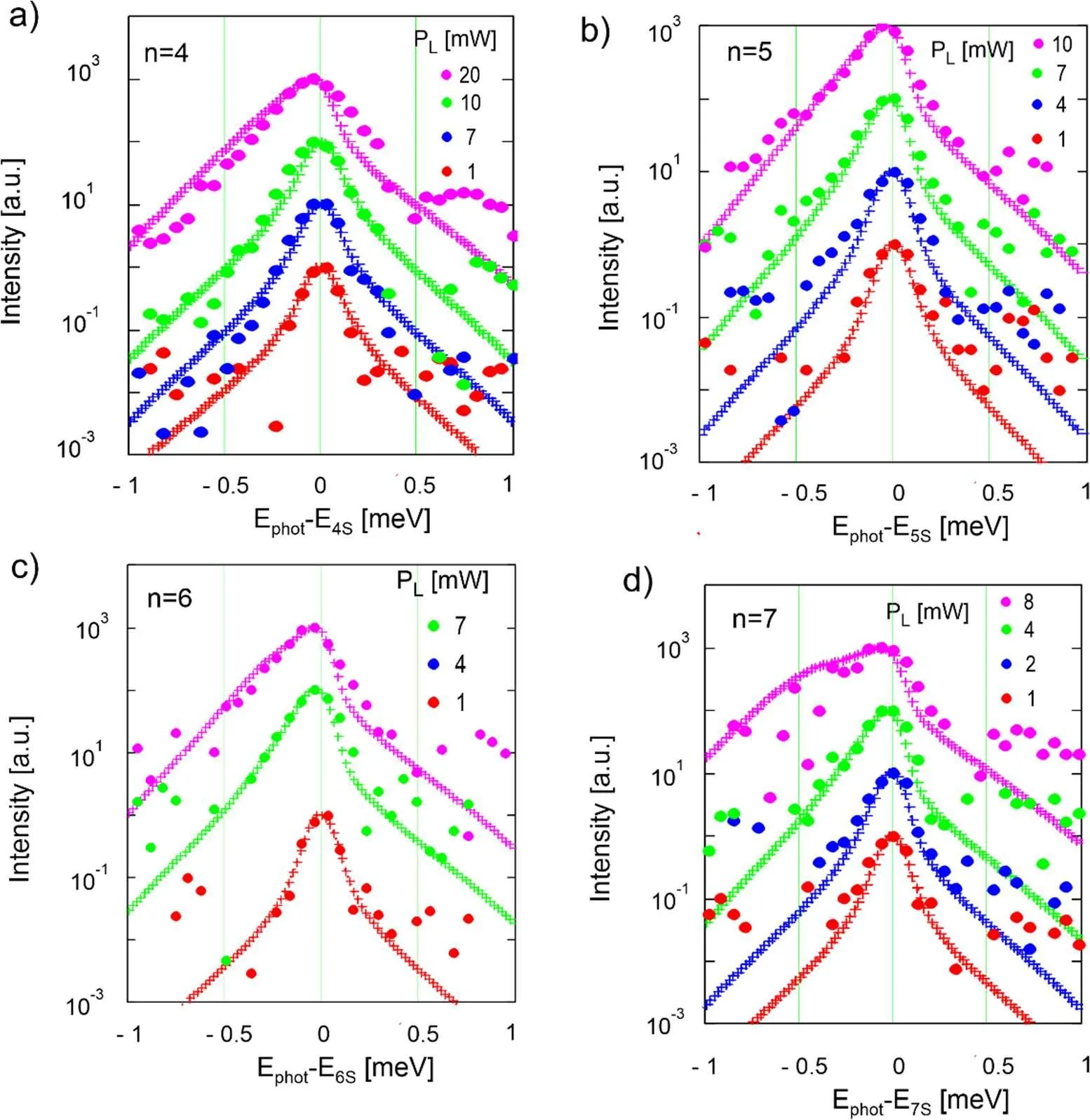
Scientists from Germany and Russia directed a laser with a peak power of up to 10 gigawatts per square centimeter at the crystal: that's like focusing the light of a thousand light bulbs onto a needle tip. The laser made the excitons emit light at twice the frequency: this is called second harmonic generation. At low pump intensity, the signal grew proportionally to the square of the power, as expected for independent particles. But as the pump increased, the growth slowed, and then the signal began to drop. Spectral lines shifted toward lower energies and broadened.
The reason is crowding. When there are too many excitons, they start to feel each other. Like guests in an overcrowded room: everyone wants their own space, but neighbors get in the way. For excitons, this means that two excitations cannot be too close: this is the so-called Rydberg blockade. It limits the number of excitons that can participate in light generation.
Two-photon absorption measurements allowed estimating the strength of interaction between excitons. It turned out to be of the same order as theory predicts for atoms, but the dependence on the principal quantum number (the 'orbit' number) is completely different. This means that excitons in a crystal are not just scaled-down copies of atoms. They have their own rules.
Checks showed that extra charge carriers created by three-photon absorption do not explain the observed picture. So the cause lies precisely in the peculiarities of exciton-exciton interaction. Understanding these differences will help create optical switches and light sources that work on excitons — compact and fast, like light itself.
An exciton in copper oxide can reach a size hundreds of times larger than the distance between atoms in the crystal, like a pair of dancers occupying an entire ballroom.