Light-matter interaction spectroscopy is the study of how light and matter exchange energy, revealing the internal structure of materials, molecules, and even fundamental particles. When light hits a material, it can be absorbed, reflected, or scattered, and the way it does so carries information about the material's electronic, vibrational, and magnetic properties. This field is the backbone of modern materials science, chemistry, and condensed matter physics.
History
The field began with Isaac Newton's prism experiments in the 17th century, but the modern understanding emerged with quantum mechanics in the 1920s, particularly through the work of Niels Bohr and Arnold Sommerfeld on atomic spectra. The invention of the laser in 1960 revolutionized the field, enabling nonlinear and time-resolved spectroscopy.
How it works
The core mechanism is that light's electric field can couple to charged particles in matter — electrons, nuclei, or excitons (bound electron-hole pairs). When the light's frequency matches an energy transition in the material, it is absorbed, creating a spectral signature. For example, in a crystal, excitons create sharp absorption peaks; in a magnetic field, electron spin transitions can be probed with microwave or terahertz radiation. By varying the light's wavelength, polarization, or angle, scientists can map out the energy levels and interactions within the material.
In practice
Used to design semiconductors for electronics, to develop new optical materials for lasers and sensors, and to study quantum materials like superconductors and topological insulators.
Fun fact
By shining a laser on a material and measuring the tiny frequency shifts in the scattered light (Raman scattering), scientists can identify the material's molecular structure — a technique so sensitive it can detect a single layer of graphene.
Light born when a fast electron enters a material is usually assumed to be the same in all directions. But in crystals where optical properties depend on direction, that's not the case. Run your hand over velvet: one way it's smooth and shiny, the other — dark and rough. Similarly, a crystal responds differently to light depending on how it's oriented.
A weak laser beam falls onto a tiny structure — a hybrid cavity made of metal and glass. Inside is trapped a single light-emitting molecule. Normally, such light only slightly changes color as it scatters off thermal vibrations of atoms.
At nine in the morning, the DarkSide-50 detector, 1400 meters beneath Gran Sasso, records a weak ionization pulse. By eleven at night, the frequency of such events drops noticeably. This is not an electronics glitch or a seasonal background variation.
Gravitational waves from merging black holes sound like bass chords, pulsars tap out a rhythm, and the cosmic microwave background carries echoes of the Big Bang. But there is a silent player — dark matter, whose presence is betrayed only by gravitational effects.
Light bends around massive bodies: this has been known since Einstein's time. But what if gravity itself is not a smooth fabric of space but a stream of tiny carrier particles? Then a beam passing near a particle should not just bend but enter into a special quantum relationship with it.
This relationship is called entanglement.
No one has ever seen dark matter, but every galaxy feels its pull. Usually, it's pictured as a sea of identical, silent particles. The new work paints a livelier picture: two kinds of particles, heavy and light, constantly exchanging between them.
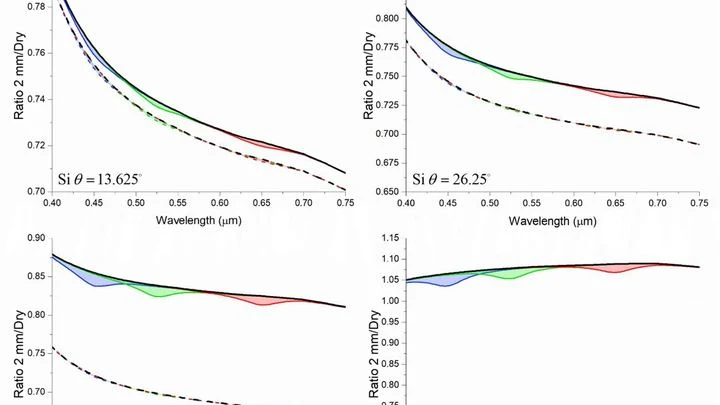
A water droplet on a leaf disappears faster under the sun than heat calculations would predict. A few years ago, a hypothesis emerged: light itself, without heating, could knock water molecules off the surface. This was dubbed the photomolecular effect. If it exists, clouds, climate, and even everyday clothes drying could work differently.
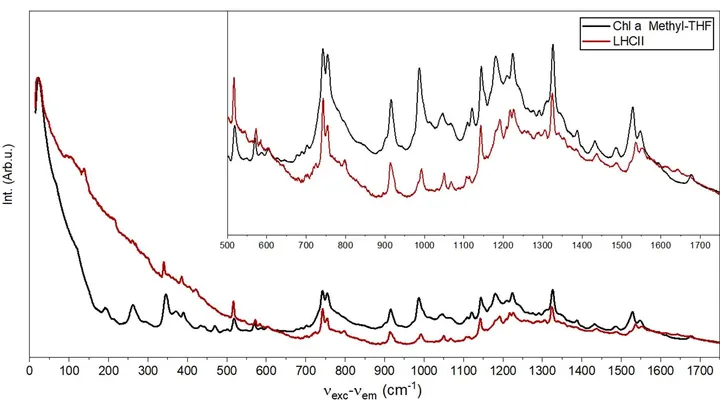
When a sunbeam hits a leaf, a relay race begins inside it. The energy of light passes from one chlorophyll molecule to the next until it reaches the reaction center — the place where the chemistry of life kicks off. This relay runs with astonishing accuracy: nearly every quantum of light finds its way.
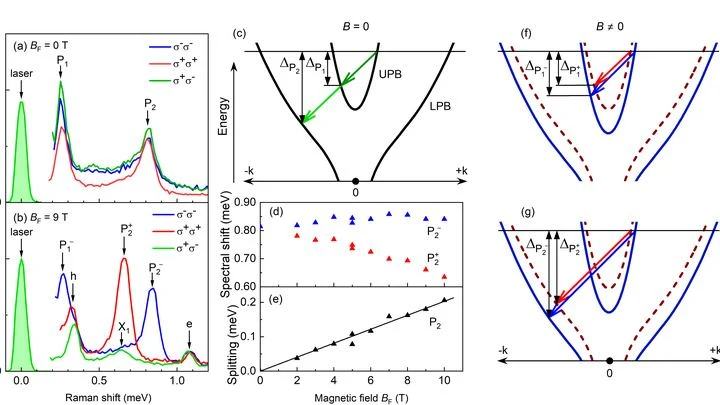
A laser beam hits a shiny crystal, and comes back different: slightly shifted in color, with a different polarization. In a magnetic field, this transformation of light becomes especially noticeable.